
Speech by Mr. V. Terzakis – Pallikaris on “An approach to women’s participation in the Cretan 1821” at the scientific conference “Mylopotamos of Rethymno in the Greek Revolution (1821-1832)”, 27-28 November 2021, Perama, Mylopotamos, Rethymno
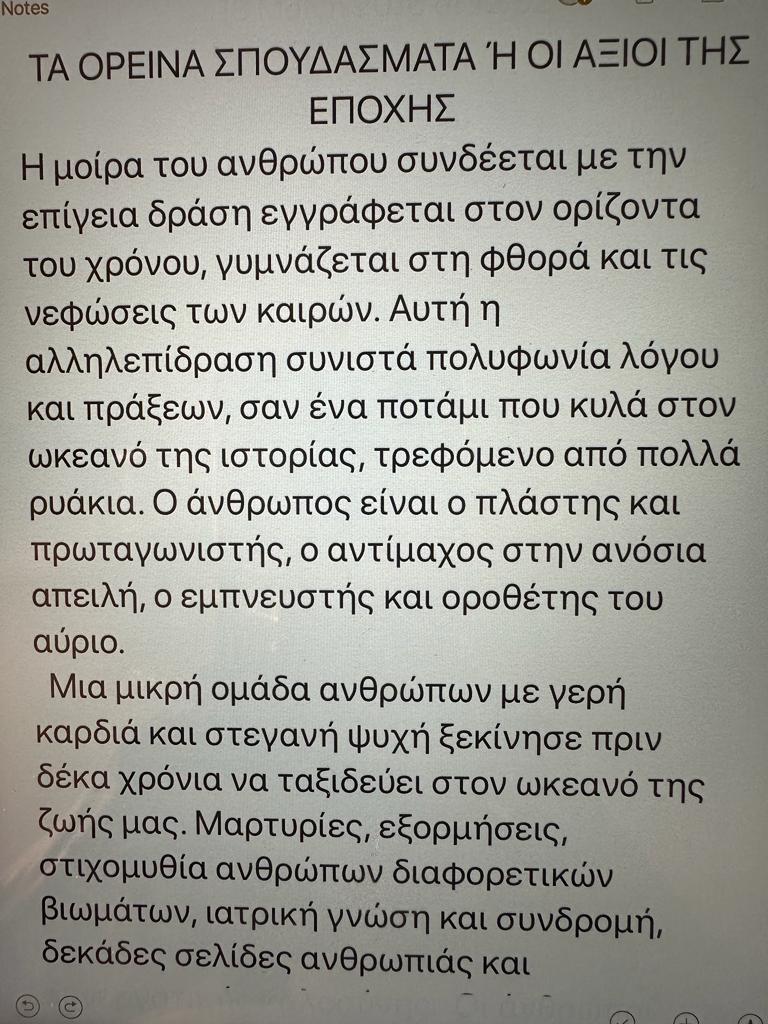
Text by Mr. G. Androulidakis “The mountain studies or the worthy ones of the time”
On Gaza, May 29, 2025, M. Skoulas
At dusk deep red,
the sun is drowned and the light is in silence,
All of us who, as spectators of a drama
We complain about the thirty pieces of silver,
noose in a voluntary drowning,
They said it was desert dust the cause,
and yet they did not discern deeper in their wilderness,
that this was the very sacrifice and the tear,
from children’s eyes.
And the rain came, a red sea of tears,
to cover shame and inaction,
with a veil that will hardly go away,
since the eyes were so ashamed and closed.
There it will always remain as the stigma,
in the soul that denied countless lives,
A candle flame that seeks in vain
A little humanity, a little affection in oblivion.
The perpetrators who were then widespread victims,
With machina breathing gods
they became murderers, they forgot the night,
that were deep in the eyes of the parents.
The pigeon on the windowsill is looking at me,
But out of shame I don’t even dare to laugh at him
Our earth is a rolling sphere
And I was small, too young to forget.
Article by N. Kotzampasakis
Article by Nikos Kotzampasakis
United Nations (UN) – FAO, In Crete the gods of self-sufficiency and faith are still alive
The dictatorship of compulsory happiness
Electrospun silk biomaterial scaffolds for regenerative medicine www.elsevier.com
Silk proteins for biomedical applications: Bioengineeringperspectives www.elsevier.com
Honorary doctorate of the Hellenic Military Academy was awarded to the rector Helene Glykatzi Ahrweiler
Warp and weft
The Greco-Turkish War: Greece in 1923
La guerre gréco-turque : Grèce 1923
E. Glykatzi Ahrweiler: The Leading Historian who wanted to become a mechanical engineer!
Meeting of Young Creators & Ancient Drama – V. Terzaki Pallikari, 5 July. 2017 Delphi
Growth through the… poverty
The Penelope Gandhi Mission participates in the Meeting of Young Artists in Delphi, 30 June to 5 July 2017
The Penelope Gandhi Mission participates in the Young Creators’ Meeting on “Delphic Festivals & Ancient Drama” organized by the European Cultural Centre of Delphi, from 30 June to 5 July 2017 in Delphi.
Indigo sheep & colorless protests – Aboubakar Fofana
Indigo sheep & colorless protests – Aboubakar Fofana, newspaper. LIFO
Documenta 14 – Aboubakar Fofana weaves a fabric in the documenta 14 Reader
Stephen Hawking: This is humanity’s most dangerous moment
Translation/editing: Panos Sakkas
Website www.skai.gr 05.12.2016
Message from Mr. Emm. Androulidaki, dr. Classical Philology, University of Athens
Well done!
The germ of the earth will become a garment of the body and a covering of the soul. The Lent of the Passions is the “canvas” (one of the meanings of the word, see Dictionary of the Academy of Athens, p. 937) that weaves the human passion as the voluntary passion of the God-man.
This action with the following symbolisms is indeed moving: the land of the fathers produces seeds that will compose a “linen” fabric, the burlap that has no equal for our clothing.
And one last thought: I was thinking today of the dozens of kites roaming the sky, reaching high and then descending through the intercession of the human hand, while many souls are proud of the spectacle….! This is what the PtO does, it is not afraid of the consequences, and if it does not blow, it will blow….!
Good evening
Emm. Androulidakis
Mission Penelope Gandhi, Presentation by Mrs. Helene Glykatzi – Ahrweiler
Heraklion, November 5th, 2012
A supplementary article of the Declaration of Human Rights voted by the United Nations (UN) in December 1948, concerns the right of every people to enjoy the goods of their culture unhindered (this article was unfortunately not accepted).
So the problem immediately arises: what do the goods of a civilization consist of, in fact one that is specifically recognized as a special achievement of certain groups, peoples and individuals?
In other words, what is culture? It is only a legacy that the past bequeaths to us, or it is also a dynamic of the future (i.e. a proposal to create a future).
Let me say right away that the legacy of the past is twofold: it consists of material heritage (monuments and material goods of every nature, e.g. works of art or handicrafts), but also of the goods provided by intangible culture (e.g. monuments of speech-songs, proverbs-dance events and steps and all the know-how, that is, the practical knowledge associated with the traditional, traditional practice of craft professions and more.
I should note that the French put French cuisine as a cultural monument (which was also recognized by Unesco as a world monument). And of course, with this thought, in immaterial culture we can classify remedies, erotic potions, spells, cooking recipes, etc.
But in the dynamics of the culture of the future, we must include every learning. With the thinking (is it what mainly guides the Americans)? I teach, I touch the future.
After all, the notorious Silicon Valley has as its motto “the best way to tame the future is to create it”.
So let me say more simply that the use of the old model, but applied to the new conditions, is the basis of any kind of civilization. In other words, this civilization is based on the certainties of the past to always create a better future.
But let’s come to our topic: the Cretan weaving. And here you will allow me to tell you an event related to the traditional Greek weaving.
We are in the early 80s when the Paris Chancellery of the Universities, of which I was rector at the time, decides to make one of its old, but classic buildings available (after of course it has been renovated) for the accommodation of foreign distinguished scientists.
This is the Suger Center, which has been operating excellently since then without interruption). For the equipment and furnishings of his guesthouse, one of the most important sponsors was Mrs. Anette Schlumberger, (I think stepmother of our own Kafatos). For the sponsorship, however, Anette set a condition that alienated the French: All bed linen, she said, must be woven by Greek, if possible Cretan, weavers. In other words, they must be Cretan patanias.
I hastened to declare that I was not the inspirer of this strange term, as the French believed because of my origin, but I accepted it and tried to meet the demand. The sequel is expected.
We didn’t find weavers ready to take on the project and Mrs. Schlumberger, who had endowed Greece with a bunch of provincial libraries, trusted me, after of course she agreed to use her donation according to the needs of the guesthouse (i.e. French bed linen was bought) so did Anette trust me with her question? Why do the Greeks allow all their folk culture, all their traditional craftsmanship, which has given real masterpieces, to decline?
I am sure that today, if she were alive, she would hasten to congratulate Mrs. Varvara Terzaki-Pallikari for her effort. So I do it, almost on her behalf, wishing every success to the national, artistic and cultural work of the University of the Mountains, which with the Penelope-Gandhi program revives the effort of the non-worker Florentini Kaloutsi-Skouloudi.
I will begin my contribution to today’s gathering here in Crete, for Penelope Gandhi, by saying that I would like to enjoy one day the Cretan hospitality, in a home that will be dressed, both on the floor and in the living rooms and on the walls, with textiles of the island, textiles that could even be window curtains. Of course, I am talking, among other things, about the long towels of the walls or the boards of the festive tables, which Rodoula Koumari studied so thoroughly.
I would also like to see with my own eyes what the books say, that is, that the colors and designs that are present in the mountainous areas are different and the aesthetic standards in Omalos are different, and others of course on the beaches, where the full-bodied patanias with ship decorations are also presented.
As for the purely Cretan creation, I would like to see in reality, something that I suspect without having any relevant indications, that is, that the Minoan vases, the palatial frescoes of Knossos that Florentini Kaloutsi had studied as well as the representations of the sarcophagus of Phaistos, among others, somehow, I think, would have influenced the Cretan weavers, as an aesthetic cryptomnesia, in the choice of colors and perhaps in the thematic weaving depiction. An example is the double axe that adorns a number of Cretan textiles.
But why am I talking about weavers, when it is now proven that (as taught by Gandhi, to whom Mrs. Varvara Terzaki Pallikari refers, the inspirer of this Mission) at least in Asia (Asia Minor not excluded) male weavers practice this predominantly female art with more talent. Female, at least this is what the traditions, vocabulary and ancient mythology make clear, as well as the rebirth of Cretan weaving by Florence and its numerous workers.
After all, an American woman had to indulge in the knowledge and execution of this noble, in order to become, at least for a moon, the weaving of fashion and fashion, in the bosom of the so-called high society.
I am talking, of course, about Eva Palmer Sikelianou, whose work, along with Angelos, of course, enlivened the Delphic festivals in the years after the Asia Minor Catastrophe, and whose loom is preserved almost intact in the Sikelianos Museum in Delphi, which can be visited.
But since I mentioned, even briefly, the Asia Minor catastrophe, let me note in passing that the settlement of Asia Minor refugees in Greece gave an excellent boost to carpet weaving, the handicraft that the Greeks of central and eastern Asia Minor practiced with great success.
Let me say in this regard that the slum of the refugee settlement where I was born is still modest with the existence of an imposing building, the carpet factory of Byron.
And here I may have to wonder if the Turkish-Cretans, while they were on the island, had their own weaving habits and methods, which they would perhaps now transfer to the Asia Minor hearths those they inherited with the exodus, the expulsion of the Greeks. In the same way, we will have to see if the long-standing Venetian presence on the island left its mark on weaving habits. That is, if there is, let’s say, a weaving of a complete wall decoration and if so with what motifs, perhaps only foreign ones.
Let me add that it would not be pointless to wonder whether Cretan literature, Erotokritos or Eriphyle, left their traces on the subjects of the weavings, since it became so well known and loved throughout Greece, despite the Western European elements that it contains subjects that anthropologists and ethnographers will certainly study, much more than I do (I see, for example, my friend Louisa Karapidaki in the room). Those who have certainly already been mobilized for the success of the work of this suis generis university, under the name of the University of the Mountains.
It would be laborious and certainly unnecessary to point out that the study of the art of weaving has multifaceted aspects. They concern the materials used (hair, cotton, flax, etc.) in the preparation of the yarns, their coloring and of course the designs, both those chosen to cover the floors (rugs and carpets) that may once have played the role of sleeping mattresses, as well as those chosen for the use of bed linen, pillows, blankets, seats and beds or even clothes.
The study, among other things, of the size of each weaving, can say a lot about its use, but also obliquely I would say, about the way of life, according to seasons. It is also obvious how indicative of the domestic economy, I would say, the production of textiles, when it is done either for personal use, or for the local alternative or non-small trade.
And here, of course, I am not talking about the industrialization of textiles, which I consider foreign from the artistic point of view of weaving that interests us here.
But I think I went astray, talking about the obvious or about things and issues that little (if at all) I don’t know.
However, I would like to underline the need for scientific research on weaving, the Greek one, and this in order to show its peculiarity, if any, in a sector that has certainly received mutual Balkan influences.
At least this is what an in-depth research on Albanian carpet weaving, promoted and carried out by the University of Tirana with the title (I translate: “Albanian kilims and carpets”), shows me. I simply recognize, without effort, motifs that made me familiar, that introduced me, let’s say the Arachovitika, but also the textiles of northern Greece, I recognize them in the rich photographic material of this publication. Of course, the Albanian study does not hesitate to present (among other things) variations of the motif of the two-headed eagle, a motif that he considers to be inspired by Albanian.
Let us consider the remark as a remnant of the Byzantine presence in Albania (the Illyria of the Byzantines), although we must not forget that the Double-headed Eagle is today the National symbol of the neighboring country.
Of course, it would be desirable if part of the Greek study on weaving was its possible Byzantine origin. Let me only remind you that the sixamita, the divlatta and the trivlatta are the terms, among others, that characterize the types of Byzantine weavings (of course, not only the official obstructed ones, those that are forbidden to leave the country (such as the precious Palia), but also the simple creations of the anonymous works, which worked to decorate with seams (i.e. with curtains) the openings between the columns of perhaps poor churches, but also that of Ag. Sofias.
Since we are talking about Byzantium, let me remind you here in passing that the Byzantine fabric, that is, the woven fabric, was a product of high technique, whose works were examples of unparalleled art.
Imperial workshops in Constantinople and the provinces (e.g. in Egypt and Syria before the Arab conquest), but also in Corinth and Thebes, produced the famous veiled despotics, those intended for the emperor and the court, works of art with religious and secular representations (hunts, lions, eagles on rosettes: aetaria, gryparia, etc.).
These precious fabrics, made of silk colored threads, embellished with gold threads, were state property that the emperor often used as gifts to foreign rulers.
The museums of Europe, as well as its cathedrals, are full of these precious items, which enriched the countries of Europe, especially after the looting of Constantinople in 1204 by the Crusaders.
The gilded Byzantine textiles were intended, apart from the court, of course, to the wealthy churches (of course those that represented religious themes) but also to the lords. Asterios Amaseias (living in the 6th century) mockingly mentions that many rich people are, because of their clothes decorated with representations (I copy): “Painted, historically wandering walls”.
The names of these weavers sometimes betray their type and color. Indicatively, I mention the sendes, the linoleotaria, the acidic megalozil, the green-dipavlat and the semi-mimilinedivlatta. These precious fabrics, known all over the world, since the fabric travels easily, became the object of loot that declares the technological superiority of Byzantium.
Let me remind you that the Normans, in an invasion against Greece in 1185, captured the workers of the workshops of Corinth and Thebes (there were also private workshops such as those of Daniilida in Patras). From these captive weaver workers, the Normans and then Western Europe, were taught the production of the famous brocards.
In any case, the habit of weaving religious themes should certainly be considered as Byzantine survival. We find them in bed linen (the so-called patanias) but also in the numerous towels woven for their dowry by the girls of Crete. Besides, one of the themes that adorn these towels is the psiki, that is, the nymphic sequence, the word psiki is a highly Byzantine term opsikion (it has exactly the same meaning) a term that gave its name to the area (opposite Constantinople) where the imperial retinue originally took place (this is the subject opsikion, in Bithynia)
Weaving has always been the divine basis of universal artistic performance for the Greeks. Its tool, the loom, as its etymological origin shows, is the pre-eminent tool of civilization. In Crete it is the art and culture workshop.
And for the divine attribute of weaving, I will remind here the confrontation of Arachne with the goddess Athena, whose characteristically, after all, one of her numerous surnames (it reminds him of the other Virgin, the Virgin Mary) was also Ergani (that is, protector of domestic life and creation, as shown by the myth of Pandora, who endowed Athena with domestic skill).
It is not without significance that in the Panathenaia, in an official procession, the Athenians offered their patron goddess a veil woven by the virgins of their city.
So let me remind you of the conflict between Arachne and Athena, as Ovid preserves it for us in his Metamorphoses.
Arachne, known for her skill in weaving and embroidery (mainly in Lydia) was the daughter of Idmon, who specialized in dyeing threads.
Arachne’s fame turned into arrogance, so much so that Arachne asked to wrestle in weaving skill with Athena herself, although the goddess tried to dissuade her.
In the race, Arachne chose the works of the gods and especially their love adventures as the theme of her weaving, which caused the wrath of the Virgin Athena.
So the goddess tore the spider’s web and the Spider committed suicide out of desperation. Then Athena transformed her into the well-known wingless insect and cursed her to weave hanging.
Conclusion: no one can compare with the gods in any way. (Prometheus knows something about it, let’s say Prometheus) but we, almost as a tribute to the skill of the unfortunate daughter Arachne, kept her name as a composite of a selected weaving creation. I’m talking, of course, about the sought-after gossamers.
Time to conclude, with perhaps a parallel. As in Homer, Penelope’s constantly unfinished weaving is the symbol of the future and probably the instrument of marital fidelity, let me wish that the newly established University of the Mountains, which has a reference to Penelope, will make the sleepless effort to revive every traditional cultural folk experience, with perseverance and faith for the future.
And of course, above all, I will wish that the divine art of weaving will thrive on this island of Crete and progressively throughout the country, as long as its old servants and servants still live and know about it.
The University of Crete, following the University of Ioannina, where a thesis on the textiles of Metsovo was recently supported, must collaborate for the success of this goal of the University of the Mountains, for the weaving of Crete, the Penelope Gandhi Mission.
I will underline this again in concluding. Knowledge of weaving is a valuable element of intangible culture. What Unesco is trying to save internationally today, while the products of this unparalleled handicraft are brilliant examples of the country’s material folk culture. In other words, weaving participates in the dual cultural creation that I mentioned at the beginning.
I’ll put it more simply: undoubtedly, every woven piece of art is a traditional work of art, along with technique. Weaving is a combination of past and future artistic, it is worth writing its history, listening to its secrets and appropriating its watering lesson for a more authentic and beautiful tomorrow, the one that the country needs so much, especially today.
I congratulate Mrs. Varvara Terzaki Pallikari and her
team for their pioneering thinking and initiative, for the resurrection of the sacred weaving art of great Crete.
The Daughter of the Mountains invites Europe
E. Sapouna Sakellaraki has been woven here since ancient times
Message from Mr. N. Stampolidis, Director of the Museum of Cycladic Art
From: Nikos Stampolidis
Date: 2 June 2016 at 08:30:47 EEST
To: “panoreon@panoreon.gr” <panoreon@panoreon.gr>
Subject: Reply: Penelope Gandhi Mission – Archaeological Museum of Heraklion
Good morning and congratulations. The efforts are commendable and it is nice for the new generations to see and be taught and learn. Above all, they should not forget!
Good luck!
My Loom – Message from Mrs. Ioulia Zafeiraki Papadaki, April 22, 2016
My Barbara!! my beloved!! Good evening,
Today, at last, the carpenter brought me my loom!!!!!!!
What a joy it is!! It cannot be described, as a small child, who is brought the most expensive gift in the world, that’s how I feel!
My Barbara, thank you very much, if it weren’t for you, something like this would never have happened.
I am grateful to God that I met you in Ziros, on that blessed day and the memories of the loom,
of my grandmother, which for so many years were hidden, awakened in me.
I put my loom (I say it and I don’t believe it) in the room where I had my sweet mommy.
I decorated the space with some textiles from the hands of my beloved grandmother, Agapi.
Don’t you know how much I begged many carpenters to make my grandmother’s loom, which I brought from the village,
and they didn’t want to, maybe they didn’t know? Or I was looking to buy an old one and nothing happened. Fortunately, Michalis was found,
it took a long time, but he fixed him.
My sweet Barbara, I feel that everyone, my grandmother, my grandfather, my mother is next to my loom and sees me.
I feel an aura, a sweetness, a magic, a serenity flooding my house, as soon as my loom came.
My grandmother’s loom, which I grew up with until I went to high school, we lived in the same yard in our village,
is next to me! in my house! If only I knew her little soul feels it.
Of course, it had a lot of damage from the worm and was not visible from the outside and so, the carpenter made
me a copy, but he omitted the details, the carvings on the horseshoe and some others. He will come to fix the paint better
and I begged him and he will do to me what he omitted. But I have from my grandmother, shuttles, ardakto, ardakti, wraps,
bobbins, I also found old scallops.
I also received the threads for the noses that Elli and I ordered from Athens.
Now, after Easter, God willing, we will slowly settle everything, with my teacher, Elli, who is an excellent
person, with kindness and kindness of soul.
I’m sending you some photos to see my loom and I’m also treating you to a kalitsounaki, which we made yesterday.
My Barbara!! My Barbara!! I send you a thousand kisses and all the thanks of the world, from the bottom of my heart.
Julia
Vespers, M. Androulidakis 10.04.2016
“I think in front of a reel time is going around, the clouds are gathering. Death has not yet been merciful for this country. The thread of life exists and seems to be stretched. It is the old glory of dead souls who wake up fraternal in a strange stillness, united in the face of our own cruelty and weakness. The aging weaver rejuvenates in our wake, as the circle from the ardachti surrounds her loneliness. Many stand and admire the antics, learned from the idols of the time. One of them is playing with his fingers, trying to imitate the weaver. He plays with the silence of time, if he sees it between the tightly knit patterns of a patania, where history plays, between day and story. Our life is gone and lost, without a tear anymore but with shaken lips and heart. Life does not leave us helpless, the beat of the loom continues the struggle of the weaver, teaches serenity”
A little veggera!
Good evening from the land of the fathers
Manolis
Paralysis, a modern way of waiting for the future
Vassilis Karapostolis
TO VIMA, 26.03.2016
One of the most striking paradoxes of our days is that, although insecure, people avoid taking their measures. There is a pervasive “numbness”, everyone realizes it, everyone feels it. But their thinking avoids asking the question clearly and openly: How is it possible that there are so many dangers around and that the threatened person cannot and almost does not want to become vigilant?
But the issue did not arise recently. Its roots go deep through time, and anyone who takes the trouble to see where they are going will find that they reach where the new faith, the only faith in modern times, begins: the belief that things will finally “work on their own.” Automation was elevated to a modern deity. It has been said so many times vaguely that it has come to mean nothing, not to touch the problem at its core at all. Because what else could happen to the deification of automatisms than to reduce the will to act? And this is exactly what is being seen today. The prolonged reliance on the solutions that some “mechanisms” would offer caused irreparable damage to the very ability of the human mind to be led to decisions, to revise, to repair, to change direction. Man’s energy was deemed rather unnecessary, since instead wires acted, lights flashed, doors opened and closed on their own, and rockets were fired at the touch of a button. Inevitably, paralysis came.
What a difference with previous times where, because the material supplies were less, the mental reserves were more. The ancient Greek state is looking for its guardians and has no difficulty in finding them. Rome also prescribes that legionnaires characteristically hold their finger in front of their mouths to ward off drowsiness during the evening watch. Symbolically it is the attitude that says: Stay awake, don’t rest, listen in the middle of the night to what is pregnant and act accordingly.
More or less the same rule will apply later, in any case where both states and individuals are surrounded by threats. Medieval knights, Byzantine frontiersmen, militiamen in the French Revolution represent only some of the types of this readiness. It is, obviously, foreign to newer morals. Is it because the past was more stigmatized by war tensions and imposed on everyone to be combative? But the relative world peace today, despite the individual conflicts, has long been mined. War is simmering beneath the surface. But while the vibrations are already being felt, the nerves eventually fade. The population of the Western Hemisphere, although more worried, is still waiting for “something” that can free them from the torment of uncertainty and especially from their anxiety to make decisions. But this “something” takes a long time to appear. It is not brought by the market, it is not announced by technology and science has long since shrugged its shoulders and bent over its microscopes again, tasked with discovering the elixir for prolonging life.
In the meantime, life has wrinkled too much from its fear. Everyone is afraid of suffering a blow to their income or health and, fearing the bad eventuality, they protect themselves so that their days become even a little longer. We live for the Little. This means that contrary to what is trumpeted, it is not life and happiness that interests people, it is the avoidance of pain in every way. And not only of pain. The slightest difficulty, the slightest setback. Anything that comes against the desire panics her. Where is the technological weapon, this invention that would save the threatened? The news bulletins shout it sadistically: the water on the planet is dwindling, energy sources are drying up, fanatical Muslims are getting even wilder, refugees and migrants are increasing, and the Chinese tiger, drunk on wine of French origin, roars terribly. What will the West, and especially Europe, do? In her despair she withdraws her old expectation that her intellect will find a way out. “Something” will not come. So what else is left but for the “someone” to come? A daring man with an unbending political will, despising any hesitation. The time has come for a new Caesarism, prophesied (German) Speggler. Was he right? The whole issue will be judged soon. And of course not with a referendum.
Mr. Vassilis Karapostolis is Professor of Culture and Communication at the University of Athens.
World Poetry Day 21.3.2016 – Songs – By Mr. M. Androulidakis
Good evening to the devastated state!
Our loneliness is now hollow, our human passions are shutting down, our brothers and sisters in the sun are being killed. We no longer have a soul, the blood runs with the iron. We feel tormented but sleepless next to those who did not learn to live by reading their verses in the rich veggeras but to write with the same breath about the person they are thinking about, the one who raised them, the one who brought them spring flowers for his celebration, the one who spoke in the square about themselves, the one who stopped on the terrace for the acquaintance, The one whose heart beat first, when they were longing, the one who sucked their time in difficult times, the one who first played the word in their joy, the one they wanted to see again, when they said goodbye with the scarf of hope. These are the poets we honor… They are also the first, but it is difficult for them to confess it, it is more difficult for them to take us to the paradise of thought, gloomy in the twilight of bliss….Let’s keep company with those, the others, they raised us, we study them on the peaks, so that they are not left alone, the handkerchiefs do not only have tears but a piece of the breath of the mother and the air of our earth generator.
Poor words to rich dear friends, on the occasion of poetry day.
Be careful!
Good evening
Manolis
P.S. : … “This world has now lost its color/as the seaweed on the shore of next year/gray dry and at the mercy of the wind… “C. Seferis, Solidarity, Ikaros (11th) 1977.
The Mountain Studies or the Worthy of the Time
THE MOUNTAIN STUDIES OR THE WORTHY OF THE TIME
Man’s fate is linked to earthly action, inscribed on the horizon of time, exercised in the decay and clouds of the times. This interaction constitutes a polyphony of speech and deed, like a river flowing in the ocean of history, nourished by many streams. Man is the creator and protagonist, the opponent of the unholy threat, the inspirer and delimiter of tomorrow.
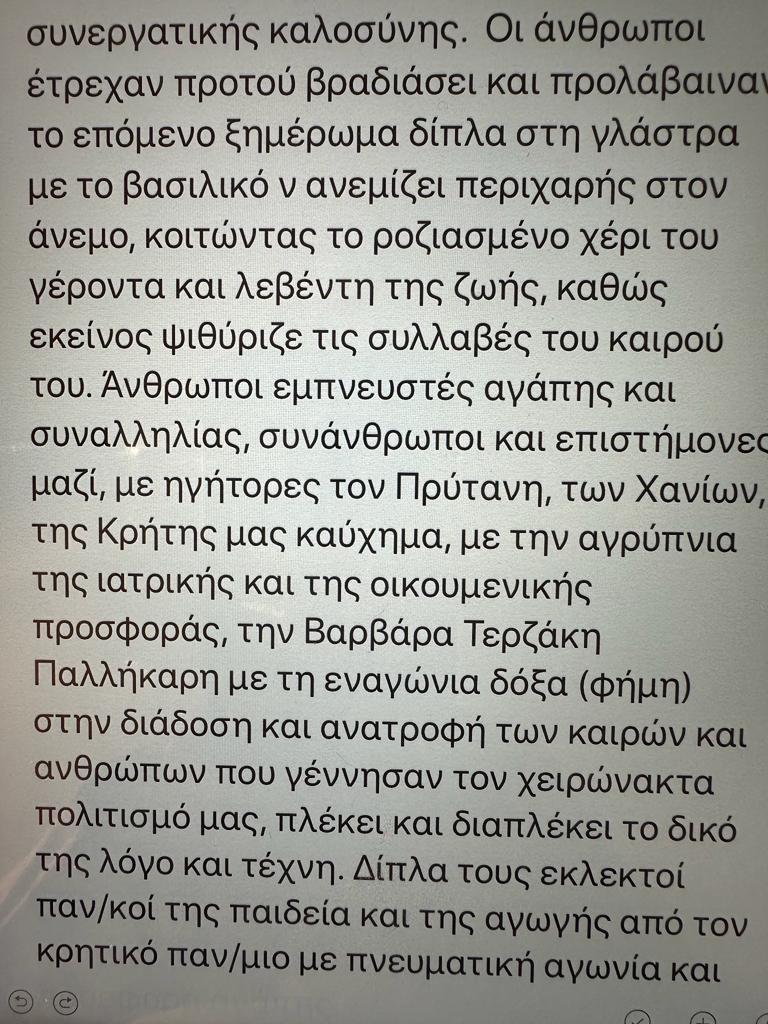
A small group of people with a strong heart and a watertight soul started traveling the ocean of our lives ten years ago. Testimonies, excursions, conversations between people of different experiences, medical knowledge and assistance, dozens of pages of humanity and cooperative kindness. People ran before night and managed to catch the next dawn next to the pot with the basil waving joyfully in the wind, looking at the gnarled hand of the old man and brave man of life, as he whispered the syllables of his time. People inspirers of love and solidarity, fellow human beings and scientists together, led by the Rector, of Chania, our pride of Crete, with the vigilance of medicine and ecumenical offering, Varvara Terzaki Pallikari with the agonizing glory (fame) in the dissemination and upbringing of the times and people who gave birth to our manual culture, weaves and intertwines her own word and art. Next to them are distinguished professors of education and education from the Cretan university with spiritual anguish and an offer of love.
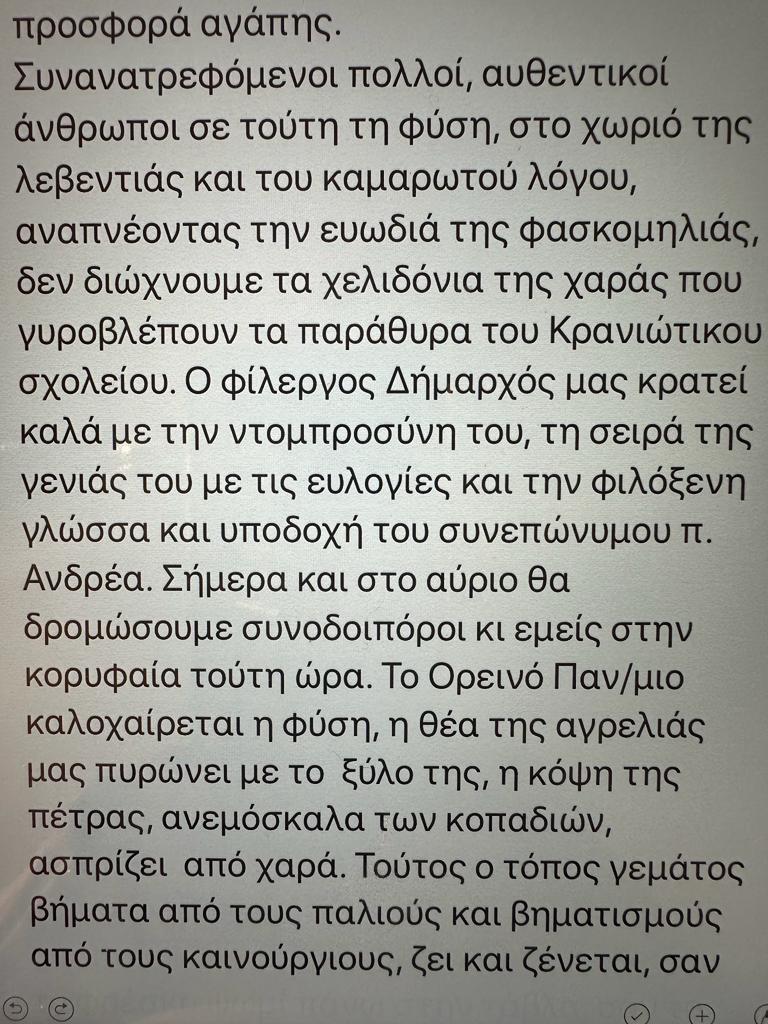
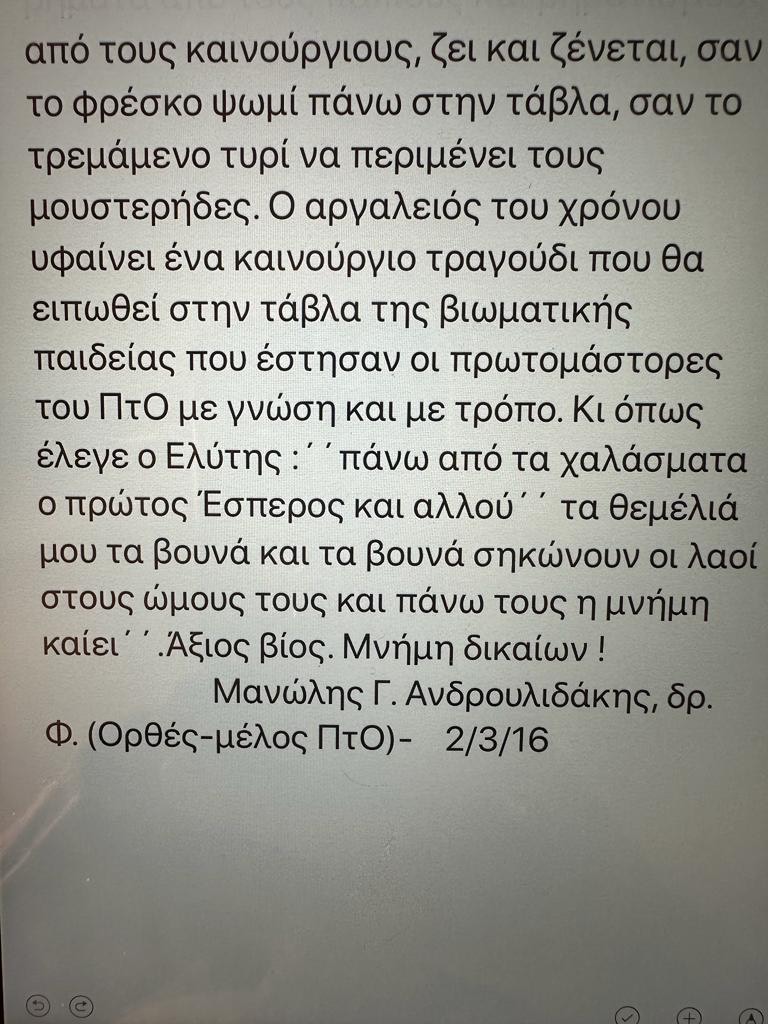
Bringing up many, authentic people in this nature, in the village of gallantry and proud speech, breathing the scent of sage, we do not drive away the swallows of joy that roam the windows of the Kraniotiko school. The hard-working Mayor keeps us well with his honesty, the order of his generation with the blessings and the hospitable language and welcome of the eponymous Fr. Andreas. Today and tomorrow we will also be companions at this peak hour. The Mountain University welcomes nature, the sight of the wild tree burns us with its wood, the edge of the stone, the rope ladder of the flocks, turns white with joy. This place, full of steps from the old and steps from the new, lives and lives, like fresh bread on a board, like trembling cheese waiting for the mousterides. The loom of time weaves a new song that will be sung on the board of experiential education set up by the master builders of the PtO with knowledge and in a way. And as Elytis used to say: “Above the ruins, the first Esperos and elsewhere, “my foundations, the mountains and the mountains, the peoples lift on their shoulders and on them the memory burns”. Memory of the righteous!
Manolis G. Androulidakis, dr. F. (Orthoses-member of the PtO)- 2/3/16
Message from Mr. Mann. Androulidaki – The ten-year-olds of the University of the Mountains
The PtO was born at a dawn in the minds of a few people with knowledge and offering, walked quickly through the streets and neighborhoods of the people of toil and creation, listened to its speech. Then he sat next to those who stayed up all night out of love for life, the offspring of nature, following the day. He looked at their hands full of toil and made sure to place them next to the new ones, those that came from another place, born in the world of the city, moving in the anonymous crowd.
In front of them is a school, a company of swallows, a heart of people with a basket full of scraps of the house, next to and at the root of Krana, the aori. Everything blooms and blooms!
These fraternal hands touched every joy of creation, they stood up so that the veggera could grow, they held each other tightly in the dance floor. Opposite and always vigilant is their animator, the spiritual sponsor, the visitor of love and the guide of knowledge.
The PtO matured and gave joy to its first creators, spread the wings of the people, set up a school of hope and primitive creation with the incorruptible folk culture and its little gods as its master. Nature, as the generator of the winds, the joy and the lamentations of life, did not leave them uncovered. It opened its paths wide, where the mitato became a workshop of life, the flax climbed, as in the old days, on grandma’s trochalo for the sale. The vein and the water of life for those who are still thirsty…
And the company lasts well, as long as it is heard in the thromble of the ardachti, in the reel, as long as the volunteer doctors “look into the eyes” of the people, kneading a wish: that the PtO live, that it is unscrupulous.
With our love.
Your toil is worth it!
Message from Mrs. Triantafyllia Giannoulaki, Director of the 9th Primary School of Chania
Only a sun-drenched vision can breathe life into such a text of soul, heart, truth. Bright thoughts, earthy colors, harmony of nature, balance of the soul in a world divided between matter and spirit. The PtO is the bridge of spirit and matter, which is why it captures health and harmony in all its glory. I wish you to be well and enjoy the long-term path of the development and development of the Wto.
The Pebbles, by the Syrian Artist – Sculptor Nizar Ali Bandar
“And this is a pebble, at the edge of the wave in a stormy sea” – Prof. Ioannis Pallikaris
The Pebbles … A stunning collection of works by Syrian
Artist-Sculptor Nizar Ali Bandar depicting Life Today in
Syria… ” All these pebbles are part of my life and they are here…
The people, the love, the children, the joy … Sorrow, misery,
war, death and exile as well…’ Written by the artist herself
Letter of His Eminence Archbishop Irineos 28 1 2016
Message from Mr. Manolis Drakakis, 11 Feb. 2016
My beloved Barbara, my beloved Rector, poets of speech and deeds… GOOD MORNING!
I feel bad for my silence of all kinds… I don’t apologize. I do not invoke excuses, no matter how plausible they may seem… I hope in the future, the nearby one will follow you on the routes of the villages of Crete.
What I promise and I can.. is to return soon with deeds of flax from those I find seed by seed, to the valuable archives of the Venetian period that are kept in Vikelaia.
My unlimited love for the Rector, the sensitive Poet of words and deeds… to MENA, and to the entire team of the offer!!
Always with love
Manolis Drakakis
The portrait of Penelope Gandhi
Thank You Message from the Primary School of Piskokefalos regarding the Mutual Teaching of the University of the Mountains on 27/11/2015
Hello,
We are sending you the material of the presentation of our students during your visit to the Primary School of Piskokefalos.
Thank you for this wonderful experience.
You are always welcome in our school, for the implementation of programs and activities.
Yours sincerely,
The Director
Smaroula Arabatzi
Archives
Letter from the Workshop ‘Panagia Eleousa’ – Agrinio 14/1/16
Honorable Ms. Varvara Terzaki – Pallikari,
We wish you a happy and blessed new year. I am sending you an attached letter on behalf of the President and the Director of our organization, “Panagia Eleousa” Workshop as well as an information note about our work.
Yours sincerely,
Mina Kyziridi
Yours sincerely,
Mina Kyziridi
Greeting message by Mr. Manolis Drakakis for the University of the Mountains
Excellent friends…GOOD LUCK… IN THE COURSE AND FOR THE NEW YEAR… OF YOUR ETERNAL AND TIRELESS EFFORT!!ALWAYS CREATIVE!!HAPPY NEW YEAR TO ALL CONTRIBUTORS!
Letter by Mr. Manolis Androulidakis on the actions of the University of the Mountains
XAPMOΣYNA NEA H ΠOΘHTH OIKOYMENIKA EIPHNH ΣYNATA ΦIΛIΩNEI ME TIΣ KOPYΦEΣ ΣTA OPEINA YΠAPXEI ΣΩΠAΣIA KAI AΔEΛΦΩΣH ME THN EIPHNH TO PIZIMIO XAPAKI H ΓEPMENH XAPOYΠE KI H ΦAΣKOMHΛE ΣTH ΦΛEBA TOY BPAXOY MYZOYN THN EIPHNH NA ΠPOΣEXETE TA KAKOBOΛA
MANΩΛHΣ ΑΝΔΡΟΥΛΙΔΑΚΗΣ
The University of the Mountains is an official member of the United Nations – FAO
See the links to the message below:
Dear Sir or Madam,
Many thanks for your message and sharing with us this interesting information about the activities in the mark of International Mountain Day 2015 that took place in Greece.
I am pleased to let you know that a news about your initiative is now onlineon the IMD website and your event is on the mapas well. I have also added the pictures to our IMD 2015 albumon Flickr.
With best regards,
Diletta
Wishes for the new year from Mr. Manolis Androulidakis to Prof. I. Pallikari and Mrs. Varvara Terzaki – Pallikari
Good evening ambassador of the whisper! We have been in Orthes since the morning but we went to Spili for a pilgrimage. We just returned to Heraklion.Many times jasmine laughs (=deceives) at its smell,because he takes from you and his heart opens.Happy New Year with dreams and hopes.I hope to see you in person.I only think of the heart that is full of pain,You never emptied it with memories alone.Kisses to the Rector.May the new year “tear up” the paths of civilization that we left at the mercy of time and the paths of romantic history. To walk and “tread” – as in marriage – those who live and live with the purpose and pace of the one who is struggling to live.With loveM. Androulidakis
Message – Wishes from Mr. Manolis Androulidakis
Good morning good friends and passers-by of the MOUNTAINS, wherever you are.The manger of the born Christ symbolizes the manger of our soul, where those we love should dwell. The night of Bethlehem foreshadows the light of birth that will scatter, as in the resurrection, the bonds of Hades and will tame the caveman to a man of prosperity and greatness. Let’s live again this myth that only the poet Hesiod in the 7th century managed to involve us as guides of our nature.The dawn of our lives is near us, we see it every dawn, behind the clouds of the times and misanthropic practices. It is not a dream, it is our voice, it is the glory of birth, peace on earth.Blessed are your works, visible and seen.Happy HolidaysWith love and soul struggleM. Androulidakis
Message from His Eminence the Archbishop of Crete
Dear friends,
I received your nice card and wishes for the New Year 2016.
I was very happy, I congratulate all of you and I wholeheartedly wish you the rich blessing of our newborn Christ, Merry Christmas and Happy New Year in 2016.
With blessings and love in the Lord
† Irenaeus of Crete
Letter from Mr. Manolis Androulidakis
Well done!
The top is the one that remains top in people’s hearts. They are the syllables of education that have been lost on the slopes of care and consumption. Now they are murmuring on the altar of hope. Time runs like clouds, life does not wait, people wear the lintel of life unadornedly. They don’t want to hear about letters that they think are school only. The cypress converses with the marble of the tomb, while the eucalyptus tree is bending. The dead do not sleep, they look forward to the naivety of the people. The top is not high, we feel low, adopting moderate verbs. Tomorrow we will be embraced by the legend again. Let’s get into his tunic, because beyond that, only nakedness awaits us.
Happy return
Manolis
Toxins and effect on children’s development
By Georgios Spanakis
www.neurotherapy.gr website
Toxins significantly affect brain development and are responsible for cognitive and behavioral disorders. According to a recently published (March 2014), review study, in the authoritative medical journal Lancet, the developmental disabilities, including autism, attention deficit hyperactivity disorder ( ADHD), dyslexiaand other mental impairments affect millions of children around the world, and some diagnoses seem to bethatthey are increasing in frequency. Chemical toxins from industry impair brain development andare now one of the known causes of this increase in the incidenceof cases.
In 2006, a previous review study by the same authors identified five industrial chemicals as developing chemicals. neurotoxic substances (i.e. substances that affect the development of the child’s nervous system): lead, methylmercury, polychlorinatedbiphenyls, arsenic and toluene. Since 2006, newepidemiological studies have documented six additional developmental Neurotoxic substances such as manganese, fluorine, chlorpyrifos, dichlorodiphenyltrichloroethane, tetrachloroethylene, and polybrominateddiphenyl ethers. However, it is thoughtthat otherneurotoxins remain unknown.
In order to control thispandemicof neurotoxicity, during the development of the nervous system inchildhood, an overall prevention strategy is proposed. Untestedchemicals should not be considered safe for brain development, and chemicals already in use, as well as all new chemicals, should be tested for possible developmental neurotoxicity. In order to coordinate these efforts and accelerate the matching of newGiven the importance ofscience and prevention,it is proposed that a new internationalindependent body be set up as a matter of urgency, which will undertake the implementation of the relevant actions.
Nuccio Ordine: The usefulness of the useless
The professor comes to Athens and explains to us why the blind logic of profit undermines everything that the money society considers unnecessary, i.e. schools, museums and studies
ef. TO VIMA 04.10.2015
By Anastasis Vistonitis
The alarm bell for freedom, democracy, education and culture due to the degradation of the humanities is sounded by the distinguished writer, academic teacher and scholar of the Renaissance Nuccio Ordine, who tomorrow at 7 p.m. will give a lecture at the Athens Concert Hall in collaboration with the Public Benefit Foundation for Social and Cultural Work (KIKPE) on the topic What is a useless knowledge useful for? and the day after tomorrow at the Aristotle University of Thessaloniki. We contacted him and he gave us the following interview with the help of his translator Maria Spyropoulou. Nuccio Ordine’s book The Usefulness of the Useless was published with great success in 18 languages. In Greek from Agra, translated by Antaios Chrysostomides.
In your book “The Usefulness of the Useless” you warn of the dangers of the degradation of the humanities. But those who make the decisions are not interested in the problem. What should be done?
“We are facing an epidemic that is spreading all over the world. Just this summer, a letter from Education Minister Hakubun Shimomura asking rectors to close or convert those departments that are not “useful” so that only natural and technological sciences can be strengthened caused an outcry in Japan. This is a political choice that can lead to cultural suicide. Today, unfortunately, knowledge that does not favor immediate profits is considered “useless”. But often the world of academics has accepted the situation and passively observes this decline. That’s why I decided to write this “Manifesto”. We have to react before it’s too late.”
It seems that what we call integrated education is a thing of the past. Specialization comes first. The picture, as you describe it, is dark. How can we reverse it?
“With educational reforms, many countries are trying to “professionalize” curricula in schools and universities. They ask students who have just turned 13 to choose a profession and continue their studies thinking only about the job. They do not realize that the subordination of Education and education to the demands of the market is an already lost battle. How can one reconcile the speed of market changes with the slow times of education? This not only does not solve the problem of employment, but there is a risk of corrupting students who enroll in university with the desire to obtain a degree in order to earn money. No profession can be practiced consciously without a general education. No one studies to get a piece of paper that they will redeem in the labor market.”
Education, literature, study of the classics… But students today have so many subjects to deal with and so much knowledge to absorb that they have no time left to read the classics – not even modern authors.
“In an excellent speech by Eugene Ionesco, the great dramatist describes the tragic condition of modern man: who runs, who “has no time” for “useless” things, because he thinks only of profit. With the foolish goal of making reading more digestible so that pupils can quickly get their diploma and degree, students, school curricula and university curricula have reduced the reading of classical authors to a minimum: pupils and students read summaries, stories of literature, explanatory texts on works they have never read. But how can a young person love Homer when he reads a summary of the Odyssey? Only by reading the Odyssey with the help of a passionate teacher can pupils and students realize that the experience of Odysseus’ journey is something that concerns our lives. That is why I believe that the role of the professor is particularly important. A teacher who does not teach with passion cannot transmit passion. In schools and universities, teachers become bureaucrats: they spend their time filling out paperwork and going to assemblies of all kinds, forgetting that a good teacher must first of all be a tireless student and a passionate teacher.”
Specialization is the trend of today’s societies defined by money. This changes our relationship with the world – and how?
“In a society where only money counts, a hammer is worth more than a poem or a spoon from a painting. We have lost all interest in the non-profit. Consequently, the love for the things that make our heart beat. Montaigne reminds us that it is not the possession of things that makes man happy, but their enjoyment. If a museum or an archaeological excavation generates profit, it is not bad. But can the value of the Colosseum or the Parthenon be calculated based on revenue? And if a very important museum does not make a profit, should we close it? And what future will the libraries and archives of the state (which are not a source of economic wealth) have in a society based on these principles?”
Years ago, Robert Graves said that anyone who knows only one thing well has the mind of a barbarian. Would you like to comment on this?
“A saying attributed to Thomas Aquinas (“Timeo lectorem unius libri”, “I am afraid of the reader of a single book”) refers indirectly and to the obvious limits of those who believe that reading a single book can be enough to understand the world. In The White Goddess Graves wanted to demonstrate the danger of knowing a single thing, specialization with the consequent loss of the relationships between knowledge and science. The years that Einstein frequented the “Olympia Academy” – where they discussed literature and philosophy – were decisive in opening his intellectual horizon and helping him grasp the mathematical formula of relativity. It is no coincidence that in all the articles he wrote about the teaching and education of young people, he had condemned the “specialization” of studies. Unfortunately, when a research project is presented today, you always have to answer the question “what is it for”. Aristotle has delicately answered this foolish question: philosophy “is of no use” because it does not “serve”, because it is not at the service of anyone, because it teaches us to be free men.”
Has the downgrading of the humanities changed the relationship of the individual with History?
“We are progressively moving towards the loss of ‘memory’. We have focused on the present, we think that the past no longer matters, and that the only essential things are exclusively about our immediate personal advantages. Again: “What is the use of the study of ancient Greek?”. The most beautiful answer has been given by Hadrian of Yourcenar: “Whatever good has been said by man, has mostly been said in Greek”. We have created a society of “immemorials”. Memory loss means loss of the ability to understand the present and predict the future. When the last connoisseurs of ancient Greek, Latin, Sanskrit will be lost, no one will be able to decode an inscription or translate a parchment. We will be forced to close libraries and museums, because no one will be able to read a manuscript. With horrific consequences for democracy and freedom…”
The first victims of the economic crisis in Europe were education and culture. It is obvious that those who make the decisions do not understand the added value that culture and humanities contain. How do you explain it?
“The crisis we are experiencing is not only economic: it is mainly moral. The dictatorship of utilitarianism has altered the functioning of Europe. Can the European identity be limited on the basis of the parameter “who pays the debts and who does not”? Is it possible to think of a Europe without Greece, Italy or Spain? How can a parliament function in which solidarity between member states is trampled on daily by the particular interests of each individual state? It took thousands of people to die in the Mediterranean to understand that the refugee issue is not an exclusively Greek or Italian problem. How is it possible that no one has complained about the scandal of Germany’s apparent conflict of interest: is it legitimate to push the Greek government to sell its property and then consent to the sale of all Greek airports to a German company? It is not fair that only the weakest and defenseless pay for the crisis. Corruption and tax evasion are the real causes of the economic disaster of many countries. But they are only partially combated by good laws. We must educate the new generations in the values of solidarity, in respect for the common good. While governments, on the contrary, are making cuts in funds for Education, culture and basic scientific research. Investing in education and culture means strengthening democracy and freedom, hoping for a future world made of human beings capable of resisting corruption and free from the shackles of selfishness.”
When & where:
Nuccio Ordine’s lecture will take place on Monday, October 5, at 7 p.m. in the Dimitris Mitropoulos Hall of the Athens Concert Hall. It is part of the Megaron Plus program
Big projects get out of hand, they are never chained
Nuccio Ordine
“Big projects get out of hand, they are never chained”
Shortly before coming to Athens, the professor of Italian Literature, philosopher and author of a manifesto in favor of the humanities, speaks to “Vivliodromio” about the need to redefine our priorities
The professor of Italian Literature at the University of Calabria and philosopher Nuccio Ordine, known internationally as one of the most important experts on the Renaissance and the work of Giordano Bruno, wrote a book that made a sensation in many countries, “The Usefulness of the Useless”, a manifesto as he calls it, in favor of the humanities and against the utilitarianism that drains the human spirit. The book has been translated into many languages and into Greek is the last translation of the prematurely lost Antaios Chrysostomides. Using the reflections of dozens of great philosophers and writers, from Plato and Dante to Marquez and Calvin, Ordine argues about how the obsession with possession and the worship of utility rapidly lead to the undermining of fundamental human values such as solidarity, love, truth, tolerance and endanger the school, the university, art and the creative spirit.
Shortly before coming to Athens, as a guest of the Athens Concert Hall, he spoke to “Vivliodromio” about the need to redefine our priorities.
Mr. Ordinos, some people, without questioning the goal of a wider cultivation in universities, nevertheless say that they cannot ignore the labor market, otherwise they will be doomed to produce armies of unemployed. How do you think this antinomy could be resolved, if it is considered that there is an antinomy?
It is ridiculous to think that defining university courses according to the needs of the market would be enough to solve the problem of youth unemployment, which is reaching record numbers (45% in the Italian South). There is a huge error in this reasoning. Today, the market is evolving at speeds so difficult to predict that what is currently valuable will be surpassed tomorrow or in a few years. Subjecting the education of young people to the rhythms of the market is like looking for fleas in a haystack. Education takes years, it takes time: what do we know about the professions that will offer jobs to our students when they are ready to enter the labor market? Today it seems that no profession (not even that of a doctor or an engineer) can ensure immediate recruitment. Unfortunately, in the name of this delusion, we are currently destroying the universal educational function of teaching: by demanding that a new student choose his future profession now, you kill his curiosity, his freedom to fly like a bee from one knowledge to another. What we need today is not specialists, in the strict sense of the word, but cultured graduates, capable of adapting to changes in the world of work.
There was a time, in the centuries before the Renaissance, when ancient texts were not circulated in the public sphere. Could you imagine a completely utilitarian university condemning them to oblivion again?
Utilitarian logic made it difficult for the classics to live at school, at university, in society in general. Lack of time favors “easy beauties”, as Tocqueville called them: texts that take a while to read, that require no effort and from which we have nothing left. Hence the loss of interest in memory, the past, knowledge that does not bring profit. Libraries, museums, conservatories, state archives are slowly dying due to the cuts they suffer every year in the subsidies necessary for their survival.
The useless, as you describe it, becomes useful in the long run. So can we say that the difference between useful and useless lies precisely in this duration? And the fact that modern Western societies have the sole purpose of immediate profit?
To identify the “useful” only with the material and immediate profit is like planning the desertification of the spirit. This also applies to the positive sciences that are primarily more oriented to the needs of the market. Some find it difficult to understand that there is a “useful” that has no material dimension and that requires long times: education, beauty, music, literature, basic research, art, philosophy can save the world from violence, selfishness and barbarism. Without this knowledge, which is unjustly declared “useless”, it will be difficult for humanity to become more humane.
Giordano Bruno dealt with some big issues that he considered important in his time. What, in your opinion, would be the issues that would attract his attention today?
Bruno fought for freedom of thought, the unity of knowledge, for the defense of the diversity of cultures and religions against all types of dogmatism and fanaticism, he advocated the importance of tolerance: these issues are more relevant today than ever. And he did so by leaving an exemplary message to future generations: if philosophy is not turned into a way of life, we will have failed. One of today’s great dramas consists precisely in the rupture between our thinking and the way we behave in our daily lives.
Art often has relations of dependence on authority. Once there was such a dependence on the power of the nobility, today, in part, it undergoes the dependencies of commodification imposed by the power of money. Which of the two powers favored it more and why? Could art one day be emancipated?
The nobles understood that a painting or a poem had the power to make them immortal. They knew that literature and art, architecture and music could triumph over the dissolving power of time. Today, many collectors invest in art in the hopes of making a profit. The self-worth of beauty is lost precisely because of this crazy race for profit. Even versions are currently undergoing a mutation. The concentration of large publishing houses in a group favors managerial management. Quantity is more and more rewarded, quality less and less. In Italy, some ministers had the audacity to label our monuments as “oil”. As if the value of a museum is a function of the amounts it can collect. But, despite all this, the great works escape the deadly embrace of power. A book, a painting, an agreement reach such a height that they can never be chained.
It took many dead at sea for Europe
to understand something In your book “The Usefulness of the Useless” you attempt to restore words such as “free” and “selflessness” that seem to have been lost from our vocabulary. However, we have been able to ascertain, both in terms of the issue of impoverishment due to the economic crisis and in relation to the issues of new refugee flows, that solidarity is not lacking, at least by a portion of the population. Perhaps these words have not completely lost their meaning.
to understand something In your book “The Usefulness of the Useless” you attempt to restore words such as “free” and “selflessness” that seem to have been lost from our vocabulary. However, we have been able to ascertain, both in terms of the issue of impoverishment due to the economic crisis and in relation to the issues of new refugee flows, that solidarity is not lacking, at least by a portion of the population. Perhaps these words have not completely lost their meaning.
I wouldn’t be so optimistic. If one part of the population shows solidarity, another large part is manipulated by racist and populist parties that, based on the social classes that are suffering, foment conflicts among the poor, with the aim of cynical electioneering. It took many years for Europe to understand that the refugee problem is not exclusively a problem of Greece
or Italy. It took all these dead at sea to push the European Parliament to take into account the presence of people
who have fled wars and poverty in search of dignity and peace. In
my opinion, what reigns is rather selfishness (personal petty interest). One only has to think about the world of politics: where is the concern for the common good when corruption and
tax evasion prevail? That is why I think that the new generations should be educated in such a way that they embrace these great values such as human solidarity, tolerance and concern for the common good. Without the knowledge that is considered “useless”, without the investment in education (school and university) it will be difficult to defeat selfishness and xenophobia.
A cliff without end
Your book is, as you say, a cry of despair against extreme utilitarianism. Do you think that the path chosen by the West is of no return? Are we living the “end of History”?
Your book is, as you say, a cry of despair against extreme utilitarianism. Do you think that the path chosen by the West is of no return? Are we living the “end of History”?
The answer to this question is difficult. Repeatedly, in previous centuries, we have heard the “end of History” or, even in the field of literature,
the “end of the novel” being solemnly proclaimed. But what I am sure of is that the current policy of cuts in culture, in supposedly “useless” knowledge, in education, in social rights, will undoubtedly drag humanity into an abyss without end.
In recent years, we have destroyed in a very short time a wealth of achievements that protected human dignity: the right to knowledge, to work and to health are fundamental elements of the dignity that must be recognized in a human being.
the “end of the novel” being solemnly proclaimed. But what I am sure of is that the current policy of cuts in culture, in supposedly “useless” knowledge, in education, in social rights, will undoubtedly drag humanity into an abyss without end.
In recent years, we have destroyed in a very short time a wealth of achievements that protected human dignity: the right to knowledge, to work and to health are fundamental elements of the dignity that must be recognized in a human being.
INFO
Nuccio Ordine gives a lecture on Monday at 19.00 at the Athens Concert Hall on the subject: “What is the use of useless knowledge”. Free admission with priority passes. The distribution of tickets starts at 17.30. The event is organized in the framework of Megaron Plus and is held in collaboration with the Public Benefit Foundation for Social and Cultural Work (KIKPE)
Crises give rise to solutions
By Tassos Kafantaris
Newspaper TO VIMA 19.07.2015
Financial terms have become a daily vocabulary on everyone’s lips lately, but it’s worth finding out who or who inspired them first. Who was the first to come up with the idea of “quantitative easing” or ENFIA and who was the first to raise the flag of austerity?
“What is man’s greatest invention?” economists are used to asking when they are criticized by other scientists. “But of course the money” they answer smugly. “Without it, none of your inventions would have reached the hands of our many fellow human beings.”
If we accept that they are right, the “inventor’s record” that has been unbroken over the centuries seems unthinkable: the Greeks are undoubtedly the first Europeans to base their economy on currency – for 26 centuries – but at the same time they are constantly champions in over-borrowing and bankruptcy. How is it that so many sufferings have not been taught to us?
There is no short answer, but there are brief descriptions of “tools” that were invented precisely in times of great economic crisis. Read them below and… may they enlighten us.
The economic analysis
The “restructuring”, which has been persistently asked of us for the last five years, emerges as an export of the analyses of our economy by the economists of the lenders – the notorious troika. But who was historically the first to teach economic analysis?
In 354 BC, Athens faced bankruptcy as it picked up the pieces from a century of devastating conflicts. Half a century ago, the Peloponnesian Wars (431-401 BC) had ended with its own debacle, to be followed in 395 BC by the Corinthian War (Athens, Argos, Thebes and Corinth against Sparta) and two decades later by the Boeotian Wars (371 BC, victory of the Thebans over the Spartans at Leuctra, 362 BC, their second victory at Mantineia). Now, with the eternal enemy also dissolved, Athens was looking for the prospect of rebirth. But how could this be achieved? The “central bank” of the time, the Oracle of Delphi, which had acquired 10% of the spoils of the Persian Wars, did not have and no longer wanted to finance any reconstruction: the numerous loans it had given in previous decades to the warring Greek cities could no longer be serviced and had been forced to carry out the first colossal “haircut” in History by 80%!
The Athenian general Xenophon then proceeded to an unprecedented “economic analysis”. The plan he presented to his fellow citizens included a restructuring of the city’s resources along with development incentives that… Keynes would be jealous. The state’s regulatory authorities, Xenophon said, needed to be made less bureaucratic and more efficient. At the same time, the city had to invest in increasing both its domestic and commercial reserves. In addition to the self-sufficiency that these measures would bring, they would also encourage foreign investment.
This is what Xenophon said – and it was recorded very nicely in his book “The Rise and Fall of Classical Greece” by Stanford University professor Josiah Ober (http://press.princeton.edu/titles/10423.html) – but fate had already decided differently for Athens: in that same year Philip II conquered the last colony of the Athenians in Macedonia, Methoni, and turned the sarees of his phalanxes towards the South.
Quantitative easing
The greatest irony of our current “rescue” by our European partners with the third and most onerous Memorandum is that it is being carried out with “money from the air”. What do we mean? That after years of stubborn refusal, the European Central Bank has now adopted the tool of the Americans, the so-called “quantitative easing” and… unscrupulously mints inflationary money. Technically it does not do exactly that, but something more elegant, because the Maastricht Treaty does not allow EU member states to finance their public debts by printing new money. So in practice, the institutions and organizations of the borrowing states sell bonds to the central bank, which the central bank buys at the price of “new money”. The question is, when exactly and how was this trick of increasing the money supply invented?
The year 33 A.D. was etched in human history because it is considered that Jesus was crucified in that year. Few note that in that same year the Roman Empire almost went bankrupt. The issue – as described by Tacitus (Ann. VI, 16-17) – began with the coincidence of some “accidents”: the merchant Seuthes of Alexandria lost three ships loaded with valuable goods in a storm of the Red Sea, the dockers of Phoenicia revolted due to the brutality of their masters, and the Gauls of NW France – where Roman businessmen had enthusiastically invested – started another revolt (dishonest… Asterix). The impact reached the lenders of the previous ones, the Roman bankers Quintus Maximus and Lucious Vibo, who went bankrupt.
Normally, such a temporary crisis would not be enough to shake the “Sophocleous” of Rome, the Via Sacra (Sacred Way, in Greek). However, it coincided with the bad harvests of agricultural products throughout the decade and with the demand of Emperor Tiberius (14-37 AD) that the “law of Caesar” be implemented within 18 months. What was this last one? A law enacted in 49 BC by Julius Caesar that provided that lenders (see bankers) should invest two-thirds of their capital within the Italian peninsula.
Overall, the bankruptcies of Middle Eastern clients, the freezing of Gaul’s investment funds and the time-pressing imposition of investments in Italian land led to an unprecedented liquidity crisis among Rome’s bankers. The lenders in turn put suffocating pressure on the borrowers to return the loans and the borrowing rate reached its zenith. Those lenders who failed to meet the demands rushed to sell off their properties, causing the value of the land to plummet. But no one was in a hurry to buy anymore as everyone was waiting to buy later in the year. The lack of liquidity spread rapidly to the extremes of the empire, with bankers from Lyon and Carthage to Corinth and Byzantium “closing the shutters” one after the other.
The unprecedented economic crisis was solved by the emperor himself with a move of “greatness”: he suspended the imposition of the “law of Caesar” and took out of his personal treasury 100 million. (around 2 billion euros today), which he lent interest-free to the bankers for three years. Don’t ask where Tiberius got so much money: he had plucked Cleopatra’s treasury. The result of his initiative, however, was to prevent thesale of many estates at low prices, to stop the lack of liquidity and to end the economic panic as quickly as it began. His example was followed by the Japanese in 2000 AD, the Americans in 2008 and now the Europeans.
ENFIA
As has recently been proven domestically, the imposition of a savage property tax “brings down governments”. So many would like to know “who was the smart one” who invented this outrageously tax-obsessed policy.
The History Clock and University of Warwick Professor Alexander Lee’s book “The Ugly Renaissance” take us back to 1424. That year war broke out between Florence and Milan. The conflict lasted longer than everyone expected, and Florence was soon forced to resort to the use of mercenaries. The result was that two years later, the city’s deficit reached 682,000 forints (about 250 million euros today) and is constantly increasing. In despair, the city’s Signoria (the senate of notables) issued a new property tax law, the so-called Catasto: from 1427 each household was obliged to record in a property register all its belongings which would be taxed at 0.5% each time the tax was collected. An exception would be made only for the very poor.
At first, the tax seemed fair and absolutely necessary. But when it came to being collected 152 times in the five years 1428-1433, everyone realized that it was taxed on the basis of real estate and not disposable income. The result was that the properties of most of the middle class were seized and the core of the economy was dissolved. And, as a consequence of this, no matter how hard the Catasto was collected, it was not enough to milk the cash that would keep the city alive. Having no alternatives, Signoria resorted to borrowing large sums of money from those merchant bankers who had managed to successfully hide their wealth from tax collectors. So by 1430 – as we all found out later, from the sponsorships of the maestros of the Renaissance – the city of Florence came to belong for the most part to just ten people, all associated with the Medici family.
The philosophy of austerity
Undoubtedly, at the moment, the inhabitants of Southern Europe are separated from those of Northern Europe by an abyss of values: what the former consider predatory austerity, the latter see as a necessary tidying up. And when Madame Merkel speaks to us about “the most important currency of all, trust”, we laugh at the Protestant hypocrisy. What is the reason for this difference of perceptions?
The easy answer would be that it is simply the difference in the anger of the Mediterranean peoples from the Teutonic peoples, which is now polarizing to the surface. However, there is a second answer that is surprising: “And we taught them austerity.”
It all started at a time quite similar to ours, when empires were shaking, economies were evaporating and religions were being revised. It was the third century BC, the century of the conflict between Alexander’s descendants, the strife between the Hellenistic kingdoms and the rise of Rome. Then, in 301 BC, Zeno of Citius founded the School of the Stoics, in the Poikile Stoa of Athens.
The central message of this school of philosophical thought was that “virtue is the only good and prosperity depends only on it. All other things, pleasant or unpleasant, are devoid of value, they are indifferent.” According to the Stoics, people are connected to each other through their common-sense nature, and love and giving for the homeland is the first step of love and giving for the great homeland of all of us, the “cosmopolis” of humanity.
Through the lingua franca of the time, the Greek language, it spread quickly to the devastated citizens of the East and West precisely because it did not speak of illusory prosperity in material goods nor did it promise peace in an afterlife (as the priests of various religions said). What he was essentially telling them was that there is no happiness when it is rooted in changeable, perishable material goods. Our bank accounts may grow or shrink, our careers may prosper or falter, and even those we love may perish. There is only one part of the world that no one can take away from us: our inner self, our choice at any time to be brave, reasonable, good. And in order to come closer to our present sufferings, the stoic Epictetus clarified: “Where is the good? At will. If someone feels unhappy, remind them that they owe their misery to themselves alone.”
This teaching of austerity in terms of material goods, self-sufficiency and the inner search for virtue passed into the layers of the Roman intelligentsia, with the first and most famous initiate being the philosopher Cato (234-149 BC). Being lovers of the frugality of the Spartans, the Latin aristocrats found in Stoicism the antidote to the corruption, arrogance and intolerance that the success of expanding their own empire fostered. It was a “cosmopolitan” philosophy that for the first time taught the brotherhood of people beyond borders, away from xenophobia. It is characteristic that the stoic Seneca told his compatriots – in those years of ubiquitous slavery – “remember that the one you call your slave was born from the same womb, the same sky smiles at him and on equal terms with you breathes, lives and dies”.
Stoicism was also embraced by the last of the “five great emperors of Rome”, Marcus Aurelius (121-180 AD), who extended the empire to the Northern Balkans, the territories of the Germanic tribes and today’s Ukraine. He wrote 12 volumes in Greek under the title “The Things to Himself”, where he presented his stoic perception of the world.
As you may already suspect, Jesus’ preaching took root so easily in the territories of the Roman Empire precisely because Stoicism had already prepared for such a new attitude of life, frugality, brotherhood and virtue. And when later, after the religious wars of the Middle Ages, Luther and the protesters appeared to denounce the corruption of the papacy, they resorted to the message of Stoicism, grafted with the religious puritanism of the principles of Christianity.
An important detail is that Stoicism began with the admiration for the frugality of the “deniers of Alexandrian adventures”, the Spartans, and ended up in our days the de facto philosophy of the military everywhere. As Nancy Sherman, a professor of philosophy at the US Naval Academy, characteristically argues in her book “The Stoic Warrior”, “Stoic philosophy is the driving force behind the militaristic mentality, especially because of its emphasis on endurance, self-control and inner strength”. If you now insist on remembering that the Germans are “the most militaristic people”… You said.
Oh, and what the chancellor said… from a Greek copied it: “Of all the kinds of capital, the most productive is trust” Demosthenes had said in the 4th century BC. But he had also added something else: “And to know that you know nothing”!
From Crisis to Utopia
by Kostas Georgousopoulos
The Venus de Milo with a tangle and arugula
Article in the newspaper To Vima
POSTED: 12/05/2015 06:00
Author Virginia Postrell concluded that… he was spinning mali
A possible solution to the mystery of what the marble statue of “Venus de Milos” was holding in his hands seems to have been given by the American writer Virginia Postrell, with the help of the 3D printing artist Cosmos Venman. “It’s an enigma,” says Postrell.
«She looks serenely at something we don’t see, something that, we assume, her hands were holding.” According to the author’s hypotheses, “Aphrodite” spun wool.
Postrell believes this activity is linked to the women who offered their erotic services. “It was the way to spend their time productively as they waited for the customers.” I thought that the tangle on the distaff would not have been made of marble because it would be too heavy, so I dyed it gold as if it were wood or a blank gold-plated bronze ball. The thread would not actually be wool, so I used a gold chain,” says Venman.
The artist believes that the activity of the hands of “Aphrodite” is the only one that could be associated with the specific and special pose of the statue. The Venus de Milo is one of the most famous original ancient Greek sculptures worldwide. It was created at the end of the 2nd cent. BC, perhaps by a sculptor from Asia Minor, and is inscribed in the movement of the revival of the values of classical art at the end of the Hellenistic era.
The statue was discovered on April 8, 1820 by a Greek peasant, in a place that was identified with the ancient Gymnasium of Milos. Today, it is kept in the Louvre museum. From time to time, other art critics have imagined the statue holding a mirror or an apple, or lulling a baby.
http://www.tovima.gr/culture/article/?aid=703055
It becomes a school without lessons
ARTICLE in Protagon
Andreas Zampoukas
The latest news from Finnish schools is talking about the abolition of lessons! They have not yet concluded, but the orientation is correct. The questions that arise for us here in the peculiar south are two: What is it that makes these peoples experiment without rigidity and how is it possible for them to design a school without classical subjects?
The answers are as simple as they could be formulated by an intelligent elementary school student before he loses his spontaneity. They experiment out of necessity. Because they are constantly trying to “play” with the new so as not to get bored. And still, they see what is around them and teach it as a lesson in schools.
The Finns can and do talk without fooling each other. A great privilege. So some have noticed that in life people experience phenomena, systems and situations and not cognitive objects. That Mathematics, Language, Physics and Biology are bases of knowledge but they are not life. And that it would be more functional for students to integrate all classical scientific knowledge into studies of phenomena.
Here are some examples of phenomena and systems that exist in the reality that surrounds us. Economy, political discourse, ecology, cultural environment, media, advertising, technology and construction, natural phenomena, entrepreneurship. All of these can be a school’s choices as action topics for the whole season. In there, therefore, the cognitive subjects could be integrated, revealing their experiential use in reality. First the example and then the theory. First the contact with practice and then the practice of theory.
Go ahead and say this here. Everyone will find something to isolate you so that you lose targeting. He is ready to say no. He is looking for the opportunity. And here is the great sorrow for the complex Greece that resists everyone and everything. The apotheosis of the partial and the case-by-case.
Our students finish high school and forget all the fragmentary cognitive elements they learned in the twelve years of school. I’m not talking about the best, I’m talking about the many. They don’t know what business, web banking means, they don’t know how to read an article, interpret a political discourse, make a transaction, evaluate a movie or understand a natural phenomenon. The mathematical operations, the paragraphs, the laws of Physics were wasted in the endless hours of boredom in the thankless school classrooms. In other words, they are functionally “illiterate” and inadequate in the experiential understanding of social development.
The new schools need issues and phenomena and the Finns will be the first to do so. They did not think of it first, but they will be the first to do so. Because they have been freed from the disease of conservatism and the phobia of evolution. They will make the modern teacher manage knowledge in reality and not reality in knowledge!
But our difference from the Finns is qualitative and immorally provocative. Observation, research and practice require courage, acceptance and consent. No irony and snobbery from the poor little people who have filled the schools and educational committees of the Ministry of Education. We have a society that fights for pensioners and is indifferent to young people. There is little room for ideas and original thoughts in schools. Only for grades, marches and parades…
The mistake is that the primitivism and “fundamentalism” we experience considers man more as an idea and not as a phenomenon. We need enlightenment to change. And in schools. And in our democracy…
Life as a teacher
ef. TA NEA 28.02.2015
By Kostas Georgousopoulos
In a tragic time, we met teachers who marked us. They did not bring their hunger to order but carried an air of freedom and pride
Today I want to talk about some of my teachers and it will be like talking about the teachers of an entire generation. A traumatic generation, since we were born in the Metaxas dictatorship and experienced the Albanian issue, the Occupation, the Civil War and the Right of the Truman plan, the military courts, the political beliefs and a higher education after our adolescence where we paid tuition fees and university textbooks cost the cuckoo nightingale.
And yet, in this tragic time, those of us who grew up in the countryside, and especially on the outskirts of the two homelands, since at night the shots and mortar shots often did not know, in the extreme neighborhoods, from which camp they were launched, we met teachers who marked us for our whole lives with the stamp of a beneficial aura and a knowledge of the foundations. We had teachers during the Occupation who did not bring to the elementary school class their poverty, hunger and the diseases of their children who did not have medicines, but carried an air of freedom and pride that came from that old generation of teachers with the kondyli and the calamari.
We had teachers who arrived in rags in our province and had studied pedagogy in the major centers of Europe. They knew the Decroly method and other methods of initiation into knowledge that stemmed from Rousseau’s “On Education or Emilios”. We learned to write with improvised printing presses, where we wrote our first texts with small pieces of cardboard with the letters, accents, spirits and punctuation marks printed.
We learned arithmetic by “shopping” at the grocer, the greengrocer, the convenience store, turning the thick coins into lianas, the cubits into meters, the okas into kilograms, the miles into kilometers, going out to the market, in the countryside and in the large public squares.
We visited our agricultural relatives in the field with corn, wheat, tobacco, cotton, chickpeas, vegetables, watermelons, melons. Together with our aunts and grandmothers, we shook the olives with the rod, we accompanied the cart with the olives to the olive press, we harvested the vine, we pressed the grapes in the wine press, we filled the bins with green olives, the pots with oil, the barrels with must.
We sat cross-legged on the three-legged streets and helped mothers, aunts, daughters-in-law to shear the sheep, collect the wool, nod it, make it into yarn, pass it on the loom. And next to the weaver we learned the warp and the weft, how the household economy transforms rags into rags and how it designs by weaving curtains, mats, towels and carpets with Genovefe and Erotokritous.
We gathered in groups of friends in the yards and “passed” tobacco, spread it to dry and when it dried, we made the packages for the merchant to come by to pick them up…
We always went out with our teachers to the fields with the fruit trees, we talked to the producers about tree diseases, worms, bad winds, frost. We learned to graft the wild sap and enjoy pears next year.
We planted shrubs, uprooted weeds, cut wood for the fireplace and picked berry leaves. It was then that in every house on the table of the strangers’ room that was rarely opened, we laid mulberry leaves and the silkworms grazed. And there were nights when in our wake we could hear the kratz of their teeth as they devoured the berry leaves.
At school and in our homes we had comfortable cages with rabbits, we fed them, mated them, observed their loves and witnessed their births.
We visited the large farmhouses where we saw pigs in the mud reaching one ton. Motionless. We saw their slaughter by the special slaughterers and watched the utilization of the animal’s products. We thickened its fat, learned how thickening is made, how syglina are preserved in brine, how sausages are made, how even the pig’s tail became a fly swatter. Many of us who had a pig slaughtered in grandma’s house took its skin to the shoemaker and we had for a long time beautiful boots with nails on the sole so that we wouldn’t melt them while playing and hiking.
Our teachers guided us to study the ceremonies, the customs, the feasts. So, with eyes and ears open, we watched the preparations of a wedding, the washing of dowries, the yuco where the dowry was displayed so that the people could be proud of the bride’s progress. We saw the groom’s shaving and the feast with the friends and the vlamis.
Then we got to know the ceremonies of the wedding ceremony and the three-day feast with the instruments and the wishes in the appropriate order: father, mother, mother-in-law, best man, brides, grooms, daughters-in-law, sons-in-law, friends, girlfriends. And the dances in the same order.
But we were also present at births. We ran to call the midwife or the doctor, when the waters of the mother, the aunt, the big sister, the cousin broke. With greedy eyes we watched the older women and the neighbors boiling the water in large cauldrons, preparing the pescaria. And with open ears we could hear the moans of the woman about to give birth and then the cry of the baby and the wishes that he would live and be happy.
Our teacher once made us take off our clothes and show each other, boys and girls, our navels, so that she could talk to us about the umbilical cord and take us off by praising our mother who is through this cord flesh of her flesh.
Death at that time was a shared experience. There were no refrigerators and no funeral homes. The beloved deceased dominated the large room of the house for twenty-four hours. Women mourned, mothers and neighbors served cognac and coffee, and men in another room smoked and told stories sometimes shared with the deceased, sometimes about the harvest and sometimes about the expectations of the future. And we children under the tables, in some corner, were trying to understand the mystery of death and get used to loss.
After the recitation, the table of consolation, of bliss, was set, where relatives, friends, neighbors and often enemies came with their food (spaghetti, pies, pilaf, fish soup – never meat) and then one could see how LIFE claimed its rights. The widow, the grieving mother, the wife, the sister who had stayed up all night had accompanied the coffin on foot to the cemetery and had returned dry from tears, they were re-entering the dance of everyday life to serve wine, bring crockery, bake coffee, remember and often happy events of life with the deceased.
Oh! Yes, the teachers of our time taught us well the book of nature and life.
DRM 51 IBID Cultural Activities of Active Perception Athens Video Art Festival (AVAF) | Maria Tsoukidou Alexiou – Academia.edu
See below in the file that follows the paper on the examination and development of cultural activities in the era of economic crisis
A timeless timeliness
ef. Kathimerini, 12.10.2014
By Stelios Ramfos
Divisions and infighting are a timeless topicality of our social and political life. They systematically delay the pace towards the future, which invites us to share it with our fellow human beings. Self-destructive discord and frustration is given blood by a poisonous suspicion, a source of intense negativity. Distrust is combined with entrapment in identity conventions (bonds of kinship, locality, homodoxity) and is a negative form of faith. If a belief #είναι spiritual surrender (unconditionally) in some certainty, there is also a positive version of it, outside of identity conventions. In the latter case, we are talking about trust. Disbelief and trust are forms of faith in relation to the future. What is connected to the future by hope as passive endurance or as effort and spring? In endurance, desire is substituted for things, illusions are cultivated and self-confidence is injured. In this effort, we attempt in the present with the reality before our eyes and the inner stability that the spirit of credibility causes.
Distrust stems largely from insecurity towards the unusual and the different. The skeptic sees them as a threat and therefore understands his identity as a life jacket and not as a springboard, so he is inspired by the familiar and the given, never by the coming and the creative! The past dominates his soul like eternity and that is why nothing in his life and his activity is surprising. The desire for stability imposes itself on the need of reality to move, while its subject experiences the expectation of the future as an obsession with its inactive self as content.
The Greeks are credulous and suspicious. How is it possible for some people to believe, blindly, being skeptical from the beginning? Are they gullible and constantly deceived? This can happen when faith is exhausted in desirous hope as a passive obsession. Then disbelief gives in to fantasies of passive desire, which is surrounded by a halo of religious truth, no matter where it ends up. In order to preserve the psychological superiority of desire over reality, we unconsciously do everything not to disturb our illusions and ask politicians to put us to sleep with fairy tales. We, the large popular audiences, do not want the truth; Politicians, in order to seize power in one way or another, respond. In fact, when the pressure of things forces some of them to face the harsh reality head-on, then we rise up and look for a new, “indestructible” liar.
The crucial thing is that we get an image of ourselves from the desiring hope, that we exist for it by idealizing our anxiety and our frustration. Precisely because it is not our actions that give us an identity but our wishful thinking, it would be legitimate to ask ourselves whether this is not where the secret of our anarchic sentimentality lies. However, with our visionary fantasies we are killing the future. If, for example, I replace in immediate life the unconscious radical insecurity with the feeling of an unparalleled national greatness, then I have nothing to learn from anyone and from anywhere, nor is there anything in me to correct. I don’t need reflection and self-knowledge; The idea I have of myself is enough for me. This idea-mentality cannot be covered in depth by any institution because it is a “discourse” eroded by fantasy.
The great idea of ourselves was behind the great idea of Greece. And behind the current test of the edifice of values with the main victims being reliability, meritocracy, evaluation – the cohesive functioning of the state. The crisis is us first and then everything else. We will overcome it when we take on our responsibilities, instead of shifting them to others.
We will learn from the crisis if the spirit of trust and trustworthiness acquires a special weight in our lives. If it forms consciences and behaviors, which will give way to its suspicion and claustrophobic negativity in a way of perpetual transcendence in the field of values. When the content of hope instead of passive waiting becomes transcendence. Values do not refer to things; they refer to the meaning of things. They place above material conditions and their irreversible historical time, the criterion of people’s concern for their own lives and the lives of others. Hence when I say “value” I am not thinking of some abstract model of perfection, such as virtue or goodness, but of a spiritual factor that activates individuals and the whole in an uplifting way (e.g. the establishment of research as a way of working in HEIs, instead of memorizing one textbook). When, again, I say “transcendence” I am thinking not of some mechanical overcoming but of the rebirth of things in their spring, their existence and function in concern for fellow human beings and the natural world. In its perspective, I perceive the conquests of science and technology as a broadly coherent good, with meritocratic energy #οπωσδήποτε, but not discriminatory of people into privileged and outcasts. There is no point in restoring values in a world that trivializes them. The crisis of values is not primarily due to malignancy: It is linked to the adventure of individuality. The consciousness of the individual initially developed for a long time in the field of group psyche (family, race, ethnicity) integrated into the security of communal life, while after the 17th century and especially after the middle of the 20th, it began to develop on its own without institutional systems following its flight. A heartbreaking and exciting epic.
With this acquis comes the question. What is required is to leave behind the spirit of partiality and confrontation, so that we can actively participate in the project of shaping a field of relations of periterritorial coexistence, distances and differences, with the aim of the good of all. We are united by the work of justice in a condition of freedom and not by the idea of unity. In the age of the Internet and Information Technology, this in turn implies as a first step a discourse of communication with otherness, an idiom and ethos of mutual trust, with the awareness that when the good does not fit everyone, we are doomed.
* Mr. Stelios Ramfos is a philosopher. Full text of his speech at the TED-X Academy.
Bliss or pleasure
ef. TA NEA, 10.10.2014
By Natasha Bastea
Psychology has taken a step forward with a new research on happiness and our genes. In the past, genes were thought to affect our bodies consistently and in one way. But now that the human genome has been mapped, this view seems to be changing. The chemical activity of genes, known as genetic expression, is influenced by many factors. It’s highly likely, scientists say, that our genes are so fluid that genetic expression changes depending on our thoughts, feelings, and mood.
This is highlighted in the first major research done on genes and happiness. Researchers from the universities of Los Angeles and North Carolina have discovered that the genetic link to happiness is two-way. Those who feel happy because they have a sense of purpose and meaning in their lives have had positive gene expression in their immune cells, especially in terms of inflammation and reaction to viruses. This kind of happiness was called “blissful”. In contrast, people whose happiness depends on consumerism and bursts of pleasure showed much worse results than the unfortunate ones in terms of the genetic expression of their immune cells – a greater propensity for inflammation and a limited ability to fight viruses. This kind of happiness was called “voluptuous”. The strange thing is that in both cases the person feels the same. As one of the researchers commented, “humans have the same levels of positive emotions in both cases, but the genome seems to react very differently.” In other words, we can fool ourselves into thinking we’re happy, but our genes know best…
The scientific findings are consistent with the tradition of the Indians who describe two paths to prosperity, the path of wisdom and the path of pleasure, and the second is considered inferior. Aristotle was the first thinker in the West to investigate the roots of happiness, which he linked to an action-packed life based on virtue – a life of purpose and meaning. He also emphasized that happiness is not something abstract, it affects the things we do every day. After all this, genetics and philosophy seem to converge.
Happiness is as important to human existence today as it was thousands of years ago. Perhaps, a genetic survey is not enough to make us reconsider its hunt. But at least it confirms that ancient wisdom had the right approach. Ali to the modern…
‘Individual Will in Wild Bee Colonies’ Kathimerini 15.8.14
‘Experts divided on the future of robots’ – Kathimerini 8.8.2014
Newspaper article. Kathimerini
E’ Meeting at Alexandros Lefkada
Text by Mrs. Kassiani Kourti-Panagopoulou, philologist
Business Universities are not just connected to the market…
… It is the market in its most sophisticated and sophisticated version, knowledge of consumption and consumption of knowledge.
See below in the link that follows the full article
http://www.tovima.gr/opinions/article/?aid=615083
Yannis Metzikov, ‘The Three Chambers: A Confession’
How imposing and at the same time familiar is the art of weaving!!
Iris Tzachili, prof. History and Archaeology, University of Crete 10 June 2014
Handwriting benefits the mind
Article in the newspaper “Kathimerini” 04.06.2014
We are going through a critical century for the climate
Article in “Kathimerini” newspaper 04.06.2014
Artisans who keep tradition alive
Eleftherna for modern Pausanias
Article in KATHIMERINI newspaper, 20/05/2014
Our fancy girl was wearing a wedding dress, newspaper. TA NEA 16 May 2014
Archives
The call of Africa, TA NEA newspaper, May 3, 2014
Archives
When fashion teaches history
The weaving art of Crete traveled to Volos
Event of the “Penelope Gandhi” Mission of the University of the Mountains
Archives
The Rise of Capitalism
The Hellenic Centre London | Venue Hire & Greek Cultural Centre – Patterns of Magnificence: Tradition and Reinvention in Greek Women’s Costume
Patterns of Magnificence: Tradition and Reinvention in Greek Women’s Costume
Tuesday 4 February to Sunday 2 March – Great Hall, Hellenic CentreThe multiform traditions of Greek women’s dress are among the richest and most splendid in the world. This exhibition brings together over forty superb originals from the eighteenth to the early twentieth century, many of which will be on display in London for the first time. They include the richly embroidered costume from Astypalaia in the Dodecanese, the astonishing assembly of fabrics, colours and jewellery from Stefanoviki in Thessaly and the sumptuously brocaded dress from Janina in Epirus.The exhibition will also illustrate the interplay of native tradition and western aesthetic by displaying the court dress of the first queen of the independent Greek state, Amalia of Oldenburg and that of her successor at the end of the nineteenth century, Olga, the Russian-born consort of George I. These costumes represent a synthesis that is emblematic of 19th century nation building. Along with these costumes the exhibition will display for the first time in public two original dolls from a series commissioned by Queen Olga to form a miniature gallery of local costumes. All but two of the costumes come from the superb collection of the Peloponnesian Folklore Foundation in Nafplio. The other two are being lent by the Benaki Museum of Athens and the dolls by the Lyceum Club of Greek Women, Athens. The curator of the exhibition is the Peloponnesian Folklore Foundation’s founder and renowned expert, Ioanna Papantoniou. The designer is Stamatis Zannos.A fully illustrated catalogue with seven essays by specialists in the field will be available for sale as will a variety of exciting design items created specially for the exhibition. During the period of the exhibition the Hellenic Centre will hold lectures on costume, textiles, the reception of the indigenous tradition and the history and culture of Greece after inde-pendence. Some events, parallel to the exhibition, will also take place at the British Museum.The exhibition is open daily Monday to Friday, 10am-5pm and Saturday and Sunday, 12-6pm. Free entry.Lectures during the period of the exhibitions:-Wednesday 5 February – From Loom and Needle to Canvas and Paintbrsuh: Images of Greek Costume in 19th and 20th Century Painting. More…-Friday 7 February – Dressed to kill or Dressed to rule? More…–Wednesday 12 February – What Lord Byron Saw in Greece (1809-1811) More…
–Tuesday 18 February – Traces and influences of Greek Local Dress in Contemporary Fashion and Costume Design. More…
–Tuesday 25 February – Athena’s Craft: Greek Textiles and their Meaning. More…
-Friday 28 February – “Old embroideries of the Greek Islands and Turkey” An Exhibition at the Burlington Fine Arts Club 1914: A Celebration and Commemoration. More…
Further information on 020 7487 5060 or at www.helleniccentre.org, www.patternsofmagnificence.org.
Guided Tours by the curator of the exhibition on Tuesdays & Thursdays, 12-12.45pm. Further guided tours for groups available on request.
Special Workshops modelled by the Peloponnesian Folklore Foundation available on request on Saturdays & Sundays, 12-6pm.
The exhibition is dedicated to the memory of Koula Lemos who gave so much for the Hellenic Centre.
Sponsored by George & Natasha Lemos and Dinos & Calliope Caroussis.
Organised by the Hellenic Centre.
The Penelope Gandhi Mission at the Benaki Museum 2 November – 29 December 2013
Penelope Gandhi Mission
The sacred art of weaving in Crete
Duration: 2 November – 29 December 2013
Speeches: Every Saturday, at 18:30 & Sunday, at 12:30
(except 16 & 17.11.2013)
Special event: 10 November 2013
Benaki Museum | Main Building
Koumbari 1, Athens
PRESS RELEASE
On the occasion of the official celebrations of the 100th anniversary of the Union of Crete with Greece, the Benaki Museum hosts the “Penelope Gandhi Mission – the Sacred Art of Weaving in Crete” with a series of events.
This Mission is an innovative, voluntary, non-subsidized initiative of the University of the Mountains of Crete. Its concern is the rescue and revival of the sacred art of Weaving in Crete, with the aim of transmitting it from the last initiated weavers to the younger generation and with the aim of establishing a small-scale, high-value economy.
Weavers from different regions of Crete come to the Main Building of the Benaki Museum and, during its opening hours, revive the “weaving” art.
WEAVERS:
Georgia Aligizaki (Kastelli Kissamos, Chania), Eftychia Motaki (Palaia Roumata, Chania), Kalliopi Kourinou (Kroustas, Lasithi), Maria Xylouri (Heraklion), Nitsa Hereti (Anogia, Rethymno), Archontia Bouze (Bodrum, Heraklion), Katina Dramitinou (Amari , Rethymno), Stella Touli (Bodrum, Heraklion), Despina Mavraki (Heraklion), Malamatenia Ploumi (Sitia, Lasithi), Maria Mastrogiorgaki (Viannos, Heraklion), Androniki Marnelaki (Palaia Roumata, Chania), Katerina Lempidaki (Elounda, Lasithi), Maria Arnaoutaki (Elounda, Lasithi), Stefania Modatsou (Aimonas, Rethymno) and Katerina Karaba (Rethymno).
At the same time, every Saturday afternoon and Sunday morning (except the weekend of 16 and 17/11/2013), small studies of the thread take place in the exhibition space of the Benaki Museum… where visitors have the opportunity to watch the art of Weaving on the loom (loom) by Cretan weavers. The end of each presentation is followed by a 15-minute speech by experts (educators, archaeologists, historians, ethnographers, etc.) and a discussion with the audience. The speeches take place every Saturday at 18:30 and Sunday at 12:30, with the exception of the speech by Iris Tzachili, on Sunday, November 10, which took place at 13:00.
On Sunday, November 10, a special event was held at the restaurant of the Main Building for the launch of the “Penelope Gandhi Mission”.
At the same time, until the end of December, evenings with herbs, flavors and tsikoudia from Crete are organized.
The events will be framed by a specially designed Educational Program, which will be addressed to school groups of primary and secondary education.
LECTURE PROGRAM Small studies of thread… meaning
02/11/2013, 18:30
Angelos Delivorrias, Director of the Benaki Museum
“The Penelope Gandhi Mission at the Benaki Museum”
03/11/2013, 12:30
Ioannis Pallikaris, Professor of Ophthalmology, University of Crete
“University of the Mountains: actions and prospects”
09/11/2013, 18:30
Varvara Terzaki-Pallikari, inspirer and coordinator of the Penelope Gandhi Mission
“Penelope Gandhi, philosophy and identity”
10/11/2013, 13:00
Iris Tzachili, Professor of Archaeology, University of Crete
“The multifaceted importance of weaving”
23/11/2013, 18:30
Louiza Karapidaki, Head of the Museum Collection of the Folklore Center of the Academy of Athens
“1963-2013: Cretan textiles, from use to decoration”
24/11/2013, 12:30
Rodoula Stathaki, folklorist
“The Textiles of Crete, decoration and symbols”
30/11/2013, 18:30
Theocharis Detorakis, Professor Emeritus of Byzantine Philology,
University of Crete
“The whole sea is a loom and Crete sits and weaves”
01/12/2013, 12:30
Hélène Glykatzi-Ahrweiler, Rector of the University of Sorbonne
“The Cretan Weaving”
07/12/2013, 18:30
Pella Kalogiannaki, Professor of Pedagogy, University of Crete
“The teaching of Weaving in the Schools of Crete in the context of the Penelope GhentMission“
08/12/2013, 12:30
Aikaterini Kamilaki, Director of the Folklore Center of the Academy of Athens
“Loom, loom, tool”
14/12/2013, 18:30
Virginia Matseli, Ass. Director of Modern Cultural Heritage of the Ministry of Culture
15/12/2013, 12:30
Nikos Stampolidis, Professor of Archaeology, University of Crete, Director of the Museum of Cycladic Art
«Noble Weavers in Homer and the Early Iron Age”
21/12/2013, 18:30
Xenia Politou, Curator of the Collection of Modern Greek Culture of the Benaki Museum
“Cretan textiles and modern Greek weaving through the collections of the Benaki Museum”
22/12/2013, 12:30
Nikos Karapidakis, Professor of History, Ionian University, Ephor of General State Archives
“Colors and their history”
28/12/2013, 18:30
Tasos Sakellaropoulos, Head of the Historical Archives of the Benaki Museum
“The Union, Cretan volunteerism and mountain societies”
29/12/2013, 12:30
Tina Daskalantonaki, Member of the Penelope Gandhi Mission
“The perfection of the island”
Closing of the events of the Penelope Gandhi Mission at the Benaki Museum:
Varvara Terzaki-Pallikari “Crete Weaved Masterpieces on the Loom long before the world discovered coins”.
Extreme poverty is apartheid
Gandhi, Christ and Churchill
The city as a starting point for culture and art
Ef. KATHIMERINI, 27.10.2013
International conference in Athens with subversive ideas and proposals
By Margarita Pournara
The conclusion in one sentence? There is money. However, both the possible sources of financial support and the way of access to financiers have changed. The international conference that took place last week in Athens, with 500 participating artists and representatives of state or independent performing arts bodies from all over Europe, confirmed the new data: whether we like it or not, the state is relinquishing its role as the main economic lifeblood of culture in the Old Continent. So instead of wasting time on pointless protests and manifestos about what the state should do, the only thing left for us to do is to adapt quickly to the new, demanding reality. And who will lead this effort? Young Europeans, the age group that is currently between 25 and 45 years old, i.e. people who know how to use new technology and social media, who have innovative and disruptive ideas, who are not afraid to dare even if they fail.
Interventions
It is the first time that the International Network for the Contemporary Performing Arts (IETM) and its members visited our country, in an interesting three-day meeting that took place thanks to the cooperation of many Greek institutions and foreign institutions, such as the British Council, etc. Its title, “Tomorrow”, with a program of discussions and artistic activities, which spread, from 17 to 20 October, throughout the city. The most important thing was the exchange of views on what is happening in each country, but also the reference to specific initiatives that show us the way. We glean some of them because they capture a pioneering spirit.
Budapest: A theater group is looking for space, but is short on financial resources. It occupies an old theater in the Buda area and is co-located with lawyers, who offer it free legal coverage for the new operating regime.
Berlin: An old printing factory is being transformed into a cultural center, but it is also bringing in other young professionals who have nothing to do with art. The artists shared the space with merchants and hairdressers, expanding their audience and securing revenue for their financial viability.
Britain: A budding writer decides to take a long trip to Europe to write a book, without having a penny in his pocket. Through the Internet, he advertises his idea, finds free hospitality in the various cities he intends to visit, while collecting his expenses from crowdfunding. Specifically, he sends postcards to his sponsors, with the experiences of the trip, for 10 euros.
Life does not stop, nor does art become stiff in the face of the crisis. But nothing can be done if we continue to think as in the era when state subsidies threw water into the mill of culture and artistic creation. The period when cultural policy was part of the wider formulation of public policy or was simply enough – in cases like our country – to have the appropriate connections with the authorities to get their hands on the funds is long gone. Today, on the contrary, we must look for new collectives, synergies with the private sector and penetration of the urban fabric with actions. One of the most basic axes of the conference was precisely the parameter, that is, that the city is the starting point for the formation of a new mentality in the management of cultural events. Author John Kiefer, an independent cultural policy consultant with such high-profile names as Tate Modern in his biography and a book on culture and the crisis in 2011, explains to Kathimerini the reasons.
Interesting experiment
“If we focus only on art, we lost. If we think about culture in relation to the city and the improvement of our daily lives, then, yes, we will find allies to achieve our goal. The city of Medellin in Colombia was Pablo Escobar’s largest “territory” with terrible crime. The authorities did an interesting experiment. They built in the most degraded and dangerous neighborhoods amazing libraries in elegant buildings. Within a short time, they became the hangouts of pupils and students, and life changed from one day to the next. Let’s take Greece now. You should not think about how we will find money for culture, but how we will make Athens a better place, with the help of cultural activities and creative people. The message is simple: everything you do in the urban fabric is immediately visible, bears fruit quickly and rallies citizens at a time when they themselves are struggling to hold on to something positive around them.”
Good. And how can one move forward with models of self-organization when everything is collapsing? Andy Field, also British, who has extensive experience in the field of independent actions and moderated the relevant discussion at the conference, has the answer: “When there is a crisis, many buildings that housed commercial enterprises, factories, etc. are abandoned and available for other uses. But it is not enough for an art collective to rent them cheaply or simply to occupy them. The most difficult thing is to attract the public, to turn them into popular hangouts, to address not only people who are interested in art, but a larger part of society. Therefore, synergies, open platforms, communication, extroversion, the use of new media are necessary, otherwise these initiatives will not last long. The toughest battle is not to find solutions, but to change minds and leave behind the old tried and failed models. Many artists are afraid of joint actions with institutions from the private sector because they think that this will bring about a discount in aesthetic values. However, in order to move forward, we must learn to negotiate and impose our terms, without rejecting someone in advance because they are, for example, a company.”
Artists equals active citizens
As Berlin’s Johann Santigh stated from the podium of the conference, he made a “beautiful mistake” a few years ago. He decided to found a cultural center, Radialsystem V. “Even today, seven years later, it is not certain that we will be able to make ends meet, even though we now have our own audience. But we don’t regret it at all and we learn every day from our mistakes. I think that the biggest shift that is taking place in the field of culture is that its people have finally understood that they need to open up to society and listen to it. To let go of their ego, their narcissism and see the collective issue. Imagine, for example, a theater that, when it does not have a performance, invites the residents of the area to an open assembly on neighborhood issues. People turn their backs and distrust the political system, looking for new forms of expression. Why shouldn’t artists serve this imperative social need? We are not talking about parties, but about a new kind of political discourse, which has to do with urban development.
After all, both in politics and in art, you cannot exist without the participation of the people…”
Crete and Globalization
Crete and Globalization by Stylianos Alexiou
Students advise businesses
Ef. TO VIMA, 13.10.2013
By Marnie Papamattheou
Ten businesses on the one hand, most of them family-owned, with decades-old roots and several employees hoping for their survival and development; forty students and eight professors on the other. These two parties will participate from the positions of “trainee” and “trainer” respectively in the first cycle of the Social Contribution Network of the Athens University of Economics and Business (AUEB), which is expected to bear fruit by Christmas.
Pioneering, the administration of the University of Economics and Business designed a large program of social contribution, setting an example to follow. The rector of AUEB, Mr. Konstantinos Gatsios, expresses his certainty that the program will have immediate and positive results in the field of small and medium-sized enterprises that will participate.
Ten businesses, in the first phase, will receive business advice as well as a comprehensive economic and technical planning of their next moves by the scientists of the University of Economics and Business. The advice is provided free of charge and the aim of the decision-makers is to help entrepreneurs survive in difficult conditions, to overcome the obstacles of recent years, to serve the long-term but of enormous national purpose of development.
“Our action was announced last May by inviting both students and small and medium-sized enterprises to participate,” says AUEB professor Mr. Sergios Dimitriadis, who belongs to the group of professors who run these peculiar courses. “From the initial applications for participation of 25 companies and 140 students, we are starting today with ten companies which will be supported by 40 students in ten corresponding groups who will help them in their plans under the supervision of eight university professors.” At Christmas, the first “trainees” will have their business plans completed and the next cycle will start in March 2014.
“These studies require funds”
“The help is invaluable,” says Mr. Orfeas Athanasiou, a representative of The Writing Fields, which even has a global patent for publishing and is now trying to open its operations abroad. So the request for Mr. Athanasiou, who runs a family business, is to be able to connect with a sales network abroad.
As he explains, it is a company with several employees that publishes note products, diaries, notebooks and has been active in the market since 1960. The marketing part and the possibility of developing his business into an export business will be analyzed by the representatives of the University of Economics and Business, in order to give him an efficient solution soon. “These studies usually require business consultants, for whom many companies do not have the necessary funds to hire,” says Mr. Athanasiou, stating that his company’s products are already in demand from similar ones abroad.
A group of ten students of the institution will deal with this, which will present the appropriate business plan under the supervision of a professor.
“We have already organized our team and we will focus on the fact that this company has an innovative foreign patent,” says Konstantina Dimoka, a student of the Department of Marketing and Communication.
“For us, the work we have started is very important, as we will help businesses that have a deficit in the marketing sector to survive the difficult period we are going through and expand,” he points out. “I believe that we are giving a message to other universities and students to be sensitized, to design corresponding programs, so that we can all together get through this period with the least possible losses,” he adds.
“Students are fresh minds”
The program of the University of Economics and Business covers the entire range of small and medium-sized enterprises, where counseling-type support services will be provided.
Mr. Anastasios Lozos runs a family business that has been active in the field of wholesale trade and home appliance repairs for 110 years. “The economic crisis we are going through has made us understand that we now need organization, new opportunities so that we can expand,” he tells “Vima”. “In essence, this is the only way not to make salary cuts or staff reductions. We just need to increase our efficiency at a time when market traffic is declining,” he says. In other words, the question from the point of view of his business is how to increase sales without increasing its fixed expenses.
“Many times if you don’t have a third eye to see your mistakes, you can’t see the problem,” says Mr. Lozos. “The students of the University of Economics and Business have a very good theoretical training, they are fresh minds, with new ideas, and this is exactly what a business needs, which often happens not to look ahead,” he points out. His business is waiting until Christmas for the results of the collaboration so that he can “restart” the engine.
Experience and knowledge
From theory to practice
The program of the University of Economics and Business has been enthusiastically received by students, especially those of its older years. “I really want to help,” Nikolaos Bougioukas, a fourth-year student in the Department of Management Science and Technology, tells “Vima”. As he explains, the groups of students have already been formed, the professors who will supervise them and the program starts immediately. “In December we will have results. We want to help and our teachers have thought of this action,” he says.
“The SSB (Supporting Small Businesses) social contribution network is an initiative of the University of Economics and Business and concerns the presentation of solutions to business problems that have been reported by businesses,” says Professor St. Dimitriadis. “Our goal is to educate students, enhancing their knowledge and experience with the appropriate skills for future professional development, but also to highlight volunteering in the economic life of our country,” he concludes.
The provision of support services will have a total duration of 100-120 hours (by all team members) in a period of no more than two-two and a half months. Students will visit the company, as well as representatives of the company will be able to visit AUEB for a meeting with the team and the head professor. At the end of the project, the company will be given a presentation with the team’s proposals.
“Indicative examples of topics are the preparation of a business plan, pricing policy issues, product costing, logistics, information systems, etc. The work may also involve the implementation of some actions (i.e. not only supportive), e.g. creation of an Excel file for costing, creation of an account / website on social networks, and so on. Each request will be checked to correspond to the level of the students,” the university representatives state.
Creative activism
ef. TA NEA, 17.08.2013
New Seasons: Why is the world “boiling”?
ef. Vima tis Kyriakis, 07.07.2013
By Ioanna Laliouti
A week ago, the image on the cover of the “Economist” caused a lot of discussion: next to Liberty leading the people from Delacroix’s painting, a typical young figure from the 1968 uprisings, a man with the characteristics of Lech Walesa – a reference to the labor mobilizations of the 1980s in Poland – and finally a young woman holding a mobile phone.
“The onslaught of protest” is the title chosen by the magazine to describe a phenomenon that is taking on global dimensions. The basically youthful uprising from Istanbul to Rio de Janeiro and from Wall Street to Tahrir Square.
What are the characteristics of this onslaught and how strong will it leave in History?
Today’s Cretans are descendants of the Minoans
To Vima tis Kyriakis, 19.05.2013
By Ioanna Soufleri
London
When Sir Arthur Evans discovered in the early twentieth century the remnants of the civilization that he himself christened “Minoan”, he was dazzled. Trying to give an explanation as to the origin of such an advanced civilization, he considered that the Minoans were descendants of the advanced Egyptians. Evans’ idea remains valid to this day, although there have been other proposals from time to time.
The final answer to this archaeological question is given today not by archaeological excavation, but by genetics. A team of researchers led by Professor of Medicine and Genome Sciences at the University of Washington, Mr. George Stamatogiannopoulos, analyzed DNA samples from skeletons found in a cave on the Lassithi Plateau in Crete, which they compared with samples from 135 other modern and ancient human populations.
As the researchers report in their article published in today’s issue of the journal “Nature Communications”, the Minoan civilization was developed during the Bronze Age by indigenous inhabitants of Crete, who were descendants of the first people to colonize the island, about 9,000 years before today.
DNA reveals
Mitochondrial DNA, i.e. the DNA present in cell organelles called mitochondria, which are the cell’s energy factories, were used for the study. Mitochondria are passed on to offspring through the mother. It was found that the mitochondrial DNA of the Minoans bore no similarities with that of the Egyptians or other African populations. In contrast, great genetic similarities were found with modern and ancient European populations. Finally, the analysis showed the highest percentage of kinship of the Minoans with the modern population of Crete and of modern Greeks from the rest of the country.
According to Mr. Stamatogiannopoulos, the scenario of the origin of the Minoans is as follows: “About 9,000 years ago, there was an extensive migration of Neolithic people from areas of Anatolia that today correspond to parts of Turkey and the Middle East. It was then that the first inhabitants of the island arrived in Crete. The mitochondrial DNA analysis we performed and the comparison with other populations, shows that the Minoans have the strongest genetic association with populations of the Neolithic Age as well as with ancient and modern Europeans and especially with the population of Crete. According to our results, the Minoan population developed 5,000 years ago in Crete from ancestors who already inhabited the island and had arrived there 4,000 years earlier.”
The Greek professor also noted that “genetic analyses play an increasingly important role in predicting and protecting human health. Our study highlights the fact that DNA analysis can help us not only have a healthier future but also understand our history. Similar investigations will help us discover the genetic relationships between the Minoans and Mycenaeans and between the Greek tribes of Classical Greece.”
Fruit of cooperation
The work is the fruit of a large group of scientists of different specialties. Responsible for the statistical analysis of the data, which was based on highly advanced algorithms, are Mrs. Peristera Paschou, Assistant Professor at the Department of Molecular Biology and Genetics of the Democritus University of Thrace, and Mr. Petros Drineas, Professor at the Department of Computer Science of Rensselaer University in the USA.
Mr. Manolis Michalodimitrakis, Professor of Forensic Medicine and Toxicology at the University of Crete, coordinated the identification and collection of ancient bones used for DNA extraction. The archaeologist dr. Vassilakis and anthropologist Dr. McGeorge provided the bones that were the subject of the research. The contribution of the late archaeologist Nikos Papadakis, who, as director of the Archaeological Service of Agios Nikolaos, was a warm supporter of the study, which began more than ten years ago, was great.
Operation “Clean Clothes”
ef. TA NEA 16.05.2013
By Pericles Dimitrolopoulos
The road to the Clean Clothes company was paved in Bangladesh by the death of 1,127 workers in the fire at the Rana Plaza factory near Dhaka and its subsequent collapse. Italy’s Benetton, Spain’s Zara, Britain’s Mark & Spencer and Sweden’s H&M are some of the clothing giants that use Bangladesh’s cheap labor to sew their clothes and yesterday signed an agreement to improve safety conditions in the Asian country’s factories. The signed agreement introduces the institution of an independent inspector of enterprises and trade unions who will be tasked with implementing “reliable and effective” fire safety measures. It also provides for rigorous and continuous inspections to ensure that safety rules are being implemented. “We had said it and we did it. With this initiative we will protect our people in Bangladesh,” said a Benetton spokesman, while his colleague from Marks & Spencer stressed that “we can no longer pretend that nothing is happening”.
The list of brands participating in the Clean Clothes operation has not been made public. However, the American PVH, which owns the Tommy Hilfiger and Calvin Klein brands, the German Tchibo.sq, the British Tesco and Primark, have also put their signatures. On the contrary, the American Gap appeared cautious. “A number of legal issues need to be clarified. But what we mainly want is a universal agreement and not just of European companies,” said its spokesman. Walmart, also a U.S., for its part, moved unilaterally by announcing that it would carry out inspections of its 279 units in Bangladesh that manufacture products on its behalf while pledging to share the results of its investigations. The first idea for the agreement was dropped two years ago. Negotiations had begun between the management of the companies and the two main unions, IndustriAll and Uni Global Union, representing about 70 million workers in 200 countries. Until the tragedy of April 24, the negotiations were progressing at a snail’s pace. It took the death of more than a thousand people in Dhaka and the awareness of public opinion with one million signatures on the relevant appeal to give the green light. Inspections for compliance with safety rules are the first step. Training seminars for workers will be held later, while businesses will have to invest millions of dollars in modernizing facilities based on Western standards. “They can’t do otherwise. They need to give a clear answer to their customers. The tragedy was the first topic on Western television for days,” Steve Hawke, professor of marketing at the University of Pennsylvania, explained to the American media. “The message that has reached businesses is one: ‘You cannot continue to earn in this way and without taking into account the death of innocent people,’” he added.
“We ask them to do what is right,” said Philip Jennings, general secretary of the Uni Global Union. “There is no time for many discussions. It is a matter of life and death.” Things, however, were not easy when in the background there was a turnover of 20 billion. and a society in poverty. The 5,000 garment factories employ 4.5 million Bangladeshis, while 80% of the staff are women. Many of them come from the countryside where they had a problem of survival. Under these circumstances they were forced to choose a dangerous job. Continuous accidents at work, however, led workers to the streets in 2010. In addition to business, the Bangladesh government also began to feel pressure. In her case, however, it took a tragedy for Textile Minister Abdul Latif Sidikwe to announce the creation of a committee to look into raising the minimum wage, which is currently around 30 euros.
Education in the 21st century
Kathimerini / The New York Times 07.04.2013
By Thomas Friedan
When Tony Wagner, an education expert at Harvard University, describes his profession, he says he is “an interpreter between two hostile races” – the world of education and the business world, those who teach our children and those who give them jobs. Wagner’s argument in his book “Creatinig Innovators: The Making of Young People Who Will Change the World” is that our education systematically fails to “add value and teach the skills that matter most in the labor market.”
This is dangerous at a time when there are fewer and fewer jobs with high pay and modest skill requirements – the kind of work that sustained the middle class in the previous generation. Now, every “middle class” job is being pulled up, down, or outward, at high speed. That is, it either requires greater skills or can be practiced by many more people around the world or is “buried” – abolished as obsolete – faster than ever.
That’s why the goal of education today should not be how to make every child “university ready,” but “ready for innovation” — ready to add value to everything they do.
A difficult task. I sought out Tony Wagner and asked him to clarify. “Today,” he replied by e-mail, “as knowledge is available on every device connected to the Internet, what you know counts less than what you can do with what you know. The ability to innovate – the ability to creatively solve problems or bring new possibilities to light – and skills such as critical thinking, communication and collaboration are far more important than academic knowledge.”
For our generation it was easy. We had to “find” a job. Our children, however, will have to “invent” a job. Sure, the luckiest will find their first job, but even they will have to reinvent and reorganize this job much more often than their parents if they want to progress in their chosen field. If this is the case, I asked Wagner, what should young people be taught today?
“Every young person will still need the basic knowledge, of course,” he said. “But it will be needed, even more, skills and motivation, which are particularly critical. Young people who are internally motivated – curious, persistent, willing to take risks – will learn new knowledge and skills all the time. They will be able to find new opportunities or create their own – which is increasingly important as traditional careers disappear.”
So where should education reform focus today? “We teach and examine things that most students are not interested in and information that they can find on Google and will forget about once the exam is over,” Wagner argues. “Over a century ago, we created factory schools for the industrial economy. Reimagining 21st century schools must be one of our top priorities. We need to focus more on teaching the ability and will to learn, but also to bring into the school classroom the three most powerful components of internal motivation: play, passion, targeting.”
The dialectic of Hestia
Kathimerini, 07.04.2013
By Nikos Xydakis
The closure of the historic bookstore of Estia, after 130 years of operation in the center of Athens, means more than an economic crisis and a management failure. Of course, no business is eternal, and the resulting gaps are somehow always filled. But on the occasion of the funeral on a street already full of “rented” funeral papers and dark shop windows, it is worth considering what the recent loss signifies.
Locally. For many decades, Solonos Street was a mythical river of books. Although it flows from the Kolonaki of the boutiques, a few verticals further down, its morphology was changing: antique shops, frame shops, art, and immediately after Estia, a clearing, before the Law School. There the whole river changed: books, students, tutoring students, teachers, publishers, poets and scholars were now downloading. Hestia, Endochora, Law School, second-hand bookstores, law bookstores, Themelio, Dodoni in the old days, Politeia now, Grigoris, Tolidis, Livanis, Ippokratous Christakis, Papadimas, Kardamitsa, and here is the Chemistry Laboratory, here the young-old Nautilus, we enter Exarchia softly; lower the Protoporia and the Alternative, and everywhere in Exarchia publishing houses, printing houses, tutoring centers.
That’s how it was. Not anymore. The closure of Hestia not only deprives Solonos of the letters and arts of the opening signage, but also means the drying up of one of the last sources of the river. Long before the bankruptcy, Solonos had become impoverished and changed; bookstores were closing and bakeries and cafes were opening. Ambitious supermarkets attracted the book-buying public, detaching them from traditional booksellers. Eleftheroudakis rose as huge as a Disneyland on Panepistimiou Street, made franchising and modernising, spared all the publishers, financially destroyed his landlord, the Michelis Foundation, and continues in decay by sparing the Athenian Club on Amerikis Street.
What else does dead Home mean? That the bourgeoisie of Athens cannot maintain a single bookstore. Neither as a hangout, nor as a source of information, nor as a focus of knowledge and cultivation. Perhaps because there is no bourgeoisie that reads and seeks such a hangout. Or because the new upper class, the economically and politically dominant, does not need a bookstore-hangout and a point of reference, does not need a historical center, does not need literary and political cafes, does not need a Pop 11 record store, dialogue, friction, exchanges. He doesn’t need the elegant Orphanides ouzo restaurant: he puts a jewelry store in its place. There is no need for Apotsos, Brasil and Brasilian with odes by poets. He doesn’t need Michalis Katsaros, Dimitris Christodoulou and Eleni Vakalo in the cafes, nor Hadjidakis – Gatsos in Zonars. The new upper class is represented by the respective Makaros in the cafes of the square and by domestic golden beetles in the tennis clubs of the northern suburbs; Her educational needs are satisfied with “glossy” Eriodika, popcorn, mol and multiplex.
The desolation of the historic center by urban landmarks goes hand in hand with the anthropological and class restructuring of Athens. Those who have wealth and power not only withdraw from the center, but also withdraw from the bourgeois ethos; they do not need, do not appreciate and do not tolerate having Michalis Ganas as a bookseller and Tasos Falireas as a record seller.
The few remaining hangouts are maintained by the middle class of the Metapolitefsi: they are not rich, they are mostly of petit-bourgeois origin, but they are still nourished by discussion and various educational goods. Filion-Dolce, for example: the last open, democratic café in the center that is a hangout, attracts a motley crowd of intellectuals, artists, politicians, media, locals, debutants, grieving relatives from memorial services of Agios Dionysios, ladies with shopping bags. Filion is the upper limit of the radical-plebeian Exarchia, as it extends towards the conservative-urban Kolonaki; defines the post-dictatorship axis, which starts from the classic Floral café of the Blue Apartment Building and ends in the middle of Skoufa Street. In the meantime, many shops are open, but few can be described as hangouts. Most of them endure as long as their fashion.
Hestia, just like Philion even now, signified the dynamic dialectical relationship between the Kolonaki of power and the Exarchia of the intelligentsia. This relationship is falling apart, everything is going elsewhere.
“Arrrgh!”: A… A cry of Greek creativity in Paris
Ef. TA NEA, 28.03.2013
By Efi Falida
A look at entities that look no further than any of our ordinary, everyday selves. A set of different beings that emerged from artists’ concerns, creators’ experiments, graphic inspiration collages, craft exercises, mixes of sounds, images and digital data spread out in a new space in the French capital and attempt with pop honesty and technological excellence to converse with the world about the question of diversity through a modern fashion phenomenon.
This is the exhibition “Arrrgh! Monsters of fashion” by the Greek art collective Atopos CVC, hosted by the Gaite Lyric in the central Marais district of Paris.
The main contributors of Atopos, Vassilis Zidianakis and Stamos Fafalios, worked on the idea of this exhibition years ago and presented it at the Benaki Museum on Pireos Street in May 2011. The exhibition hosts creations by 58 designers and artists from around the world, as well as loans from the ModeMuseum, Antwerp, the destefashioncollection and the Opéra national de Paris.
“Fashion monsters” are a phenomenon of modern characters. It has influenced a new generation of avant-garde fashion designers. Among them are creators from Greece and Cyprus. Who, with their work, constantly redefine the relationship between body and clothing, the possibilities of the human figure and the inexhaustible mutations into imaginary beings, mixing visual and dress codes of communication.
Since then, the monsters of “Arrrgh!” have added more members to their ensemble and the Gaité Lyric, the new meeting place in Paris with digital art (art numérique) welcomed Atopos’ work for three months. And it enriched it with other parallel events of screenings of new films, speeches, music, programs for children.
“The capabilities of Gaité Lyric did not limit the subject only within the limits of fashion. From the beginning, “Arrrgh!” was against fashion. I argued that people do not need so many clothes that they constantly consume what the luxury houses presented to them. The fashion system simply takes advantage of man’s instinct to constantly change his image. Therefore, the monsters of ‘Arrrgh!’ question this artificial desire for successive purchases.” Vassilis Zidianakis explains to “NEA” the success of the “monsters” that is approaching 20,000 tickets.
The Queen of Doubt
TO BHMA, 24.02.2013
By Dimitris Sotiropoulos
Every society accepts as “normal” social perceptions and behaviors that are generally considered inherent in human nature. Social anthropologists, assisted by historians and other social scientists, consider that what we consider “normal” is valid only in limited temporal and spatial contexts and is open to more than one interpretation.
If the social sciences are the inspirers of creative doubt about the “normal” way of organizing our societies, social anthropology is the queen of doubt. Nothing is obvious to her, nor is it a given. Anthropology even doubts that football is a competitive sport. The most important anthropologist of the 20th century, Lévi-Strauss (1908-2009), writes about the New Guinean tribes who learned to play football from missionaries: “Instead of seeking to win one of the two teams, they multiply the games until the victories and defeats of the opposing teams are tied. The game ends… when they are sure that there will be no loser.”
Anthropology is not surprised by the antics of people because, as he writes, it studies the “human phenomenon” in all cultures, old and new, bearing in mind that “the advanced civilizations of the West and the East are an exception”. As a rule, most people lived and still live in other, non-Western cultures. It is a mistake to think that anthropology deals with obsolete subjects because it investigates pre-industrial civilizations or endangered communities.
By studying non-Western societies, anthropologists have collected data even on issues that arose in the Western world during the postmodern era, e.g. who is recognized as the parents of a child resulting from artificial reproduction. This kind of breeding is a recent Western achievement, but anthropologists have documented a variety of solutions to a similar issue on the occasion of the institutions of surrogacy and polygamy in African tribes, Brazilian Indian communities and Tibetan villages.
The “third humanism”
Anthropology, according to Lévi-Strauss, constitutes the “third humanism”. The first, the “classical” humanism of the Renaissance, was limited to the Mediterranean world and the privileged class, the only one that enjoyed its fruits. The second, the “bourgeois” humanism of the 19th century, was intertwined with commercial and industrial interests that supported it. Anthropology marks the advent of a third humanism which is inspired by the “most humble and long-discredited societies, proclaims that nothing human could be alien to man. It thus establishes a democratic humanism [and] calls for the reconciliation of man with nature within the framework of a generalized humanism.”
An important consequence of “generalized humanism” is the halting of productivism. This is the ideology of the most extensive and efficient exploitation of natural resources in which the great ideological opponents, capitalism and real socialism, coincided. Lévi-Strauss underlines the disastrous consequences of productivism for the fate of humanity and highlights them as well as the harmful consequences of the homogenization of lifestyles on a global scale. Humanism is opposed to the curtailment of the diversity of cultures, the result of the Westernization of more and more societies.
Arguments of an “innocent” era
Lévi-Strauss’s legitimate concern for the extinction of the biodiversity of the social world leads him to an expected but problematic cultural relativism in favor of which he puts forward three arguments. First, there is no indisputable progress of humanity by which to judge which societies have not progressed enough. Progress does not exclude “stagnation or even regression in places”.
Second, the anthropologist, studying pre-industrial societies, “is not able to derive criteria that allow him to classify them all on a common scale.” And third, the moral criteria are not timeless and supernatural, but “constitute a function of the specific society that has adopted them”.
These arguments reflect the comparatively “innocent” era in which the book was written. (Lévi-Strauss co-authored the three chapters in 1986 in order to give a series of general lectures on anthropology in Japan.) Today, the baton of relevant reflection has been taken by modern political theory, since we are not called upon to judge or not to judge other societies from a distance, but to live with them. Others, very different from ours, have already settled in miniature, in the form of ethnic or religious “communities”, within our multicultural societies.
Cultural relativism does not answer thorny questions that polarize liberal and communalist political thinkers, such as whether it is permissible for “communal rights” based on particular traditions about marriage, inheritance, and the social status of women to limit the rights of the individual. In this regard, Lévi-Strauss’s humanism may have been in a dilemma. The book received a very good translation, while it is accompanied by a biography and works of the author.
Mr. Dimitris A. Sotiropoulos is Associate Professor of Political Science at the University of Athens.
The lecture of ‘Michalios’
Ef. Ta Nea, 22 February 2013
Michael Herzfeld’s studies in Crete earned him a nickname. In his lecture yesterday on “Crisis and Creativity”, it was his fame that attracted the audience.
No, it didn’t look like a Cretan feast, even though Harvard Anthropology professor Michael Herzfeld is loved in Crete (in Zoniana to be exact) because of his anthropological research there, as early as the ’70s. Instead of males with stivania, in the audience of yesterday’s event at the International Center for Hellenic and Mediterranean Studies, a domestic representative of the College Year in Athens, were students with glasses. Professors or simple interested parties.
The power of colors
TO VIMA, 10.02.2013
By Irene Veniou
Our lives are like a kaleidoscope full of images and their color seems to hold… hostage to our feelings, by extension affecting our actions. In recent years, many researchers have tried to explain the mechanism of color perception and their effect on human psychology, but there are still many unanswered questions. Other studies have dealt with the healing power of the “rainbow”, analyzing chromatology or investigating the effectiveness of phototherapy. Colors surround us, in the form of products, advertising messages, favorite objects or even experiences – pleasant or unpleasant. The moment some of them “drop” us, some others can make our heart beat like crazy in a flash… Some of these reactions have a biological basis, others stem from personal experiences.
Imagine a daily life where your coffee mug has no color, the orange juice is gray, the sky is colorless, the clothes are boring and the surrounding environment is simply indifferent. Horror? Now imagine that you are in a green meadow full of blooming flowers and colorful butterflies that “dance” to the rhythm of colors and aromas. It is really impressive how colors can “play” with our psychology, make or spoil our mood respectively.
But are things that simple, or is there a more complex background? Based on what criteria do we baptize a color “favorite” and why when we are asked to choose one object among many we end up with a specific color choice? In search of answers to these questions, we spoke with psychologist Dr. Karen Schloss from the University of California, Berkeley, who, together with Professor Steven Palmer, tried to explain the mechanism behind our color preferences.
«Our color preferences seem to encourage our decisions. Regardless of color, our clothes provide warmth, our iPods play music, and our cars go to our destination. The same object can be produced in all the colors of the rainbow, but each time we dedicate time and energy in order to choose the perfect one for us personally. So since colors mean so much to each of us, we decided to explore why we like certain colors but also why we have color preferences in the first place,” Dr. Slos explains to “Vima”.
Stereotypes and experiences
Based on the scientists’ findings, it appeared that everyone’s personal experiences play a decisive role in choosing a color or an object of a specific color. An important role also seemed to be played by what each color represents and what concepts it is associated with.
«We believe that in general people tend to prefer colors, such as blue, which are associated with positive meanings (e.g. clear sky, clear water, etc.) and to abhor colors such as dark yellow, which refer to unpleasant things (e.g. vomiting). Of course, there are also unpleasant things with a blue color and correspondingly pleasant things with yellow. In our studies, however, we found that 80% of our color choices are directly related to the preference that We have in objects and concepts of the same colors. These preferences seemed to guide volunteers to approach positive things and concepts (e.g. a ripe fruit, members of a social networking group) and to avoid negative ones (e.g. a rotten fruit, members of a competing social networking group),” says the psychologist.
Other experiments carried out by the Americans have shown that the experiences (negative – positive) that one has experienced and related to colored objects or living beings directly affect color preferences.
«In our tests, we saw that color preferences can change, e.g. by seeing a pleasant/unpleasant photo depicting a colored object. For example, the sight of a crimson juicy strawberry enhances the preference for red, while the sight of a bleeding wound leads to dislike of that color,” says Dr. Slos.
Colored “camps”
«In another experiment we conducted among students at competing universities in California, Berkeley (with a blue logo) and Stanford (with a red logo), we saw that young people showed a greater preference for the color of their university compared to their “opponents”. In fact, how much they liked the color of their university seemed to be directly related to how much they declared that they loved their school. These findings suggest that our reaction to ‘colour’ experiences can lead to a change in our colour preferences – because it is rather unlikely that one will choose the institution at which to study based on one’s favourite colour.”
“Finally, based on our recent findings, we have seen that political beliefs can influence voters’ preference for the color their party represents. On the day of the last election (November 6, 2012) we saw that watching the map of the United States be colored with the election results, Republican voters showed a greater preference for the color red than Democrats, despite the fact that this was not observed in the days before or after voting,” adds the researcher.
Experiences “color” life
The experiences we add to our personal “diary” and concern experiences related to colored objects also seem to play a role in shaping the color palette of our choice. According to the researchers, a negative experience in the shot of which, for example, there was a blue car could predispose us negatively towards this color.
«We all share basic things: e.g. the blue sky and yellow vomit. However, many of our experiences are strictly personal, such as the color of the room we had as children, which is a combination of our shared experiences and our personal experiences, which is what determines our final color preferences,” adds Dr. Slos.
How a color affects our psyche is partly due to our aesthetic perception. “Clearly the colors that surround us can cause our positive or negative aesthetic reaction. Colors in general, depending on their intensity and purity, are accompanied by a fairly strong emotional “load”. For example, bright and bright colors are usually associated with feelings of joy, while darker and less vibrant colors are associated with feelings of sadness. Nevertheless, whether colors can effectively affect our emotional world remains a big and open question,” says the expert, pointing to the tangle of emotions, experiences, perception and colors that scientists are called upon to unravel.
WHICH DISEASES ARE
TREATED Phototherapy in iris colors
It may sound quite “alternative” as a form of treatment, but there are many experts who argue that light therapy in specific colors can provide relief to health problems, from insomnia to back pain. “This is a very interesting topic, but it needs further study,” says Dr. Slos.
Researchers applying the light form of therapy, on the other hand, are of the opinion that exposure to different wavelengths of light, i.e. different colors, offers different health benefits. “In the past, the effect of phototherapy on the body was not yet known, which was a big problem as some wavelengths were associated with the occurrence of skin cancer along the way,” dermatologist Dr. Bab Sergil had argued some time ago in a British publication. “Today we have phototherapies of a specific wavelength, which make these non-invasive treatments even more tempting.”
The “unfaithful Thomases” towards the effectiveness of this method are many, but just as many are the studies that have presented impressive results, while as many are in progress.
Blue
- As part of clinical trials, experts at Massachusetts General Hospital, USA, saw that the emission of blue light in the stomach of patients with Helicobacter pylori led to the reduction of infection by up to 99%. In such cases, the antibiotic treatment usually followed can lead to the eradication of the bacterium, although not 100%, but also to the appearance of side effects, as well as to the increase of the bacterium’s resistance to antibiotics. According to American scientists, blue light has a strong antibacterial effect and can kill bacterial cells while leaving healthy tissues intact.
- Researchers from the Forsyth Institute, in Boston, discovered that a few seconds of blue light was enough for both the prevention and treatment of periodontitis and gingivitis, as the lightning light appeared to kill the “guilty” bacteria in the mouth.
- Researchers at the University of Missouri have found that blue light is an effective “weapon” against acne. As they had published in June 2011 in the scientific journal “Journal of Drugs in Dermatology”, the volunteers who had undergone the blue treatment showed an improvement in their condition already from the first week, while after two months more than 90% of the participants had shown visible improvement. They argue that such a treatment could help people who do not tolerate conventional acne treatments.
Red
- The wound healing process is accelerated by red light, according to findings by Chinese researchers from Yao Tong University in Shanghai. A test by experts showed that the wounds of patients who underwent daily 30-minute phototherapy in the form of LEDs healed on average two days earlier compared to those of other patients who did not follow the same treatment. According to them, exposure to light enhances blood circulation and therefore the transport of oxygen and nutrients to the wound area – elements necessary for its healing. It is also believed to activate collagen production.
Orange
- A study by experts at Stanford University, in the USA, showed that orange light is a “medicine” against insomnia, especially in older people. Based on their results, the elderly volunteers who were exposed to orange light for 30 minutes were able to successfully deal with their sleep problems. Researchers believe that orange light affects the mechanism of balance hidden inside the ear.
Green
- A non-invasive treatment against prostatic hyperplasia is, according to researchers at the University of California, Los Angeles, the green laser. As scientists have seen, this particular form of light, which reaches the prostate through the urethra with the help of optical fiber, can successfully remove excess tissue. The Americans even argue that the results of the bloodless approach are comparable to those of surgery, but without the side effects and risks of surgery. Green phototherapy could help people with prostatic hyperplasia who are taking hemolytic drugs and who in case of surgery must stop taking these substances
Euro-brake on pesticides
Kathimerini, 09.02.2013
By Yannis Elafos
In recent years, the phenomenon of bee collapse has caused great concern, as bees are not only an important part of agricultural production, but also a critical link in biodiversity.
Bee collapse occurs when bees lose their orientation, thus unable to return to their hive, resulting in death. The consequences are really very great. For example, 10% – 35% of beehives in Greece are lost on an annual basis. The causes that lead to damage to the GPS of bees are many and not all of them have been investigated and correlated. However, scientific research has shown the responsibility of insecticides, called “neonicotinoids”, for the disorientation of bees.
What preceded
On 31 January 2013, the European Commission announced that it would ‘propose a two-year European-wide ban on the use of neonicotinoid pesticides in three crops that attract bees’. This was preceded by a letter from 85 MEPs (on the initiative of the Green MEPs) to Health Commissioner Borg. And of course, an opinion by the European Food Safety Authority (EFSA) on January 16, according to which neonicotinoid insecticides pose an “acute” risk to bees.
It is worth noting, of course, that Germany, France, Slovenia and Italy had already banned the use of neonicotinoid pesticides. In fact, in Italy, after a six-year ban on investing seeds with these pesticides, there are signs of recovery in bee populations.
After this positive step, with the announcement of the Commission, the battle to decide on a ban begins, without loopholes. The Commission aims to have a decision made within the next two months and for the ban to apply from July this year. Obviously, a reaction is expected from the lobby of the chemical industry, which is very strong in Brussels, but also in many member states.
“It must be made clear that the problem does not only concern beekeepers, as the mass death of bees is a danger signal for the health of the entire ecosystem. After all, the services offered by bees in agriculture amount to 25 billion. If bees were lost, this is how much the technical solutions for pollination would cost,” said MEP Nikos Chrysogelos.
A critical issue is the stance of our country. The Federation of Beekeeping Associations of Greece is campaigning to ban destructive insecticides in Greece. “About 20,000 of our fellow citizens are engaged in beekeeping, with our country ranking among the first places in honey production (16,000 tons) in the EU. Beekeepers in recent years have been experiencing massive losses of their beehives, being unable, in the midst of the economic crisis, to repair the damage,” MEP Kriton Arsenis said in a statement, calling for immediate intervention by the Ministry of Rural Development. “The argument of the ministry’s services about the inability to replace these pesticides is refuted by the fact that large agricultural countries (France, Italy) have banned neonicotinoids,” he underlines.
In order for bees not to lose their orientation, it is necessary that we do not lose it too…
What does it mean to live avoiding living
Kathimerini, 03.02.2013
By Vassilis Karapostolis*
“We have to survive first and then… we see.” The doctrine of our day is spread everywhere in whispers or out loud. It penetrates offices, homes, shops, even where there should normally be a special – but what? – insulation to prevent it: in schools. And yet, it invades there as well. How can one stop the air of a society from passing through the cracks in doors and windows, and how can one filter minds to protect them, if this air smells of something irreparably polluted? Because as paradoxical as it may seem, saying that there is great value in surviving is not healthy at all.
I know that especially today we find it very difficult to discern what is behind what is pressing us urgently. We are pressured to act quickly to prevent the worst. It is necessary to collect what is left of us, to make quick calculations, to grit our teeth, not to drown in our own indignation. All these are actions that must be taken. But imagine: Would these rules be enough to constitute a guide for younger people as well? Let’s put it differently. If today, in the situation we find ourselves in, the country’s leadership decided that it would be useful to teach schools an emergency lesson, what would this lesson include? Let’s call it “Education in Self-Rescue” (“Citizen Education” is already a thing of the past anyway).
In this lesson, therefore, we could first of all include knowledge, techniques and methods that enhance students’ ability to cope in rough and unexpected conditions. Concentration, self-discipline, saving strength would be taught. The program would be supplemented with physical exercises, which would be something more drastic and “operational” than ordinary gymnastics.
It was supposed that the children would acquire such supplies in a short period of time, which would make them real soldiers, not for a real war, but not for a real peace. They would be minors committed to the preservation of “life”. The child who would progress well in his studies would be the one who would prove that he has good reflexes, that he is not surprised and that he knows how to avoid pitfalls. In the end, the best would receive the relevant distinction: “The best young survivors”.
Do you think that is where the case would end? Do you really believe that the teaching of such a lesson would go smoothly and that the children would quietly assimilate all the tricks and cunning of a conscience – the consciousness of the elders – which has at its center nothing but the fear of existence? Because, indeed, children may be taught how to acquire adaptive skills, but the spirit of teaching would not cease to be a spirit of pusillanimity. It would reduce life to the dimensions of a biological event: ‘I live, as long as I still breathe.’”
Let us not think that a child is incapable of protesting against such a relegation. In fact, it is most likely his instinctive logic to react at some stage of this training. And then, the teacher will hear the most difficult question addressed to him: “So, sir, can we do anything to survive?” It seems that in times of crisis, moral issues can only be raised by minors. And here, really, the question that arises is whether what needs to be done (in order for a person to prevent his physical extinction) precedes what needs to be done (so that a person can remain human).
Contest
The child is essentially asking if there is so much value in someone floating that everything else is sacrificed to him. Beyond that, however, with his question he already questions the dominant dogma: that once the problem of food, clothing and housing is settled, as soon as one begins to be full and warm, only then is he allowed to think whether food, clothing, house are in for a purpose and what that purpose would be and what a full person could do other than be full and Also, as long as he is full and some others are hungry, whether he will feel or not a new emptying inside him.
Perhaps in some books that the child may read later he will find that this emptying is called “guilt” and that one of the ways to avoid guilt is precisely to shout that things forced him to seize himself in this way, from himself alone, and to be deaf and blind to anyone else. The survivors, therefore, are the ones who choose to stay alone.
The school lesson can only end up there. That is the conclusion, this is the suggestion. Children will react at first (no child likes to be told to shut himself in his shell, to come out now and then and eat crumbs wherever he finds them and not to trust anyone even to play with him), but inevitably if the elders insist, the younger ones will submit. A couple of generations will be lost like this. They will live only for the emotion that “I am saved” gives. They will not even have time to be tempted to try their hand, for dangers will frighten them much more than they provoke them, and they will thus withdraw from the field of the only battle that stimulates in depth: to risk for something that is superior to yourself.
Minor skirmishes
These generations will live and die in petty skirmishes. They will be haunted by envy, anxiety, their lenders, and their reward will be so fleeting – a sense that where others have collapsed, I am still standing on my own feet – that they often feel that they are the victims of an invisible global sadist; They suspect that the universe is sarcasm by taking back what it gives them.
It will take other generations to come to put an end to this degradation. It is not at all certain that the desired reformers will eventually appear. However, if they come, the old training for precaution against dangers will be an unbearably sloppy and at the same time servile solution for them. Its replacement is an immediate imperative. Instead of it, the education in generosity will then be chosen. A new programme will be drawn up accompanied by a new method. In the first chapter of the manual, the student will read some basic sentences: “Generosity is generosity and generosity is self-affirmation. Whoever gives, gets strength. Whoever gives, increases his life. To give means that I have what I thought I didn’t have to give.” From then on, the discussion will begin in the classroom. And then the whole class will be thrown into action. An action that will make the country start living, living beyond just keeping itself alive.
*Mr. Vassilis Karapostolis is Professor of Culture and Communication at the University of Athens.
An ambitious report on human nutrition
Ef. TA NEA – Weekend insert 12-13.01.2013
by Kiki Triantafylli
Download the file in pdf format.
Culture is an economic tool
Kathimerini on Sunday, 09.12.2012
By Olga Sella
Edoardo Nezi describes in his book the unconditional subordination of industry to globalized Chinese production
Edoardo Nezi from Prato, Tuscany, did not begin his life as a writer. He had to manage an old family business of wool production, but it fell victim to the globalization of consumption patterns and closed.
Edoardo Nezi, having the education and education of his urban origin, continued his way by another route. He became a writer. And with his latest book “My Own People” (published in Greek by Kastaniotis Publications in a translation by Antaios Chrysostomidis) he received last year’s prestigious Strega Award.
It is a short book, between an essay, an autobiography and an economic analysis, about the unconditional surrender of European industry to globalized Chinese production. And in it he recounts, sometimes with humor and sometimes with bitterness, how the industrial tradition of Europe was lost.
The beginning of the new industrial revolution
Kathimerini 09.12.2012
PETER MARSH
The
New Industrial Revolution: Consumers, Globalisation and the End of Mass Production,
ed. Yale University Press, p. 312
Something very important is happening in the manufacturing, manufacturing industry. Those who want to understand this will probably not find a better driver than Peter Marsh. A columnist for the Financial Times, he has spent many years visiting factories that manufacture useful things in clever ways. His observations are pertinent and his book provides useful answers to those who associate the word “industry” with “decline”.
Silk is revived in Soufli
Ef. TA NEA, 17.12.2012
By Giorgos Fintikakis
The leadership of the Ministry of Rural Development is considering the creation of a modern yarn production unit from Greek silk in Soufli, which is considered one of the best in Europe, but remains unexploited for the time being.
Characteristic of the potential for the development of sericulture, as the cultivation of mulberry trees is called, from which natural silk is produced, is the interest shown by the Bulgarian side for joint investments in this sector, as the soil and climatic conditions of the wider region, on both sides of the border, are ideal.
Giant cities, poverty and hunger
TO VIMA on Sunday, 09.12.2012
By Stathis Efstathiadis
In 2011, more than 88,000 adults died of hunger in India with a daily income of just one dollar. (We don’t know how many under the age of 16 died.) In 2041, it is predicted that at least 60,000 adults will die of hunger in India, even though their daily income will exceed 30 dollars! There is an explanation: because there will not be enough food to feed the country’s population, even if the crops are intensified and yield more than three times today.
The case of India is not unique. Countries in Africa and East Asia where urban populations are growing at an impressive speed are facing the same threat, warns a report by a UN committee based on research, studies and conclusions by the McKinsey Global Institute, a body specializing in population and urbanization.
It is not so much the increase in the population on earth as the “colossal” development of the cities that will create the “great drama of hunger”, writes the report that “To Vima” has in mind. And he cites the “prescribed hyper-urbanizations”: Shanghai from 22 million. inhabitants today will reach 31 million. in 2025, São Paulo from 19 million. It will have a population of 23.2 million. After 13-15 years, Bangalore, India, will grow by 8 million. to 13 million. in 2025, but also Istanbul from 11 million. will see its population exceed 15 million. over the next 12 years. None of these cities – and this applies to a few hundred others – has the “biological-productive environment” and the wider infrastructure to meet the “basic survival” needs of its inhabitants, the report finds. Beijing, of today’s 18 million. will exceed 30 million. after ten years but its infrastructure is delayed.
Examples abound. Industrially booming Tokyo had a vegetable problem in the early 90s, when its population grew from 28.8 million. to 32.4 million. Los Angeles had – and still has – a water supply problem when at the beginning of this century its inhabitants increased from 9.1 million. to 12 million. Prices of daily food in Bangkok rose by more than 15% in the middle of the previous decade compared to the 90s because the productive areas could not meet the increased consumption, as the city’s population increased sharply from 4.2 million. to 5.8 mil. A problem, in a milder form, will also be faced by cities-regions that have the means, e.g. New York, Moscow, Ankara, etc., which will see their population increase by 8% to 12% in the next 12-15 years.
The report also brings to the fore other problems that will directly or indirectly affect living in big cities and global balances. The economic equilibrium is moving from Europe and America to the East, and at great speed. The authors of the McKinsey report write that in the next 10-12 years “the greatest economic transformation will take place (…), with cities becoming urbanization giants (…), markets expanding”, without “parallel development and transformation” keeping pace in time and technology.Consequence: lack of basic food products and ‘scarcity of sufficient water’.
China
“Rocket” of
urbanization Some other changes noted in the McKinsey Global Institute report are interesting – from an economic and political point of view at the same time. Today 600 urban areas produce 60% of the world’s GDP. After 15 years, in 2025, 600 cities will again produce the same percentage of GDP, with the difference that they will not be the same cities in these 600. And most impressively: 250 of them will be in China! Names of cities unknown today in the West, e.g. Fouschu and Wuhan, will have a population of 4 million. and 12 million. respectively and together with 75 other cities in China will “produce” a third of the world’s GDP. Of course, this does not mean that today’s big cities and their percentage of “production” will disappear. They will simply give the primacy they currently hold in Asian cities.
The report devotes four of its total 11 chapters to the “China effect“. It impresses from the front lines: The speed at which China is “urbanizing” is ten times faster than that of the second in line, Britain. In the previous decade the increase in the urban population was by 50%, while ten years earlier it had barely reached 36%. It is this population that today “produces” 22% of global GDP – from the 16% it offered ten years ago – and is projected to “produce” 35% in 2025. As James Reims, who presented the McKinsey Institute report currently being worked on by two UN committees, notes, “without any contingencies the future of urban centers and their production will be written in Chinese characters”.
Culture is an economic tool
Kathimerini 09.12.2012
By Olga Sella
Edoardo Nezi from Prato, Tuscany, did not begin his life as a writer. He had to manage an old family business of wool production, but it fell victim to the globalization of consumption patterns and closed.
Edoardo Nezi, having the education and education of his urban origin, continued his way by another route. He became a writer. And with his latest book “My Own People” (published in Greek by Kastaniotis Publications in a translation by Antaios Chrysostomidis) he received last year’s prestigious Strega Award.
It is a short book, between an essay, an autobiography and an economic analysis, about the unconditional surrender of European industry to globalized Chinese production. And in it he recounts, sometimes with humor and sometimes with bitterness, how the industrial tradition of Europe was lost.
Edoardo Nezi came to Athens last week and presented, together with this year’s Strega Prize winner Alessandro Piperno, his award-winning book. We met him at the Italian Institute in Athens shortly before the event. He had by his side the translator of his book, Antaios Chrysostomides, who also undertook the interpretation of this conversation. I had in front of me a charming man, around 50, direct, noble, but who did not mince his words at all.
Prato’s workers
He spoke about his childhood and Prato’s economic boom: “My own life was indeed privileged in the first phase. But one of the first things I was proud of was that I was the son of a businessman, who worked in a system in which those who deserved it were rewarded.
Many poor people came to Prato from the Italian South. After a few years, they had taken out a loan to buy a house, they had a permanent job, and if they lost it, they would find another one very quickly, and most importantly, what I call the moral side of capitalism, they could very easily go to the bank, get a loan and become small businessmen.
The well-being that existed could be shared.
To give you an idea, my father had a Mercedes and a house by the sea, but he didn’t have a helicopter, but all the businessmen in Prato had the most was a house by the sea and a Mercedes. Because the wealth was shared.
Prato’s workers were the best paid in Italy. So, the feeling of guilt that I felt because I was the child of a businessman, was compensated by the fact that others were also living well, because there was this good side of capitalism, which no longer exists.”
Edoardo Nezi referred to the initial “advantages” of globalization and its evolution: “It is obvious that globalization also had an advantage, e.g. in fashion, as long as we continue to be consumers. For example, we go to large clothing department stores and buy much cheaper products than we did 10 years ago. But when our wife is at home, who is no longer in the production chain that used to give products to department stores, then the problem begins. Very often I am told that I only see a part of reality. You have to remember, they tell me, that 1 billion. Chinese people live better now. I told them, come and talk to the laid-off workers of Prato and explain to them that 1 billion. Chinese people live better. The great mockery was that they made people believe that globalization was good for everyone.”
Winning with quality
In his book he talks a lot about the creative and romantic role of entrepreneurship. How would he convince today’s young entrepreneurs of this view? “First of all, he would say that the quality that we are forced to use to defeat the Chinese.
In Italy, in Greece, in Spain we have something that we can produce, compared to the Chinese, at a higher price. It’s our culture. Today, the way we manage our culture is not good. Culture can become an excellent economic tool.
Is it possible for my mobile phone to show where the best restaurants in Athens are and not show where the works of art are?
Our greatest wealth is wasted. And young entrepreneurs need to take advantage of our culture, what their parents taught them.”
– Is there a magic recipe for people to learn to discern opportunities?
– Before I spoke to you about quality, which I consider very important. For example, today, in the fashion sector, people are pushed into large mass-produced stores. They want to sell us the illusion of luxury for little money. It’s a colossal mockery. We are constantly subjugated to the blackmail of honor. We must learn to live in the world with solutions that are completely new…
– And not to include tradition?
– Of course they have to contain it, but you have to tell these traditions in the most modern ways. The information manufactured by humans is of the lowest level. Anyone who deals with serious culture is usually unfamiliar with technology. We must try to combine the old and the new.
No to the prophets of whining
– You write in your book about the nightmare of unemployment. What do you say to the generation that begins to age at the end of the Age of Abundance? What should they adapt to?
– Nice and difficult question. I am usually asked what young people should do. But this is also a serious problem. The point is to accept that the changes that are being made bring us to a difficulty in understanding the changes.
And the threat is to become the prophets of whining, to remain in a nostalgia of the past. I lived like this for several years. Now that my children have grown up, I have understood that my role is to explain to them that there is not only this present.
But that there is the possibility to live better and more dignified. I try to tell them not to be afraid, because the world belongs to them.
Young people today should not be afraid
– In Greece, in recent years, many businesses have been closing and there are many more that are under-functioning. What way would you suggest to entrepreneurs, which is also linked to the needs of society?
One thing that society cannot live without is bank lending. Without bank lending, no business can be born. Debt today is a kind of sin. On the contrary, debt must be the consequence of an agreement between the one who has the money and the one who has the possibilities. It’s a very old deal. It is obvious that whoever asks for money, does not have it.
But the money must pass from the one who has it to the one who does not. Otherwise there is no other way to develop the economy. Today anyone who is in debt is treated like a criminal who does not want to repay his debt. And this concerns both businesses and states. And it’s something that has never happened before. This is the problem, that debt today is considered something unnatural.
It is the only way for life to pass from the older to the younger.
I note to him the big problem of tax evasion that exists in Greece.
“The same thing is happening in Italy and it is something that needs to be solved,” he answers. “We all have common responsibilities and our politicians have been destroyers. But states cannot go bankrupt because of policies.”
“Polyphemus” with lace
TO BHMA, 02.12.2012
By Katerina Lyberopoulou
For the first time, a traditional shop, the Mentis Spinning Mill in Petralona, is being converted into a museum
From the court and palace guard uniforms of Otto to the figures of French fashion that were copied in the post-war Athenian salons and from the furniture manufacturers during the residential development of the period 1970-1980 to the Greek woman of the 21st century, the name-synonym of the braided and the tassel was one: Mentis.
The oldest commercial and craft enterprise in the country, which operated continuously for about a century and a half – founded in 1867 – offering gallons, passementerie, chevrons, cords, fringes, brandebourg, elaborate embrasses, silk threads, etc., was forced to close in 2011 due to problems in the historic center of Athens. And as soon as it came to an end, a new beginning was on the horizon.
In an unexpected move by Greek standards, the Mentis family donated the renovated craft space at 6 Polyfimou Street to the Benaki Museum for the creation of a “living” workshop-museum in order to save an endangered know-how. The Benaki Museum officials responded willingly and the dream came true.
From ferns to Europe
Spyros G. Mentis started the operation of the first yarn and silk processing industry in Nafplio, the then capital of Greece. And when the Bavarian rulers transferred the capital to Athens, he followed them, as his main client was the Court and the royal guard. “My grandfather knew the art of the “kazazi” – that is, the silk worker, that is, who takes cocoons and turns them into a shiny and wonderful thread – from my great-grandfather, Georgios Mentis, who was killed by the Turks in the struggle for Greek independence,” says his grandson Spyros O. Mentis.
“He preferred the more peaceful art of “kazazi”, therefore, given that the way people of the time dressed favored it. Both the islanders and the mountaineers wore fermele (the embroidered vest worn by the tsoliades) and sigounia (a woman’s jacket with wide sleeves). Few were the “Frank-dressed”, that is, those who wore a jacket, shirt and trousers, at that time.”
The first Athenian shop opened in Mitropoleos Square, while the first workshop, which included a spinning mill, silk mill, weaving and dyeing shop, on Kirykeiou Street, in Monastiraki. In the 1880s the store was moved to Kapnikareas Square. During its long operation, “Mentis” adapted to the requirements of each era. “After women threw away their cigars and started following the European style, Mentis entered the dance of fashion,” notes Spyros Mentis, adding that it was such a legendary store that Georgios Souris included it in one of the satirical poems.
His clients were also the Presidential Palace, the royal and then the presidential guard, the Greek National Opera, the National Theater, the Concert Hall, the Lyceums of Greek Women, the Greek Dance Theater “Dora Stratou”, the Royal Welfare, EOMMEX, major hotels in Greece and abroad.
Another era, another face
Mentis continued its operation in the 21st century with the store having moved to Romvis Street and the craft to the property on Polyfimou Street in Petralona. “But the customers were thinning, the historic center of Athens was almost constantly besieged by marches and demonstrations and we were tired. We decided to stop working but we didn’t want to sell the business, something mentally difficult and sad. It wasn’t just family memories. They were also the customers whom we had felt like relatives for years. And like a deus ex machina, some customers and the Directorate of Popular Culture of the Ministry of Culture stood by us in full cooperation with the Benaki Museum to reopen Mentis, with a different face, in a new era.”
With the generous support of a sponsor who wishes to remain anonymous, the industrial space was renovated and the Benaki Museum inaugurates the “Mentis Donation. Initiative for the preservation of traditional techniques” in the area of Petralona. The official inauguration takes place today in the building on Piraeus Street of Benaki. The “Donation of Menti” space itself will be open on the opening day from 11.00 to 18.00.
Shop, exhibition and bazaar
“The aim is for the visitor to get to know the operation of the historic craft. At the same time, the new space aspires to be a core for the preservation of traditional techniques related to yarn processing, weaving and embroidery,” says Xenia Politou, curator of the Benaki Museum’s folklore collections and head of the “Mentis Donation”.
“The space was recreated as a miniature of what was there. A shop will coexist with the material of the Mentis spinning mill and the machines that will continue to produce this material. At the same time, a core of people will undertake to transmit the relevant know-how, while educational workshops for children will also operate. The proceeds will be allocated to make the space viable and to withdraw the sponsor who undertook to finance the project for a few more years,” he concludes.
At the same time, the Benaki Museum Shop (Pireos Street building) presents from December 6 to January 13 an exhibition entitled “Mentis reopens!” with works by 47 artists who use products of the Mentis industry as raw material to create objects of modern aesthetics. Finally, today there is a product bazaar at both the Benaki Museum and the “Donation of Menti”, while from December 3 to 7 the bazaar will take place in the “Donation of Menti” building.
Luxury suits ancient princesses
TO VIMA, 02.12.2012
By Maria Thermou
More than 500 ancient objects, from pottery and utensils to ornate jewelry, are on display at the Cycladic Museum. A coquettish and tasteful female world at the dawn of history
«… These women take special care of their bodies and often exercise, sometimes alone and sometimes with men, because it does not seem obscene to them to see them completely naked… In fact, when they have dinner, they do not lie on the couches with their husbands, but with those who happen to be present at dinner. And the Tyrrhenians raise their newborn children without knowing who their fathers are.”
In the 4th century BC, the historian Theopompos from Chios records, not without surprise, the customs of the Tyrrhenians, i.e. the Etruscans. Having grown up, like everyone else in Greece, with Homer at his bedside, he cannot help but remember the faithful Penelope, who for years waited for Odysseus from Troy, inventing tricks to avoid the pressing suitors and of course all the anonymous women of his homeland, who stayed locked in the house. In the Mediterranean at the dawn of history and until the 5th century BC, every people kept strong the traditions that had already been formed in closed societies since Prehistory, especially with regard to women.
But how come archaeologists find women’s tombs filled with jewelry, symbols of power, and cult objects? Who were these women who stood out and enjoyed respect even after death in a purely male-dominated world? And what was their involvement in the development of the ancient Mediterranean civilization?
These are questions that the exhibition “Princesses of the Mediterranean at the Dawn of History” organized by the Museum of Cycladic Art attempts to answer, but after first dazzling us with the richness and luxury of ancient objects that came from Cyprus, Italy and many Greek museums, 24 unique ensembles of art and value. After all, the exhibition is a venture of the Museum in the difficult times we are going through, a note of optimism that culture is holding well, despite the difficulties.
The people
Women of antiquity, whose bones were found entirely covered by the jewelry they wore while they were alive, the gold-embroidered garments, the symbols indicating their status, their personal belongings, and even the vials with the perfumes that bathed their bodies compete in the halls of the museum. Some of them are even identical, as noted by the Professor of Archaeology, Mr. Nikos Stampolidis, director of the museum. She is “our” “Lady of the Goats” from Macedonia of 500-490 BC, who archaeologists consider likely to have been a real princess from Lydia, whom the Persian court gave a bride to King Archelaus by planning war alliances shortly before the Persian campaign in Greece.
In the class of the five hundred and mediums, the richest in Athens, probably belonged the so-called “Prosperous Athenian”, a 30-year-old woman who died in the ninth month of pregnancy somewhere in the 9th century BC. And it is not excluded, as the study of the findings says, that she was the wife of Ariphron, king of Athens. Engraved on silver vases found in the chamber of her tomb in Cerveteri, near Rome, was the name of Larthia. Together with her patronymic name, Larthia Velthurus, the findings lead to the identification of an Etruscan princess of the 7th century BC.
The jewel
Real princesses or nobles, women of gender or knowledge, priestesses, healers, perhaps even witches, were the special women of these centuries. The early princesses-priestesses of Vergina of the 9th century BC were bronze-wearers. They held their dress with buckles made of rows of perpetual circles, and sometimes they were accompanied by a small bronze wheel that passed through a cord and rotated, a device necessary for love sorcery.
Five generations later, the women of Oenotria in Southern Italy wore the same bronze, with caps that had bronze nails, spirals and octagonal buckles. Copper, gold, silver and semi-precious stones, but mainly amber, were loved above all by the princesses of Tuscany and Etruria. Magic stone, natural healing for every disease, which became earrings, necklaces, pendants – amulets and belts. However, gold was worshipped by the noblewomen of Macedonia from the Mansion, Sindos or Aigai, as well as the priestess of Eleusis and the twenty-year-old princess who died in childbirth from Eleutherna in Crete.
The costume
“And he wore divine garments, made by Athena / with plenty of embroidery and gold on her chest / he fastened pins. And she girded her belt / which was adorned with tassels more than a hundred / and earrings she passed over her pierced ears / triplets whose grace sparkled abundantly / and wore a veil together from head to toe…”.
This is what Homer mentions by literally painting the costume of Hera, which is decorated to seduce Zeus. This is how the clothes of the princesses were, fastened with gold safety pins and with gold jewelry sewn on them.
A large category is made up of objects of a symbolic nature, often with an indistinguishable meaning for the uninitiated, but which mark different worlds, from social life to the magical-religious sphere. Such as the bronze double axe of the Lady of Aigai which, attached to a wooden stem, functioned as a scepter, referring to a sacrificial ceremony. Also the bottles, mainly glass, which are found in many tombs and have a purely libational use. Also, the miniature thrones from Greece and Italy – for the first time outside Italy, the famous wooden throne of the dead princess from burial in Verruchio will be presented. But also the gold jewelry-encolpia from ancient Eleutherna with helmeted warriors and a solar disk in their center, which indicate a cult related to the Cretan-born Zeus.
In 24 sections
More than 500 ancient objects are presented in the exhibition, in sections corresponding to each of the 24 burials. From the bronze, faience and clay vessels and utensils to the small spoons for spreading cosmetics, from the ivory figurines and the infinite number of elaborate jewelry of all kinds (buckles, heart guards, earrings, wristbands and armbands, necklaces, hair wasps, belts to the golden masks that covered the face) and from every precious material (gold, silver, copper, Faience votes, beads made of semi-precious stones, amethyst, cornelian, rock crystal, amber, Egyptian blue, faience), all with excellent goldsmithing and silversmithing techniques (with circumcision, with granulation, bowed, flat, wire), are a whole world of art and wealth, fame, ideas and beliefs by women who lived at the dawn of History.
The exhibition is organized in collaboration with the University of Crete and the Ministry of Education and Religious Affairs, Culture and Sports (DMEEP), while it is under the auspices of the Presidency of the Hellenic Republic and the Presidency of the Italian Republic.
Women of ideas and culture
“Often in the tombs of princesses-priestesses, objects of bureaucratic, archival or notarial character have been found, such as sealstones and scarabs, expressing the appropriation of the past of the deceased’s family but at the same time the practice of sealing agreements and contracts under the protection of the deity that these women served” says Professor of Archaeology Mr. Nikos Stampolidis. The proof comes from Cyprus with the depiction of an elderly priestess with all her high priestly uniform and jewelry, which has the seals hanging around her neck.
The inkwell, a small tablet with the alphabet and the accompanying tools, i.e. pens and sharpeners made of wood, ivory and metal, belong to the sphere of literacy of the princesses. Around the base of the inkwell is engraved an alphabet with the sequence of the Greek alphabet. It has 27 left-handed letters.
“Although the use of writing is associated with men from the sources, I remind you that around the 7th century BC at the northeastern tip of the Aegean an aristocrat of Lesvos, Sappho, wrote poetry that has reached this day and I cannot imagine her not knowing how to read and write,” says Mr. Stampolidis. Through the burials that were chosen to be presented in the exhibition, “the concentration of wealth and grave goods on the one hand and the affinity of burial customs on the other create an ideological current and a social dimension as it seems that these women, of high prestige in their societies, were carriers of transmission of cultural and ideological elements” he concludes.
From time to time:
“Princesses of the Mediterranean at the dawn of History”. Museum of Cycladic Art. From 12/12 to April 2013.
An “experiment” that exceeded expectations
BHMA on Sunday, 21.10.2012
By Ioanna Soufleri
Nowadays a business being profitable or even not being in debt is a feat. So when we wandered around the website of the University Press of Crete (PEK) in search of new books and read the report of their 28 years of operation, we were impressed: 23 million. euros are the total revenues of PEK from sales all this time, while the grants they received from the Pancretan Association of America (which was also the first sponsor), and mainly the Foundation for Research and Technology – Hellas (FORTH) of Crete, amount to a total of 2.8 million. euros! With such financial data, we could not resist the temptation to subject the director of PEK, Mr. Stefanos Trachanas, to a mini “interrogation”!
The chronicle of a passage through Crete
TO VIMA
14.09.2012
Crete, charismatic, proud, wounded, counts its wounds and prepares for the great counterattack. With its quality and uniqueness as a banner.
Feed from Greek fields
Kathimerini 04.08.2012
By Ioanna Fotiadi
Greenpeace campaign for the cultivation of fodder legumes in our country
“The bean and the chickpea” from the popular fairy tale are in the news – this time through Greenpeace’s campaign for fodder legumes (bean, chickpea, pea and lupin). The aim of the campaign is to promote the cultivation of these legumes in our country and their utilization as raw material for animal feed. The ambitious initiative, which will bring significant environmental, economic and social benefits, has already found a great response in Greek society. In a very short period of time, especially in the middle of summer, 10,000 signatures of citizens were collected and the campaign continues with the aim of collecting 20,000, a number capable of acting as a lever of pressure on the political leadership, but also on the companies producing animal products.
The opportunity was hidden in the carob tree
NEWS
24.07.2012
Follow the link to the pdf file to download the publication.
Flax cultivation is making a strong comeback with great prospects
ETHNOS (insert: Professional Opportunities) 13.08.2012
Flax is dynamically coming back to the fore and its demand in the world market is constantly increasing. This is because it can be used in three ways: as a fiber in the textile industry, as an edible oil and as an oil for industrial use.
Of course, depending on the use, the cultivation of a different variety is required. In particular, today linoleum is the raw material for the manufacture of ecological paints. Also, flax can replace cotton for the production of clothes, while edible linseed oil is extremely beneficial for the body and helps fight bad cholesterol, which is why we find it in all health food stores.
The cultivation of flax is particularly satisfactory, as it yields 200 kg per acre, and the prices are very tempting for producers: the price of flax oil is 5-7 euros per liter for industrial use and 10-15 euros per liter for edible flax oil.
Presentation of the philosophy and work of the University of the Mountains
TO VIMA 29.07.2012
By Olga Klontza
Read the article in pdf format.
Me and My Doctor, Yannis Pallikaris – Michael Herzfield
14.07.2012
NEWS Weekend
Download the file in pdf format
All eyes on Africa
Kathimerini 15.07.2012
By Suzy Menkes
The continent is breaking into the fashion arena and offers the prospect of economic boom
Africa has been in the news a lot lately, for different reasons than one might imagine. The continent is breaking into the fashion arena, thanks to the quality of the handmade element and artistic creation, along with the prospect of economic boom.
Institutions – a “window” to the crisis
By Efi Falida
TA NEA 10.07.2012
Culture is an ally of philanthropy in dealing with the socio-economic situation. This is the conclusion of the conference on the role of charitable foundations organized by the Stavros Niarchos Foundation in Athens
Weather for a global university
TA NEA 08.02.2012
Edited by: Giorgos Angelopoulos
The e-teaching will enable students to attend lectures by top professors
One of the top US academics and former Treasury secretary, Lawrence “Larry” Summers, has a bold vision of how Higher Education should change in the age of high technology. In its brave new world, universities will abolish lectures by local professors in auditoriums; instead, the best experts in each field will address students from anywhere in the world via video.
[Roads] Some…
TA NEA / THE NEW YORK TIMES, 18.06.2012
By Thomas L. Friedman
Some…
… weeks ago I was in Amman, Jordan, talking to teachers, when I met a young American woman who had an impressive job. Her name was Ceylin Romney Garrett. She introduced herself by saying that she and her husband, James, were former Peace Corps volunteers in Ireland, who remained in the country to create a non-profit organization, Think Unlimited. It helps Jordanian teachers learn how to “teach creative thinking and problem-solving” in their classrooms. “This would be the real Arab Spring,” I said. Because mechanical memorization is still the dominant educational method in most Arab public schools.
[People] The Unknown India
TA NEA 23.05.2012
By Giorgos Angelopoulos
«My name is Amol. I want to introduce the poor of the city of Mumbai (Mumbai), especially those living in the slums of the slums. I live in a slum called Sate Nagar Basti. I feel painfully that they are keeping my community out of the Mumbai development process. Nevertheless, I love my city. Mumbai is the city of light, a city that never sleeps. I decided to take on a role at India Unheard because I know the power that community media has in people’s lives. We, the slum dogs, must make our problems known ourselves, otherwise they will appear distorted. This is the case with my community, the major media writes that we are still defecating in the streets and so we are filthy the area… They forget to write about the lack of communal facilities. India Unheard is a means to appeal to the people around me. They have been voting enthusiastically for years, without anything changing. The videos we make are a way of telling them that they need to stand up and fight for their rights.”
Life without the euro, with donations and beans
TA NEA 23.05.2012
Edited by: Sakis Malavakis
Dozens of alternative currencies are now circulating in crisis Europe, replacing the common currency to some extent. With the aim of social contribution, more and more Europeans are choosing to live better by exchanging goods and services without the mediation of money
They found the antidote to the crisis
TA NEA Weekend, 12-13.05.2012
Reportage: Evi Saltou
People who changed their lives by making a new start against the difficult period speak to “NEA”
Some changed professions, some others changed their place of residence, but all of them made a big turn in their daily lives. “There was no other way but change,” say people who decided to change their lives completely. A key role in this decision, of course, was played by the economic crisis, which forced some to be out of work and look for alternatives and others to understand that their previous way of life could not continue. “TA NEA” spoke with people who made a new beginning. As they explain, the difficulties did not discourage them and they support their choice with optimism.
A model winery in the barren line
Giorgos Manalis
TA NEA Weekend 12-13.05.2012
In Sikinos, overlooking the endless blue, he produces wine in the traditional way, without medicines
Reportage: Dimitra Skoufou
In the middle of the Aegean, between Folegandros and Ios, on the small island of the Cyclades Sikinos, Giorgos Manalis chose to revive winemaking on the island with a view of the endless blue. With his wife Maria and their two children, Kelly and Loukas, by his side, he managed to create an ecological vineyard and a visitable winery that operates exclusively with renewable energy sources and was awarded for this innovation by the Cyclades Chamber of Tradesmen.
“On a lightning trip to Syros, in 2004, the… seed,” says Giorgos Manalis. “I had already planted a small piece of vine on my estate, on the island, for domestic consumption. Until then, I never had in mind to deal systematically and professionally with winemaking. It was then that a friend came up with the idea of building a bigger vineyard and, why not, a winery.
At that time, in fact, there were some subsidized programs for the creation of wineries. I didn’t really want to decide. After all, the idea fascinated me,” he explains.
Lamb, the Greek
By Stefanos Krikkis
NEA 13.04.2012
The message sent by the first bell when it started ringing nervously in Gramos said bluntly that “we have sat on it”. The ewe had fixed her eyes on the border and could not believe what she was seeing. Rams and ewes from Northern Europe and specifically Germany, assisted by scales, flowed into our country in an orderly manner without anyone putting up the slightest resistance.
“Modern” crops for anxious young farmers
By Machi Tratsas
To Vima tis Kyriakis 01.04.2012
With one and a half million young people, most of them of a high level of education, wanting to leave the large urban centers, the Ministry of Rural Development has… furies. Studies carried out by its services on innovative crops (truffle, stevia, aloe, date palm, mango, etc.) and their adaptation to the Greek land demonstrate that the evolution of the Greek countryside and agriculture in times of crisis is possible. At the same time, well-known historical crops and productions, undervalued today but valuable and promising, which can offer development prospects to the agricultural economy, are strengthened, supported and promoted. Such are sea crops (e.g. octopus, mussels, etc.), the production of honey, meat and traditional cheese products and the cultivation of olive oil, grapes, wine and fruit and vegetables. The nationwide survey conducted at the beginning of March on behalf of the organization ELGO “Dimitra” showed that young people who wish to settle in the province are interested in the production of traditional items but also more… sophisticated and modern alternative crops. The aim of the Ministry of Rural Development is to create the conditions for a return to rural development and production and to free farmers from the hostage of state subsidies.
“Erotokritos” in Turkish
News
31.03.2012
The first ten lines of the epicolyric poem by Vitsentzos Kornaros and their translation by Professor Haki Bilgehan
POET
The turns of the Circle, which go up and down,
and of the Wheel, which go high and hours in the depths;
and the things of Weather, which have no rest,
but in Kalo and Kako they walk and run;
and of the Armatas; the riots, the shores, and the burdens,
the grace of Love and the grace of Friendship;
these things have moved me this day,
To rethink and say what they did and they brought
to a Daughter and an Unripe One, who got confused in a group
in a Filian amalagi, with no askima.
OZAN
İnişli çikişli olan devranin döngüleri,
feleğinkiler de bazen aşaği bazen gider yukari.
Ve zamanin olaylari da istirahat bilmezler,
ama iyiliğe ve kötülüğe koşarlar ve giderler.
Ve silâhlarin kargaşasi, düşmanin ağirliği,
ve aşkin kudreti, dostluğun iyiliği,
bunlar bugün beni harekete geçirdi,
ne yaptiklarini, ne getirdiklerini animsamaya zorladi,
bir genç kiz ve bir toy oğlan birlikte dolandilar,
kötülüğü olmayan el değmemiş bir dostluğa.
1.5 million people are “flirting” with rural life. Greeks
By
Maria Youroukeli
Imerisia 28.03.2012
More than 1.5 million people are
flirting with the idea of returning from urban centers to the villages. citizens, looking for
professional opportunities in the primary sector.
This is shown
by a study by the Ministry of Rural Development, data of which were presented yesterday
by Minister Kostas Skandalidis, who, at the same time, announced the re-announcement of a
program, with a total budget of 60 million euros. euros, for the
bonus of young farmers. The aid will reach 10,000 euros for the unemployed,
while 6,000 people will benefit from the program.
They are lagging behind in… good students the countries with rich subsoil
Revenues from natural sources
“hibernate” skills development
THE NEW YORK TIMES, BY THOMAS L. FRIEDMAN 13/03/2012
I am often asked:
“What is your favorite country, other than the one you live in?” I
always give the same answer: “Taiwan”. My interlocutor is surprised:
“Taiwan! Why Taiwan?” Quite simply, because Taiwan is a
barren rock in a sea swept by hurricanes, it has no wealth-producing
resources and yet it is the fourth country in terms of financial resources in the
world. Because instead of selling oil, diamonds or gold, the 23 million. of
its citizens prosper thanks to their talent, energy and intelligence.
How do Taiwanese do so
well? A recent OECD survey has shown the relationship between students’
performance in basic subjects and each country’s income from
exports of natural wealth-producing resources. This is an inversely
proportional relationship, as evidenced by the International Programme for Student Assessment (PISA). This is a
biennial survey conducted under the auspices of the OECD and concerns
the performance of 15-year-old students from 65 different countries in Mathematics, Science and Reading Comprehension
.
Crete is betting on green energy
News 10.03.2012
It will become independent from polluting and old PPC units and will gain energy security
Crete can become energy autonomous in the coming years, and without the expensive old PPC oil
plants, if
the investment plans for its submarine interconnection with the
Peloponnese are implemented and thus the rich wind and solar potential is exploited.
70 species of birds overwinter in Greece
They come to our country in October and return home in
March and April
News 18.02.2012
The migratory birds that arrived again this year in
various regions of our country to winter felt at home. Despite the fact that in
recent weeks there have been very
low temperatures, mainly in Central and Northern Greece, and the snow has not melted, the weather for
migratory birds looks like spring.
When the professors come down from the podium
By Michalis Mitsos
News 18.02.2012
A billion dollars: that’s how much the United States spends each year
to build new, state-of-the-art university classrooms.
However, research shows that students absorb only 20% of the knowledge taught.
That their interest in lectures does not last more than ten minutes. And
that a third leave the University after two years of study.
So something is wrong with the traditional teaching model, which in addition to
the United States is of course also applied in Europe. In the age of the iPad and smart phones, teaching from a
cathedra no longer makes sense.
He put Cretan herbs on the shelves of the USA
Cretan’s company Herbalchem exports
natural products from thyme, prickly pear, grape and olive
By Maria Vassiliou
News 18.02.2012
“I’m looking for artichoke extracts,” he had told Vangelis Kastrinakis, in the late
80s, director of a pharmaceutical company in Norway. It was the
time when the Cretan producer of extracts from herbs and essential oils lived
for five years in the Scandinavian country, his wife’s homeland.
His work at the time was directly related to his studies. He holds a bachelor’s degree in
economics and a master’s degree in business administration, which he earned from
American universities in Pennsylvania and Houston. However
, his move to Europe – first to Norway, later to Brussels and other
European capitals – played an important role in his choice to
be active in the production of natural cosmetics from herbal extracts and
essential oils. After all, he made acquaintances necessary for his current
activity while looking for an excuse to return to Crete.
They learn the agricultural profession at school
The Agricultural Lyceum educates those who want a new life close to Nature
By Ioanna Fotiadi
Kathimerini 11.02.2012
A short distance from the bustling Kifissias Avenue, the bell rings every morning at nine o’clock for fifteen aspiring farmers – the students of the EPAS (Vocational School) of Syggrou. The Agricultural Lyceum opened its doors in September after an eight-year hiatus, in order to train those interested in plant engineering and landscape architecture over a period of two years. High school graduates, higher education graduates, the unemployed and family men are summoning their courage and sitting back at desks. “We operate like regular schools, with absences, checks and exams,” the school’s director and agronomist, Mr. Panagiotis Skotidakis, points out to Kathimerini.
The shift to agriculture and agricultural schools
By Vassilis Manios*
Kathimerini 13.02.2012
Agriculture, the second oldest profession in the world, unfortunately, in our country had the fate of the first. Disrepute and rejection. For most indigenous urbanites, the profession of farmer was never a title of honor and reputation. But also for most farmers due to its cruelty and general rejection, it was a “cursed” profession, preventing their children from following it. The aversion of young people to Greek agriculture reached its peak during the artificial prosperity of the borrowers of the last decade. Of course, the shrinking and further degradation of the role of the agricultural sector in the country’s economy contributed to this, where it was led, mainly, by the clientelistic electioneering political system of the post-dictatorship years. The package of money that flowed in from the EU and was intended to make our agriculture competitive, in the globalized market, was squandered in the search for votes. Party agro-paternalism ostracized every factor of production and indulged in the hunt for subsidies even for its own benefit. The remaining elderly farmers were transformed from factors of production of primary wealth into poor-waged patrons of the countryside. The country’s agricultural production in many sectors has been reduced to zero and in others it has become uncompetitive. Exports of agricultural products have been reduced to a minimum and the internal market today is flooded with imported goods, which, in the unaccountability of the Greek reality, are “baptized” Greek. Once again, in the history of the country, the crisis of the agricultural sector has contributed greatly to the current general economic crisis.
Smell profits in aromatic plants
Foreseeing the end of tobacco, he set up Anther, which today exports 90% of its production
By Giorgos Fintikakis
News 11.02. 2012
When, in the late 90s, the then young Epaminondas Kamariaris started experimenting with aromatic plants in the family’s tobacco fields in Agrinio in search of a realistic way out in the face of the looming shipwreck of tobacco, many farmers in the area treated him with disbelief.
A new school without classrooms in Sweden
Designed by Rosan Bosch creative agency
Source: lifo.gr
An original school has opened in Sweden, in which the classrooms are not separated by walls, or rather, in essence, there are no classrooms at all in the form we know them, but spaces that look like a designer modern amusement park, where children can be taught and play at the same time.
A Europe without solidarity
The inglorious end of the EU’s feeding programme for needy citizens
By Petros Stagos
News 05.01.2012
Shortly before the end of 2011, the political decision taken by the Council of the European Union, which secured for two more years the funding of the Food Aid for the Most Deprived Citizens (PEAD) programme, a programme that for many years was considered the only embodiment of the Union’s practical solidarity with a portion of its population pierced by poverty and exclusion, left a bitter taste in Europe’s civil society.
Between the parties and the market
TO VIMA
By Nikos Mouzelis
Civil society is a concept that plays a central role today both at the level of political practice and at the level of theoretical discourse. Like all basic concepts in the social sciences, the term civil society (CS) is polysemous. In other words, it has a different meaning depending on the theoretical and historical-social context in which it is placed. The dominant definition today conceptualizes the CI as a third, intermediate space between the party-state system and the market. This space, at least in terms of regulation, does not operate either on the basis of the party-state logic or on that of the market and profit. In our country, CP, in the above sense of the term, is extremely stunted. One of the reasons for this stunting has to do with partisanship. In other words, with the tendency of the parties to penetrate all the institutional spaces of society, thus undermining their autonomous logics and values. In the current period of crisis, we see on the one hand the complete depreciation of the parties, while on the other hand the consumer culture of the market, due to the poverty of a large part of the population, has been significantly blunted. In this situation, we observe both positive and negative developments in the field of the Communist Party.
Starting from the latter (which are in a way the dark side of the CP), political apathy, delinquency, social lawlessness and the flight of many young people to the artificial paradises of substances are intensifying. The power of groups and organizations, such as “Golden Dawn”, which promote racist values and mentalities, while resorting to scapegoats to explain the current plight, is also intensifying.
Volunteering
In contrast to the above developments, we are observing reactions to the crisis that have a much more positive and optimistic character. The shrinkage of the state’s social services has led to the activation and multiplication of help groups for people in need of social welfare and protection. From volunteer groups that provide financial assistance, clothing and food to those that offer medical and legal services, we are seeing the development of a culture of solidarity that is not manifested through the state but much more directly and spontaneously “from below”, by citizens responding to fellow human beings who ask for help. So another Greece that most of us were unaware of before the crisis is now gradually coming to the fore.
Of course, there are those who look critically at the above developments. As far as voluntary social assistance is concerned, it is considered to encourage a neoliberal strategy that aims, regardless of the crisis, at the transfer of the functions of the welfare state to the private sector. I think that the above criticism is not valid. Social volunteering does not want the shrinking of the welfare state. It is simply trying, both in times of crisis and in times when there is no crisis, to supplement state social services by offering assistance that does not have the impersonal bureaucratic character of state welfare.
The political role
Moving now from the social to the political space of the CP, here too we observe politicized individuals who turn their backs on the parties and decide to participate in the public space through non-governmental organizations. Organizations that promote human rights, democratization of institutions, transparency in politics, protection of weak groups from state authoritarianism, the fight against pervasive corruption in the public sector, etc. In this context, one must also mention the independent authorities, which, when they are truly independent of the respective government, put a brake on both state arbitrariness and the monopolistic unaccountability of the markets. There is no doubt that the crisis creates favorable conditions for the development of such organizations that alleviate the imbalance between the state and society.
However, there are also objections against the independent authorities. The criticism here is that these organizations do not have democratic legitimacy, since they have leaderships that are not elected by the people. So they don’t represent anyone but themselves. But no serious analyst of democratic institutions advocates that the only way to participate in political processes should be exclusively through parties or referendums. In societies where parliamentary democracy has deep roots, citizens participate in the political space and through a multitude of organizations that are part of the CP. It is precisely when the latter do not exist or are weak that There is a serious democratic deficit, which widens the gap between parties and citizens.
Finally, the political space of the CP includes the “Indignados” movements, which, as in other European countries, also challenged the parties in power and the neoliberal policies of the eurozone – policies that intensify recession, unemployment and socio-economic marginalization. The movements of the “Indignados” both in our country and elsewhere are a continuation of the movements of the Seattle and Genoa types. Although these did not lead directly to institutional changes, they have changed the political culture.
They have led to new forms and ways of questioning that develop outside the parties. They lay the foundations of a form of democratic governance in which, in addition to the parties, there must be alternative ways of participating in public affairs. Ways that do not undermine but that can revitalize parliamentary democracy in the current situation.
I do not have space to refer to non-governmental organizations in the ecological as well as in the cultural field – which are also growing rapidly due to the crisis. The only thing I want to emphasize in conclusion is that the crisis, among the myriad evils it brings, has also created positive conditions that can lead to a more humane, more democratic, more civilized society.
Mr. Nikos Mouzelis is Professor Emeritus of Sociology at the London School of Economics.
A Georgian friend
Ta Nea 27.09.2011
By Michalis Modinos
Watching Olympiacos in a café-bar the other
day, I caught a conversation at halftime with
a Georgian who was sitting at the next table. The occasion is the upcoming
match between the national teams of the two countries in Tbilisi, which
will probably decide our qualification to the next Pan-European. This
man, who has been in Greece for thirteen years working
as a painter and speaks excellent Greek, also referred to the Georgian community here
. In his opinion (no official data
exists) over a hundred thousand Georgians work in
our country, but only a third have been legalized. The
majority are women and work as domestic workers. The
specialization of most of them is the care
of the elderly.
The Minoan who came out of the soil
To Vima 04.09.2011
By Maria Thermou
The earthquake was great, the whole building moved to one side and then to the other, and while the tremors continued the walls began to recede, the wooden beams that supported it broke and at some point the collapse came. The floors fell, the floors of one were found above the floors of the other, eliminating the gaps in between, and a multitude of objects fell and were trapped between them.
About 3,600 years have passed since this great catastrophe occurred in Zominthos of Psiloritis and throughout Minoan Crete. Until one afternoon at the end of last July, just as the archaeologist Efi Sapouna-Sakellaraki was guiding the inhabitants of Anogia through the excavation, a beautiful bronze Minoan emerged from the soil. With a long garment and a belt at the waist, with one hand on the forehead and the other straight on the buttocks, but also with an elaborate hair: a bun at the back of the head from which tentacles spring.
Private Cities in the Jungle
Eleftherotypia/Le Monde diplomatique 04.09.2011
By Maurice Lemoine
Brilliant economist” (the expression is not ours), a professor at Stanford University, has been scouring the planet and especially Africa for many years, looking for a country where he can apply his own inspired theory: “What hinders the development of poor countries is the ‘ugly rules’ that states impose on investors, discouraging them in this way.” What needs to be done, therefore, is to find some virgin land to set up “charter cities”, “model cities” in which these investors, domestic and foreign, will set up their factories and crafts, as well as road networks, homes, shops, schools, clinics and basic services, all thanks to a workforce that will be driven there because of unemployment. It goes without saying that this enclave will have its own laws, courts, police, its own government – and will not pay taxes to the host country.
Romer simply arouses a discreet interest until the day when, in January 2011, on the initiative of Javier Arguello, the Honduran president of the American construction company Inter-Mac International, he meets in Washington with Juan Orlando Hernández, president of the Parliament of this small Central American country. He arranges an appointment with Lobo and some of his associates in Miami.Romer cites the success of Hong Kong, Singapore and special economic zones in China. Some hardcore guys would counter by saying that the historical, geographical, economic, and cultural conditions in which these examples were developed place them light years away from Honduras. But these are not enough to shake Lobos and his people. In order to emerge from scratch a “model city” of 1,000 square kilometers, Congress revises on February 17 Article 304 of the Constitution – “under no circumstances can bodies be created with extraordinary jurisdiction” to add “with the exception of (!) the legal privileges of the Special Development Areas”.
Political brawl in Honduras
Eleftherotypia/Le Monde diplomatique 04.09.2011
By Maurice Lemoine
With this in mind, the government of Porfirio Lobo – which emerged after the June 2009 coup – agreed to the return of former President Manuel Celaya to the country, which was one of the four demands of the resistance in Honduras. Insects buzz everywhere, while the air gives off a smell of wet wool. This suffocating filth is the realm of malaria. There are many old people and children. A peasant woman who wrinkles her nose as she blows it, pronounces a name: Miguel Facusé. “He is a strong man, he moves mountains with his money. And we are afraid of him.”
Nothing is wasted…
The exchange of goods is becoming a way of life for more and more Americans
EDITED BY: GIORGOS ANGELOPOULOS
PUBLISHED: Wednesday 31 August 2011
One day every week, in Bruswick, Brooklyn, one of the most “metropolitan” districts of New York, fresh eggs arrive from the countryside from free-range hens raised in traditional chicken coops by the Amish, basil and rosemary with a Mediterranean aroma, tomatoes from organic farming. The products are purchased by the members of the Brusvik Food Cooperative. Such as 29-year-old Ben Rasmussen, a dancer by profession; 30-year-old Shira Saham, 25-year-old Ariel de Leon. All young and penniless. They are not the typical customers you would meet at Whole Foods, the organic supermarket of the rich, where everything costs 30% more expensive. They, on the contrary, have the privilege of filling their refrigerator at truly popular prices and with first quality items. The only condition is that they work a few hours each week for the cooperative.
Another characteristic scene takes place in Somerville, Massachusetts. Hundreds of young people flock there from neighboring Boston for National Swap Day: in an auditorium rented for the occasion, they trade all sorts of used items, from “branded” clothes and accessories to books and DVDs. Within half an hour everything has disappeared. The logic is that when I no longer need an object, it does not mean that its only destination is the garbage can.
The antidote to the crisis is hidden in the Greek land
Ta Nea 29.07.2011
Reportage: Petros Stefanis
They are the farmers who dare to take the
extra step, try their luck on less widespread crops or breeding
. At least at the beginning, most people
take risks. With little or no subsidy, they do not give up
even now, with the general financial squeeze.
On the contrary, they have secured their stable clientele, mainly
in foreign markets…
The University of the Mountains at the heart of Aegean Airlines’ Blue magazine
Where scientific knowledge meets the ancient wisdom of the countryside and the professors of the University of Crete (together with fellow professors of distinguished universities abroad, such as the well-known anthropologist Michael Herzfeld from Harvard) alternate roles with the inhabitants of the mountain villages of Crete, the essence of the University of the Mountains is based, a pioneering project that has already attracted the eyes of the planet, through tributes on CNN and dozens of publications in the international press.
Read the full article in pdf format.
By Ifigenia Diamanti
Kathimerini 16.07.2011
Back… at the roots, literally and figuratively, scientists suggest, highlighting the multiple benefits of agroforestry, in the fortnightly 3rd International Summer School for the evolution of the ancient art of cultivating the land, which was completed yesterday. It was organized by the John S. Latsis Public Benefit Foundation at the Group’s offices in Kifissia, in collaboration with the Technological Educational Institute of Lamia, the Aristotle University of Thessaloniki and the Universities of Florence and Extremadura. 34 students from 11 countries and 27 professors from 8 countries participated.
A combination of agricultural and arboreal plants and possibly animals, agroforestry makes full use of every natural element. Nothing is thrown away and everything is useful, as in the “grandmother’s garden”, a popular form of the agroforestry system with various vegetables, where fertilizer was the manure of the family’s animals, while the concept of waste was unknown, since everything was useful and recyclable.
In India, growth overshadows dysfunction
By Jim Yardley
Eleftherotypia / The New York Times 03.07.2011
GURGAON, India – In this city that just
two decades ago was almost deserted, today there are 26 shopping
malls, seven golf courses and
luxury stores, Mercedes-Benz and BMWs shine in the showrooms,
skyscrapers spring up everywhere like concrete weeds, while a
futuristic shopping hub called Cyber City
is home to many of the world’s biggest companies.
One might think that Gurgaon, located
about 25 km. south of New Delhi, it has everything,
but in reality it lacks a lot: a sewerage network
that covers the whole city, reliable electricity and
water supply networks, adequate parking spaces, safe roads and a network of
any means of public transport that covers the
whole city.
Siblings by choice
Ta Nea 08.07.2011
By Giorgos Angelopoulos
Michael Mattocks was 7 years old and
homeless, wandering from asylum to asylum and living off soup kitchens
in Washington when he met 20-year-old John Predergast,
a volunteer with the “Big Brother” program. Their relationship lasted
for years and was an important support for Michael. The child
became a drug dealer at some point, but soon got a
stable job and today he is a husband and father of five
children. His story, Predergast says, is typical
of the effect that small acts of volunteering can have to
lift underprivileged children out of poverty and
crime.
German for prospective immigrants
By Natasha Bastea
Ta Nea 08.07.2011
In Spain, where unemployment
is now reaching record rates, everyone is desperately looking for a way to
survive. The community leader of a village believes he has found the
answer: German lessons for residents to
prepare to emigrate to the country with the largest
economy in Europe. But their teacher tries to warn them
that not everything is perfect in the land of
beer and sausages.
The curse of the Three Gorges dam broke out
By Giorgos Tsiaras
For years now, Chinese leaders have been touting the large Three Gorges dam as a “modern Great Wall”. It is a work made on the scale of the gods: it took 15 years – and 16 million tons of concrete – to stand up and tame the momentum of the great river, the Yangtze. One in three Chinese lives in the Yangtze Basin. For millennia now, the third longest river in the world, has followed its natural cycle of droughts and floods – drowning men, but also feeding huge populations with its fruitful mud. But not anymore: after an unprecedented period of drought, which caused problems for 40% of crops – a drought for which, as many experts believe, the hubris of the mega dams are largely responsible – the first strong rains of the summer brought chaos to vast areas. Many are already talking about the “curse” of the Three Gorges Dam.
Does money create culture?
By Yannis N. Baskozos
“Is there a world without money?” the author wonders. Would we be better off without it, as some fledgling economists claim? Ferguson cites the Hivaro tribe of Ecuador, one of many hunter-gatherer tribes, where deaths among its male members reached 60 percent, due to the violence that was developing. When this tribe encountered another tribe, they preferred to fight each other for scarce resources (food and fertile women) rather than exchange products. Hunter-gatherers do not trade, nor do they store, since they consume their food the moment they find it. No money is needed. “Are those who today invoke a life without money asking for something similar?”Ferguson wonders.
Fertile sociological schemes for the future
By Thanasis Vassiliou
Kathimerini Newspaper
03/07/2011
From the domination of the markets and the crisis, to the rebirth of society
With the importance of the “social” being important, the sociological gaze does not define the crisis only as a “damage” to the capitalist economy. The French sociologist Alain Tourenne, who, in 1971, was one of the proponents of the “post-industrial society”, the technology society, the possession of knowledge and the control of information, describes here the stage of the “post-social society” – the society characterized by the gap that separates the globalized financial elite from the rest of the world.
The Left should let the imagination run wild
By Olga Sella
Kathimerini Newspaper
26/06/2011
Chilean writer Luis Sepulveda talks to Kathimerini about the crisis
A citizen of the world, a leftist activist and an ecologist, but also a realist, a thinking man is the Chilean writer Luis Sepulveda. In the few days he stayed in Greece, during his fourth visit last week, he did it all: he spoke at the Cervantes Institute as part of the 3rd Ibero-American Book Festival, passed by Syntagma Square to see those gathered there, signed books for “Eleftheroudakis” and as he came out of the loudspeaker he addressed a message of support to the gathered book employees. He proposes, submits opinions, is not comfortable with old, ready-made schemes, does not have blinkers, does not fanatic, does not excommunicate. And he says things in a very simple way:
Water lilies and horror
Cervantes Institute
With the pen of eight authors, the lens of photographer Juan Carlos Tomassi and the assistance of Médecins Sans Frontières, the audience of the Cervantes Institute will discover the true side of horror, in countries without tomorrow
Man’s relationship with the world around him
By Magdalini Tsevreni
“Democracy is the worst form of government; with the exception of everything else”
As a collection of short stories, with short, independent narratives and various forms of writing, this volume combines lectures, presentations, interviews and publications by K. Popper from the 1960s to the mid-1990s. The title of the book, “Life is problem solving” comes from the text of the same name, in which the philosopher argues, in the simple way of writing that he has chosen from the position, that our life is determined by the problems we face and the efforts – successful or not – to solve them. These problems may concern the democratic regime, the teaching of History, everyday decisions, the content of philosophy, the role of intellectuals, natural science or even evolutionary biology. In short, they characterize our world.
Olive Oil Production Award, Tradition and Modernization
Archives
The food we throw away
By Giorgos Angelopoulos (Ta Nea)
Briton Tristram Stuart, a Cambridge graduate and “frigan” activist, puts on the table the food thrown away by supermarkets and restaurants. “While the world is hungry, we throw away a third of the world’s food production,” he emphasizes.
Serge Latouche: Frugal abundance, the new way of life
Interview with Yannis Elafros (Kathimerini)
“The
river of consumption overflowed, flooded everything and now leaves
the swamp of recession. After societies fell ill from excessive
economic growth, they are now “fading” from the bursting of the bubble.
Is it time to think about the prospect of degrowth?”
We met the “prophet” of the utopia of frugal abundance, the French
intellectual Serge Latouche, a prophet without a god. “We are the atheists of
the economy, of the real religion of modernity,” says
Professor Emeritus of the University of Paris-Sud 11 (Orsais), an
expert on economic and political relations North-South. S. Latouche came
to Greece invited by movements of an alternative social and
ecological approach.
Greece
is suffering today from the recession, the crisis and the memorandum
policies of savage cuts. What is the point of talking about degrowth,
we ask. “Let’s not confuse our own project with deprivation. On
the contrary, what is happening in Greece and throughout Europe is the
horrific consequences of the crisis of the societies of financialization,
overgrowth and consumption. For many decades the system
told us that we must give everything for development, without
asking about the next day. But the planet is finite, energy
sources, natural reserves need a different management,”
the French philosopher replies.
Interview with Yannis Elafros (Kathimerini)
“The
river of consumption overflowed, flooded everything and now leaves
the swamp of recession. After societies fell ill from excessive
economic growth, they are now “fading” from the bursting of the bubble.
Is it time to think about the prospect of degrowth?”
We met the “prophet” of the utopia of frugal abundance, the French
intellectual Serge Latouche, a prophet without a god. “We are the atheists of
the economy, of the real religion of modernity,” says
Professor Emeritus of the University of Paris-Sud 11 (Orsais), an
expert on economic and political relations North-South. S. Latouche came
to Greece invited by movements of an alternative social and
ecological approach.
Greece
is suffering today from the recession, the crisis and the memorandum
policies of savage cuts. What is the point of talking about degrowth,
we ask. “Let’s not confuse our own project with deprivation. On
the contrary, what is happening in Greece and throughout Europe is the
horrific consequences of the crisis of the societies of financialization,
overgrowth and consumption. For many decades the system
told us that we must give everything for development, without
asking about the next day. But the planet is finite, energy
sources, natural reserves need a different management,”
the French philosopher replies.
“The
modern tragedy”, according to S. Latouche, “consists in the fact that, while
we are in a hyper-consumerist society, we cannot
consume. In the logic of frugal abundance, which we stand for, there is no
deprivation. On the contrary, in today’s market-based
society, the deprivation index is always higher than the
satisfaction index, because this is the only way to create the need for consumption. Advertising
reproduces deprivation and creates new, fake needs.”
For
the thinker of degrowth, modern societies are
founded on the absolute lack of moderation and that is why
“hubris is committed, in the ancient Greek sense of the term. For many
decades, the dominant virtue in the financial industry has been greed.”
Isn’t this how the murderous managers and the stock market
weapons of mass destruction were created?
According to the French philosopher, the project of degrowth calls
for the construction
of society with other values. “To find the measure, changing both
man and society.” To better illustrate what
he means, S. Latouche uses an excerpt from an old speech by Robert
(Bob) Kennedy, delivered a few days before his assassination:
“Our Gross National Product also includes
air pollution, cigarette advertisements and the routes
of ambulances that pick up the wounded from the streets.
It involves the destruction of our forests and the destruction of nature.
It includes napalm and the cost of storing radioactive
waste. On the other hand, GDP does not take into account the health of
our children, the quality of education, the joy of their games,
the beauty of our poetry or the stability of our marriages. He does not value
our courage, our integrity, our perception, our wisdom.
It counts everything, except for what gives value to life.”
But how
can we transition to this other social reality?
The manual of the “specific utopia of degrowth” contains the
method of the eight R’s: Re-evaluation,
re-conceptualization, re-structure, re-distribution
, re-localization,
reduction, re-utilization,
recycling. Although the sign is in the direction of reducing
growth, there are also elements of redistribution, so as to cover the
distances between North and South.
“The
challenge today is not to own more, but to
conquer well-being, not through consumption, but through social
networks to support and meet social needs,” says S.
Latouche. “Today,” he notes, “there are certain social trends in
which similar concerns appear, such as the so-called
cities in transition in England (which are trying to reduce dependencies
on energy inputs and other resources and protect
the environment) or the movement for energy saving and the post-carbon
era in France. Also, on an individual level, in North
America millions of people have consciously chosen the attitude of
deliberate simplicity. They try to live simply, more frugally, without meaning
that they are deprived of their rights. But individual attitude, individual
morality has never changed society by itself. Political change is needed
. Individual or even group
actions are not enough, but fragmented actions. A total change of course is needed. For example, if
I don’t consume gasoline, nothing tells me that someone else won’t
consume more.”
That is why S. Latouche is more inspired by comprehensive political
interventions, such as those made in Bolivia and Ecuador. “There,
through social uprisings, governments led
by natives emerged, who have a different relationship with Nature.
It was established, and constitutionally, that Nature cannot be abused,
and that energy sources belong to society and cannot
be privatized.”
Degrowth or barbarism
“We must
free our imagination from the colonialism of
the economy, as Cornelius Castoriadis stressed,” Serge
Latouche stresses, noting the distortion of values imposed by
Debord’s “Society of the Spectacle”.
Serge Latouche speaks of the alternative of an ecosocialist democracy
and the overcoming of capitalism, but criticizes Marxism
and the Left. “The essence of capitalism is growth. The
Left has fallen into the trap of productivism.”
The French philosopher
is also critical of the theories of sustainable or green
development: “It seems as if the big multinationals and the giant lobbies
of interests have hijacked the concept of the environment,
baptizing meat as fish. Before Fukushima, for example,
they were trying to convince us that nuclear power is
environmentally friendly and anti-climate change. But can the protection of the environment be
handed over to those who destroyed it?”
Leading sections of Europe’s Green parties
do not escape his arrows, which he accuses of sinking into management,
government or otherwise.
Is
the proposal for degrowth a historical setback, is
it turning back the clock of social development? Does it lead to isolated societies
?
Serge Latouche predicts
that the current crisis will deepen, heralding
chaotic situations, without missing the possibility
of mega-disasters, such as Fukushima. “It is the crisis of the
consumer society that sets us back. Today the dilemma of degrowth
or barbarism arises.”
He carries books with donkeys
Article from the Sunday edition of Vima
Yoanes
Ghebregeorgis, 59, was born in Negelle Borena, a small village in
southern Ethiopia. His father herded cows and was illiterate. He
wanted to learn to read and wrote and walked 375 km to the nearest
elementary school.
Fair trade against poverty
By Ioanna Niaoti (Eleftherotypia)
Italian economist and activist Rudi Dalvai, one of the founding members of the movement, speaks to “E”, explaining why fair trade is an effective and efficient response to poverty, contributing to sustainable local and global economic development.
Tell us about the history of the movement and how it has benefited the global community.
Dimensions: The mule refuses to move forward
By Michalis Mitsos (Ta Nea)
The authorship of the term belongs to a
sociologist and activist from the Philippines, Walden Bello. Clear
proof of this is the title of the book he published in 2003:
“Deglobalization. Ideas for a New Global Economy”. In the same
year, he said at the World Social Forum: “Globalization
has trampled on its promise. The forces that represent
human solidarity and community have no choice but to
intervene as soon as possible to convince the frustrated masses that ‘another
world is possible!’” Bello disagreed with Oxfam’s view
that the best way to develop poor countries is free
access to the markets of the countries of the North. For him,
developing countries had to focus on regional
trade and impose tariffs to protect their markets.
Goal of the University of the Mountains: Life in the countryside
Eleni Fountoulaki
Haniotika Nea
Published on: 19-04-2011
For the villages and the region of Chania to come back to life. This
is the goal of the creation of a Deanship of the University of the Mountains
in Chania, as pointed out yesterday at a meeting held in the
Vice-Region of Chania.
The organization of parallel events in the field of Education
and Culture was also
discussed, starting with the Municipality of Kandanos – Selino.
At the same time,
the organization of a large meeting, which will take place on May 7
in Omalos, on livestock farming, was announced.
The Greek who won Harrods
Archives
Modern-day Robinson lives happily in the Texas desert
Interview with K. Tsavalos (To Vima)
A life experience on the edge. In 2007 he left New York, where he worked for 25 years as a fashion photographer, sold his house bought with an unbearable loan, “cleaned” for all the money he owed and escaped, with only his dog, to the Texas desert. At the age of 51 today, the American John Welles is a modern Robinson. Not because he was washed away by the wave somewhere, but by conscious choice. He bought very cheaply – for just 5,500 euros – 160 “barren” acres near the border with Mexico and set out to build with his own hands, with little money, his personal little paradise. Resourceful and lonely, this 21st-century hermit is only accountable to his vision of being self-sufficient with frugal means, without luxuries, without family and social commitments. And today, four years later, he declares himself “happier than ever”.
Honorary distinction of Professor I. Pallikaris as a member of the International Academy of Ophthalmology
- 31/03/2011, International Award to G. Pallikaris, PATRIS
- 31/03/2011, Pallikari Distinction, Nea Kriti
- 31/03/2011, Member of the International Academy of Ophthalmology Yannis Pallikaris, Cretan Review
Indian Schools Without Memorization
Vikas Bajaj
Eleftherotypia
PANDAGAR, India – The classrooms of Nagla Primary School and 1,500 other schools in the Indian state of Uttarakhand have been transformed into a laboratory of an educational approach unusual by Indian standards.
Cosmetics from Symi in the USA
Christina Poutetsi
To Vima
A Greek expatriate creates a company that “packs and sells the best that Greece has to offer”At the well-known Warney ́s department store in New York, the corner dedicated to sophisticated luxury cosmetics hosts a series called “Sponge”, with simple packaging on which are written in Latin characters: “ladi avocado”, «krema triantafillo», «krema mattia», «aromatotherapia levanta». “They are from Greece,” explains the unsuspecting saleswoman and adds that the products are particularly popular and the favorites of famous Hollywood stars, due to their plant origin and quality. Their creator is Mr. Markos-Lambros Drakotos, a first-generation Greek expatriate, who was born and raised in New York. The founder and president of the cosmetics company that bears the name “Sponge” chose this word because it reminded him of his origins. His parents grew up in Athens, but his mother is from Sofades, Karditsa and his father’s family immigrated from Santorini to Symi. He tells “Vima” that “like most Greeks, I spent all my summers in Greece”. A lawyer by profession, he studied Law to work in the family business that manages 40 buildings in New York. “The only reason I became a lawyer was to help manage our portfolio,” he says, explaining that he is involved in every activity, from renovation to construction and design.
The folklore of the Carnival
By Walter Puchner
Eleftherotypia
The most characteristic feature of the Carnival is the masquerade and the disguise. It is one of the most ancient manifestations of human civilization, which signifies the change of identity. The mask is the material expression of an entire theatrical performance with one object, the realization of acting. All cultures know the external means of inner transformation. The disguised person is perceived as other, different, changed. Already in Paleolithic civilizations, the hunter disguises himself with the skin of the prey and imitates its movements. The goal of this act is magical, man’s attempt to influence and prejudge what is happening around him by means of “analogue magic”: whatever I can name, I govern, everything I can imitate or represent, I manipulate. In the disguises of the carnival, this magical expediency has receded and another element is projected, which could be called “mundus reversus”, the upside-down world.
The “exceptional event”
By Maria Katsounaki
Kathimerini
A three-day feast was set up last Sunday in Avdi Square in Metaxourgeio. It was early in the evening, music was playing, people were gathered, a large group of people, dancing, clapping, whirling, everyone participating in their own way. The gathering gave off fun, energy, joy. I approached. I looked for the orchestra, the singers, the masquerades, the ribbons, the confetti. Nothing. No musical instruments, no disguises, no carnival equipment. People were having fun like that. Producing improvised sounds, tunes from an unspecified country of origin. They were there, all together. Residents of the area. Greeks and immigrants. A lot of young people. Some, few, colored wigs. Wine in plastic cups, maybe tsipouro, and, above all, a willingness to participate. Desire to celebrate. Carnival seemed to be just the occasion.
End of an era, with clarity
By Nikos G. Xydakis
Athens allied with Nature yesterday afternoon to say goodbye
to the artist. Everything was found in harmony in the First Cemetery, as
befits a leading man of his generation, as it befitted the talented
painter, the sensible and bohemian, the master of the acheiropoietos, Nikos
Alexiou. Everything hovered in clarity. The ether: the
sky is cold ash, and cold is dry. The color: under the cold sky the
tones of green, pine, cypress,
palm, off-white roses, the polychrome of flowers shone clearly. The sound:
the chirping of birds, echoes from the funeral procession, fragments
of John of Damascus: “Always a shadow is weaker, all dreams
are more illusory… Like a flower it withers, and like a dream it passes away… Wealth does not
remain, glory does not accompany…”
Scholarships 2011: Opportunities for free studies in Greece and abroad
Ta Nea
Newspaper 08/02/2011
Archives
Agricultural Issue: Equation with many strangers
The University of the Mountains: A Higher School of Integrated Studies where everyone learns from everyone
Ioannis Siatitsas
… But
could you,
as I,
turn
yourself inside out,
so that you all
become one mouth?
Let me teach
you,…
B. Mayakovsky, The Cloud
with Trousers.
Met. G. RitsosThe
idea is simple: I know something that you don’t know and would like to know;
You know something that I don’t know and I would like to know. Let’s find ourselves exchanging
our special knowledge; And this exchange alone will make
us better. And no money is needed for this. A little further: you have a
problem that I can solve for you; I have a problem that you can
solve for me. Let’s devote some of our time to these problems. And if
we may not reach mutually acceptable or definitive solutions, we will have taken a
step towards each other; We will manage, at least, to share our
problems, to break the isolation that brings exclusion. And it’s not
a small thing. Money is not needed for that either. Even further: to change the
relationship between town and village; I, the man of the city, should go to the village, not only to
enjoy its indulgence and warmth, but also to offer goods
of which the peasant is deprived, to facilitate the peasant’s coming to the city whenever
he wishes and not when necessity calls for it. And to take: to rediscover the values,
lost for me, living for him, that keep him in the village, the
management with the few means and the even fewer – and largely miserable – services,
survival in nature and coexistence with nature. And let’s always remember it:
it is the bleeding of the village that feeds the city.
Saint Catherine was restored in Heraklion, Crete: Museum of the future in a 10th century church
By N. KONTRAROU – RASSIA
Eleftherotypia
Who said that a place of worship that smells of incense and is
charged with centuries of human prayers, cannot
function as a museum with works of art, but also high-tech multimedia, even laser
beams to promote its architectural elements?
Shift to lifelong learning
By Apostolos Lakasas
Kathimerini
11/02/2011
Job insecurity and the fear that technological developments
may devalue their field of work are leading more and more
Greeks to lifelong learning programs. It is, after all, indicative
that most people no longer associate lifelong learning with
specific social groups, such as the unemployed and young people. These
figures emerge from a nationwide survey carried out
in January on 3,050 people over the age of 18 on behalf of the
Ministry of Education, by the company Public Issue funded by
the NSRF.
Our daily bread…
Christos Michailidis
I CAN ONLY RECOMMEND our current “guest” – what a guest,
that is, that I saw and suffered until I found him and, above all, convinced him to
meet, get to know each other and talk. His name is Dimitris
Kotsaris and he was born about 75 years ago in the village of Velanidia
in Messinia, to a farmer father, “a very strict man, authoritarian, rigid,
but also blameless, my brother”, and a mother “saint, what can I tell you,
he raised ten children without wronging anyone, with an excess of love for
everything – do you know why? – because he had nothing else to give, Only that,
love.”
Solidarity vs. selfishness
Edited – Translated: Thanasis Yalketsis
Eleftherotypia
19/01/2011
Alain Cayé is Professor of Sociology at the University of Nanterre
and has created the “Anti-Utilitarian Movement in the Social
Sciences” (Mauss), inspired by the ideas of the French anthropologist
Marcel Moss (1872-1950).
according to which individuals are motivated only by their
selfish interest. To this “utilitarianism” he opposes another
fundamental motive of human action, the spirit of generosity
and solidarity. The following text by Alain Calage was
published in the newspaper “Liberation”.In 1797, Thomas Payne, the leading defender and
theorist of human rights, dedicated to the Directory a
libel whose argument remains more relevant than ever
. Wondering whether “the state of society has increased or decreased
the happiness of mankind in general,” he concludes that the
primary political question is to learn how to make civilization
preferable to the natural state in the eyes of the
vast majority of human beings. Who can doubt that
this will be the primary issue of the 21st century as well: how can
we avoid that one part of humanity, which becomes
poorer as the other part becomes richer
and richer, prefers the “natural state” – that is, the war of all
against all – to the social condition? Beyond the multiple individual answers that
can be given to this challenge, it is important to approach
the problem as it is posed in its most general form. This lies
in the fact that the foundations of our inherited conception of
democracy are being revealed more and more inappropriate for the state of the
globalized world. These utilitarian foundations are organized starting from
the question: “What is this good for me?”. Therefore,
democracy is seen as the fruit of a free union of individuals who
are indifferent to each other, as they all strive to
maximize their individual advantage. Its purpose is to
seek the greatest happiness for the greatest number of people,
and the means is economic development. Three categories of problemsThis utilitarian interpretation of democracy poses three categories of problems:1) To the extent that the democratic ideal is globalized, it makes
the inequality and asymmetry between the
old Western rulers – who are often the old colonialists – increasingly intolerable.
and other countries, nations, cultures, civilizations. Without a
recognition of the equal dignity of all peoples and all cultures
– which is easier said than done – we will
not avoid a war of all against all. 2) The acceptance of market democracy depended
to a large extent on an unprecedented economy.growth, which
offered everyone the prospect of upward social
mobility. However, in the West the momentum of this strong growth
has been halted. The question is to find out whether the democratic
regulatory ideal will be able to remain alive when there is
anemic or near-zero growth.3) Finally, the whole world sees that where the
dynamics of growth still remain strong (in the cases of
Brazil, Russia, India, China and emerging
countries), nothing guarantees that it will be a factor of
substance and stable democratization. Above all, everything leads us to
believe that this growth will only be possible for a
relatively short period of time, at the cost of a dramatic and irreversible
degradation of the ecosystem. As is well known, it would take many
planets like Earth to make possible the universal spread of the
Western way of life. Non-utilitarian democracyAll this boils down to a simple and dramatic question. The utilitarian
hope, of which the West has been the bearer for centuries, was the hope
of overcoming the conflict between people by increasing
material well-being. Such growth without limits is already becoming
more and more problematic. Now that there is no unlimited growth, will
we be able to find the means to live together democratically and with
dignity, without slaughtering each other? So what could the plan to
find in democracy non-utilitarian or anti-utilitarian foundations mean? In
his “Essay on the Gift” (1924), Marcel Moss proves that archaic
societies were not based at all on buying or bartering,
buying and selling or contracting, but on what he calls the triple
obligation of gift, acceptance and reciprocation. In other words,
the obligation to compete in generosity in order to
recognize the subjects as fully human beings. If the gift
has this peacemaking power, it has it because it symbolizes the
recognition that conflicting people give to their mutual human
worth.
This is what a
new type of political ideology must learn to do, which we can call
“convivialisme”. Liberalism, socialism or
communism were versions of a utilitarian political philosophy
that considered the unlimited development of material prosperity as the
pre-eminent response to democratic expectation. Symbioticism raises the
question of learning how to “live well” and how to revive
democracy, even if there is no longer sustained economic growth.
It is therefore directly confronted with the key issue of our time, which
is that of the means of struggle against excess, “hubris”:
how can humanity learn to limit itself? The basic principle
of symbiotism and the struggle against the lack of boundaries lies
in the affirmation of the “common humanity” and the “common sociability”
of all human beings. The principle of common humanity has two
necessary consequences: to prevent some
from falling into a state of degradation of their humanity, into a state
of subhumans, and others from jumping into a state of superhumans.
In particular, the first consequence converges with the sentence developed by
Thomas Payne in his libel. The only means, he wrote, to convert
the vast majority of people to the certainty that culture
is preferable to physical fitness is to offer
them unconditionally a minimum income that will allow them to
avoid misery.
Unlimited wealth for no one
In the symbiotic society that we need to build, the primary source
of legitimacy of states and governments will lie in
their ability to genuinely provide citizens with the basic
material conditions for their existence, depending on the general situation
of the country or region, whatever their race,
religion or belief. Symmetrically, the first measure we must
take to fight against the spirit of excess, which
has prevailed in the world for the last thirty years, is to
institutionalize that no human being is legitimized to
enjoy potentially unlimited wealth.
The democratic debate has the task of
determining what is the desired and acceptable divergence of wealth and
income. Only the affirmation of the unconditional principle of common
humanity and the combined institutionalization of a minimum and a
maximum income can give us real opportunities to
prevent the double catastrophe that threatens us in the short term: that
of a dramatic and irreversible degradation of the natural
environment and that of the outbreak of the war of all against all.
If we had life, we became seven billion.
Christina Pantzou
Eleftherotypia
16/01/2011
Hopefully, and with five babies born every
second, the world’s population reaches seven
billion inhabitants this year, according to the United Nations Population
Department, bringing to the surface long-standing fears about how sustainable
the future of the planet might be.
This is the second time in the history of humanity that
we have grown by one billion in just 12 years. The
world’s population has not stopped increasing since the 14th century, after the
time of the Black Death, i.e. the plague epidemic. But it never
experienced the enormous increase that occurred in the 20th century, especially due
to the rapid decline in mortality thanks to medical advances but also
due to technological innovations that contributed to the increase in
agricultural production.
It took hundreds of thousands of years to
reach one billion in 1804, while, as experts estimate
, until the Renaissance the population doubled every 16-17
centuries. But it only took a little more than a century to
get through the one billion. to two (1927) and since then we
have not stopped accelerating: we reached 3 billion in 1960, 4 in 1974, 5
in 1987 and 6 in 1999. However, if there is an optimistic message,
points out the magazine “National Geographic” in a
related tribute, it is certainly that for the first time the growth rate
of the world’s population has slowed down, which after an impressive peak
in 1963 with 2.2% reached its nadir in 2009 with only 1.1%.
The seventh billion was conquered in twelve
years, which is as much as the sixth, and this means that between
1999 and 2011 we grew by only a sixth compared to a fifth increase in the
world’s population between 1987 and 1999. And forecasts
want the world’s population to continue to grow, but
at a slower pace, until it stabilizes somewhere in the middle of the
century.
This is confirmed by the developments themselves
, as technological progress and changes in morals lead
from a demographic model with a high birth and death rate to another
with lower fertility and mortality rates.
This model of “demographic transition” adopted by the United
Nations has already been achieved in developed countries where
life expectancy increased from 35 years at the beginning of the century to 77 and
fertility fell from 5-6 children to 2.1 per woman. It is now
beginning to make its appearance in the developing world at a rapid
pace, with life expectancy having almost doubled in many
countries and the fertility rate having fallen drastically in the Far
East, North Africa and Latin America.
However, humanity is growing at a rate of about 80
million. per year, but not the Earth, a reality that brings back every
now and then the pessimistic (and repeatedly refuted) predictions of
Thomas Malthus, in the 18th century, that we are being led to extinction because goods
increase with numerical progress while the population increases geometrically.
Despite repeated denials, the anxiety about whether the resources are sufficient, whether the
ecosystem can withstand remains
relevant. How will it be possible for all the inhabitants of the planet to have
a dignified life? The crucial question is not whether the
planet’s resources are sufficient, but how they are distributed and whether everyone has access to
them. The problem is that these resources are not
available where they are most needed. Only
politicians can provide the answer.
A young planet in the future
The profile of the Earth’s population, with its 7 billion. inhabitants, as outlined by the newspaper “Le temp”:
* 60% will reside in Asia. More than four
billion will be Asians, while some one billion will
live in Africa and another billion in the Americas
. As for the European continent as a whole, its population will
reach 750 million. While in the early 1900s Europeans
represented 25% of the world’s population, they will be content with just 11
% by the end of the year. And two out of five inhabitants of the earth will
reside in only two countries: China and India.
* The prevalence of urban centers. According to
United Nations estimates, city dwellers will surpass
those of rural ones, and more than three and a half billion
citizens will now live in urban centers. Especially in colossal
megacities, which are home to more than ten million
inhabitants. In the 1950s there were only two cities of
this size. Today there are over twenty.
* New migration flows. 3% of the
world’s population will live in countries where they chose or were forced to
emigrate. About a third of them will move within
the South, a third from the South to the North and the remaining third
within the North. And only about ten million will leave the North
to settle in the South.
* Two billion minors. The
world’s population will be younger, as 50% will be under 29
years old and more than a quarter will not have turned 15
. Only 600 million. people, one in twelve, will be over
65 years old. While one in two will be under the age of 15 in
Uganda, in Japan it will be only one in eight, while one in
four will be over 65.
* Fewer women. Humanity will have somewhat
more men than women. This difference, in the order of 50
million, is explained by the fact that more
boys are born than girls, while in many areas selective
abortion of female foetuses is practiced. This difference decreases with
age, so that women become more numerous after
a certain age.
Eliza Trantafyllou (Eleftherotypia)
16/01/2011
A little fear of the crisis, a little love for
nature, a considerable wave of “flight”
of many Greeks from large urban centers to the countryside has been created in recent years. “K.E.”
came into contact with some of them, the… farmers and
livestock breeders. Here are their stories.
The village was enlivened by the immigrants
Gioula Zachioti (Eleftherotypia)
16/01/2011
Instead of building a wall, the mayor of Riace built a new society
At a time when illegal immigrants
are becoming increasingly unwanted, a small corner of southern Italy
has opened its arms to 200 families of foreigners.
In the villages of Magna Graecia, in the region of
Calabria, the mayor of the small village of Riace, Domenico Lucano, has
created in the last six years a model society of
immigrants who live peacefully with the locals. That is, the few who
are left after the expulsions of the Ndrangheta and unemployment in
recent decades.
Quinoa: the supernutritious seed
Thanasis Koutsis (Eleftherotypia)
16/01/2011
Those who are suspicious of the gourmet universe already know it
– there is no list of the type “superfoods of the future” that
does not contain it.
Quinoa, of the genus Goinopods, is not a cereal – in fact
as a plant it is more related to spinach, beetroot and
amaranth – but its seeds are consumed as such, and even with
advantages over many similar foods: it does not contain gluten and
is easier to digest than wheat, corn or rye, while
it can replace rice in any form.
Shea S, Lionis C. – Restoring humanity in health care through the art of compassion
An issue for the teaching and research agenda in rural health care.
Historically, the value compassion spans thousands of years,
particularly in a religious context. Despite the historical usage and
interpretations of the term compassion, there is still discussion on
how to define it, particularly as it may encompass a number of values
such as sympathy, empathy, and respect. Speaking at a recent event in
the UK, Jocelyn Cornwell, Director of the Point of Care Programme at
the Kings Fund1,
suggested that compassion in its totality differs from other values in
that it goes beyond simply feeling something for another person, and
implies some kind of action and effort as a result of the desire to
do something for another. Along similar lines, perhaps a most widely
used definition of compassion is that it reflects a deep awareness of
the suffering of another, coupled with the wish to relieve it2.
Slavoj Žižek – Fragile relationship between the market and democracy
The global economic crisis is putting democratic institutions to the test
, according to the Slovenian philosopher Slavoj
Žižek
Interview with Petros Papakonstantinou
Although he was fired for his heretical
views and political activism in favor of democratic rights by
Tito’s regime, Slavoj Žižek remained loyal to left-wing
radicalism.
Balancing deftly on the
tightrope that connects Marxist political economy with the Lacanian
school of psychoanalysis, the Slovenian thinker gained worldwide fame when
his major philosophical work “The High Object
of Ideology” (Greek edition: Scripta, 2006) was translated into English.
Today, Žižek is considered a kind
of “superstar” of the humanities. His numerous books usually become
bestsellers, as confirmed by his latest work translated
into Greek “Violence – Six Oblique Reflections” (Scripta, 2010).
The geopolitical game with the “rare earths”
Since the time of
Deng Xiao Ping, the Asian giant has invested in elements with technological
added value and today holds almost a monopoly on the world market
By OLIVER
ZAJEC*
There are certain metals necessary for
the manufacture of high-tech devices, which are called ‘rare
earths’. Their global production is dominated by China, which
recently imposed restrictions on their export. The “great geopolitical game” has just
begun. To consolidate its control over these strategically important
minerals, China implemented what Western capitalism rejects:
long-term industrial policy.
The Athens Dialogues
21/11/2010
Newspaper: VIMA
Archives
Language, the Achilles’ heel of the students
The vocabulary they use, in written or
spoken language, is poor, weak and mainly telegraphic
. By Apostolos Lakasa
Greek children feel that they can
communicate well with their parents, friends, teachers, social
environment. But, unfortunately, the language they use is poor. Most of them
can use the computer but the
dominant use of English or Greek makes children’s vocabulary telegraphic, without
the depth that the wealth of the Greek language allows. These
conclusions emerge from a large survey carried out by the Pedagogical Institute
on teachers, professors and students.
The vocabulary they use, in written or
oral speech, is poor, weak and mainly telegraphic.
By Apostolos Lakasas
Languages that slide
By Michalis Mitsos
Friday, November 19, 2010
Perhaps it is still early to take stock of the events of the year and people who stood out. Nevertheless, some writers in France are already rushing to suggest the word they consider to have marked 2010.
We and the “barbarians”
By Alan Shapiros
Friday, November 19, 2010
The American archaeologist is looking for the roots of Greek identity in the context of the great International Conference “Dialogues of Athens” organized by the Alexander Onassis Foundation next week
When and how was the Greek identity built? Archaeologist Alan Shapiro, a professor at Johns Hopkins University, rejects newer views on antiquity, including that of the American-Palestinian literary theorist Edward Said, according to which Greek identity was “forged in the furnace of the Persian Wars”. And based on findings from the archaeological dig, mainly amphorae from the Getty Museum, he says that the basic components of Greek identity were accepted in Greece long before the Persian Wars.
Down with the grades!
By Michalis Mitsou
Thursday, November 18
, 2010
We complain – and rightly so – about the
situation in Greek schools, the low level of studies, the indifference and
the fun. But let’s also take a look at France.
The unfortunate blacksmith by Georgios Nikiforos
Archives
They grow exotic fruits. Greek growers turn to tropical flavors
REPORTAGE: Manos Charalampakis Evi Saltou
Thursday, November 11, 2010
It’s called nashi, it’s yellow, it looks like a pear and it’s the… pride of Cyprus. About two weeks ago, the Cypriot Minister of Agriculture, Natural Resources and Environment, Demetris Eliades, announced that the exotic Japanese fruit is now also produced in Cyprus and more specifically in the community of Kyperounta.
“I live in the village of volunteers”
Young people talk about their experience of volunteering abroad
REPORTAGE: Zoe Liaka
Monday 1 November 2010
Knowledge, experience, living in a foreign country and postponing the stress of work for a year, are enough to entice and push young people to volunteer work. Food, housing and a small amount for daily expenses make the idea even more attractive.
An alternative village just outside Vienna became the residence of Faye Radou, who was studying Social Anthropology at the University of Athens, for about a year. Shortly before her graduation and while she began to think about her professional future, she decided to take part in some of Elix’s programs. “I chose what was in cooperation with the European Voluntary Service, the European Voluntary Service (EVS) because I would not have any stress about my money and living there.” The village where Fay Rantou stayed to volunteer for her services gave her the opportunity to live close to nature and deal with the children, whom she loves very much. “The inhabitants have made their own rules, which are connected to the environment and nature. The educational system they follow for their children is Montessoriano. In this school, children attend their basic education until the age of 14 and then follow the conventional system. The structure of education in this school gives children the opportunity to somehow choose the subjects to be taught each day. I was in charge of the craft room. Some children decided to start their day with crafts and then, for example, enter the Mathematics room. Not everything was easy from the beginning because I didn’t speak German and the young children didn’t speak English. Fortunately, I was able to do intensive German lessons and little by little we solved the issue of communication, which was a key obstacle to our contact,” he says.
Humanity held hostage
By Santiago Alba Rico
The following article by the Spanish philosopher Santiago Alba Rico was published in the Italian magazine “Proteo”.
On the same day that the FAO (Food and Agriculture Organization of the United Nations) informs us that hunger currently affects almost one billion human beings and estimates that the necessary aid to save their lives is 30 billion dollars, the coordinated action of six central banks (USA, European Union, Japan, Canada, England and Switzerland) is pouring 180 billion dollars into the financial markets, to save the private banks. Faced with such a fact, there are only two alternatives left: either we are demagogues or we are realists. If I refer to the natural law of supply and demand, and say that in the world there is much more demand for bread than for cosmetic surgery and much more demand for malaria drugs than for high-fashion clothing; If I call for a Kantian referendum asking European citizens whether they would prefer their country’s savings to be used to save lives or to save banks, I am undoubtedly a demagogue.
Roads Roussos Vranas, 01/10/2010
There is something…
… For which we owe a debt of gratitude to the global economic crisis, which most people on the planet have never experienced worse than this. It made us turn our attention to the inequalities that are becoming increasingly deep in Western societies. There is no research that does not come to this conclusion: the rich are getting richer, the poor are getting poorer, and the middle class is disappearing.
Greece is everywhere”… By PANTELIS BOUKALAS
As soon as I first saw the slogan “Greece is everywhere” written on the bus used by our national football team for its travel to the cities of South Africa, my mind went to the well-traveled Nikos Kavvadias and his “Shift”. So he remembers and narrates to his companions one of the characters of this excellent prose:
“I was a sailor at the time with one of the Koupas. Nianiaaro. We caught up there on an island of these, for skins. -He scratched his head – I don’t remember what they called it… Koska… Kiska…. Just like that. Cold. You and he didn’t have time to get down. It was freezing in the air. Porto to succeed you! Some warehouses covered with tin. All night. How to sleep in the bow… Five of us Kefalonians went out together. Behind the warehouses we discovered a low house, with a hanging lantern, that read: Spirits and wines, smoke and matches. He didn’t say about women. He opened it for us, dressed heavily, like a Skimoos. Some huge mustaches were sticking wildly out of his swaddled face. “Sit down Sorrs”, he told us as if he was cursing us. We sat on some benches in front of a low table and ordered him a bottle of drink. The floor was strewn with wood chips. A couple of shelves with dusty bottles on the wall. He stepped on a stool to reach the shelf. He slipped if he managed to keep the bottle from getting out of his hands.
Without knowing it, I was happy By Nikos G. Xydakis
“As a dog, which is tied with a very short rope in the yard of its master, cannot bark or bite outside the beam and bow which the short rope traces, so I can neither say nor do anything more than the narrow jurisdiction which I have in the office of my superior allows.”
The Papadiamantikos narrator describes himself in “Dream on the Wave”. And he describes the current state of bitter despondency of the Greek, so tied with a short rope, that if he is stretched he is in danger of drowning, of being roped.
There is life outside of development <br />By THANASIS GIALKETSIS
Serge Latouche: “A cultural
revolution is needed to be able to take capitalism out of our lives”
The name of the French economist Serge
Latouche has been associated with the idea of “degrowth”, which was considered heretical and
utopian, but is now gaining new interest as a possible political response to the
current economic crisis. Serge Latouche gave the following interview
to the Italian newspaper “il Manifesto”.
– You speak
of “degrowth”, but there are many who raise objections to the
possibility of implementing such a plan.
Reviews often highlight the
fact that getting out of a growth model based on the accumulation
of goods implies a decline in the quality of life. I can say that
degrowth marks the exit from a growth model and a profound
change in our way of life. However, this does not mean a worse quality of life
than that which characterizes the societies of the North of the planet. What
is certain is that the criteria, the parameters that determine
the quality or not of life in a society must change. Industrialization meant an
accumulation of commodities that had to be consumed before they could then be
produced again. This caused environmental pollution and an “consumption”
of natural resources, without the possibility of their reproduction. It is the state of the
planet that dictates that we change the direction of course, because if
we continue on the same path there is a risk that
the collapse of capitalism will coincide with the end of the human race. Degrowth can therefore
be a solution. This does not mean that we need to give up machines
and tools that have improved our situation. What should mainly
be emphasized is their use value and not their exchange value. This means
that materials that pollute less should be used, with the prospect of
lasting much longer over time and consuming less energy.
Then there is the issue of lifestyles. Here the change must be radical,
because we need to take into account the natural limits of development.
– Degrowth also raises
issues of democracy. Who decides? And which are
the organizations that control those who decide?
If the problem were summed up in the two
questions that you have raised, we would already be at a good point. In
other words, we would be in a situation in which we are given the task of democratically organizing
the exit from the “development society”. In all the meetings
I have, this is the problem I pose to my interlocutors, because
degrowth indicates the direction of course, but does not set barriers to how
we will walk it. We must experiment by establishing forms of life and
democratic social institutions, in which austerity, the reduction of
consumption and the use of renewable energy sources will play a role in
guiding and orienting choices. In other words, a
previous cultural revolution is needed, which will aim at the critique of the
theology of economic development, that is, of that ideology that
traps people in social relations that do not allow a
happy life. I use the term happiness as a synonym for freedom, overcoming
the commodification of human relationships and liberation
from necessity.
– In
your speech, there is a resonance of Marxist themes, such as the critique of
alienation, but also of the theories that identify capitalism or the market economy
with modernity.
I am aware of the criticisms
that some Marxist friends make of degrowth. To them I always answer that the exit from
capitalism is also my goal. But, unlike them,
I pose a primary problem: how can we get capitalism out of
our lives? And here I return to the necessity of a cultural
revolution before the political revolution. I am referring to André Gorz, who
in his work clearly states that the workers’ movement has long been
convinced that the overcoming of capitalism did not necessarily mean a critique
of industrialism. And it was Gorz himself who spoke of actually existing
socialism as a variant of industrialism, as this socialism was
captive to the fetishization of development and progress. We are in a
situation in which we can work to build a free
society, without having to pay the high price of
the destruction of the environment and natural resources, as was the case under real
socialism.
You
argue that the economic crisis makes degrowth a feasible
political solution for the near future.
Yes, my perception of time has nothing
to do with the conjuncture. Degrowth is a long-term social
and political process. For now, we need to continue to
denounce the social limits of economic growth. Let’s take the
example of China. If industrial-type economic growth continues,
there is a risk of ecological collapse. And indeed, even in
Beijing, strong doubts are beginning to be expressed about the path they have
taken. Then there is a lively interest
in the green economy in the United States. These are encouraging signs that need to
be helped and strengthened. Knowing, however, that these are only small
indications of a reversal of the dominant trend. We need to work so
that from small steps big movements are born for the transformation
of society. *
Roads <br /> Roussos Vranas, newspaper. Ta Nea, 13-09-2010
The children…
… They are again called upon to communicate with each other and with society essentially
without a linguistic instrument. Dumb and aphasical. I wonder how many words will be lost from their
already meager vocabulary this year as well? Teachers may be in
their place, but the language has remained in exile for many decades. Only
a few fragments of its historic body remain, which
now looks like a forest felled by reckless people.
Children struggle to match them in meanings, at a time when
information is condensed into increasingly small and practical “packages”, with
increasingly limited content.
The dialects…
… and the languages of the world are retreating in great numbers. Every ten days one
is lost, writes author Alex Rose in the journal of the American Drexel
University. 40% of them are currently in danger of extinction. C. David Harrison also writes about the
death of languages in his book of the same name. And
he expresses his concerns. Because language shows us how the mind works.
Each of its losses means that the door to an immense wealth of
knowledge closes forever. Knowledge is often embedded within the language itself. When a
culture abandons its mother tongue, as is the case with the prevalence
of globalized languages (English, American, Spanish), an invaluable wealth of knowledge is lost forever
. The Kayapo people, let’s say, call the
bee in 85 different words. Each one specifies the infinitesimal
differences of bees in the way they fly, in mating rituals, in the
construction of the honeycomb. If their language is lost, their wealth
of beekeeping knowledge will be lost with it.
The language…
… it is a storehouse of the mythical and historical heritage of a civilization. The
stories passed down from generation to generation with oral tradition are
irrevocably lost from the moment the last person who speaks
that language dies. “What would Western civilization be today without Olympian
immortals like Zeus and Hera, Apollo and Dionysus, Poseidon,
Mars, Hermes, Aphrodite, or mortals like Narcissus, Endymion,
Pygmalion, Perseus, Electra, Odysseus?” asks Harrison.
“Their legends have inspired countless narratives over the centuries. I wonder how many
such narratives will manage to pass on to the next generation today?”
Who we are…
… Who will tell our children to preserve their
linguistic heritage, even if it costs them access to more practical studies
that lead to a more lucrative career? the counter-argument resounds. However, as
language studies retreat in the face of the prevalence of the practical and
lucrative, the values that are threatened with extinction today are knowledge,
tradition and beauty. Are these things that can be weighed with the
cost-profit equation?
Checkmate in the crisis with carbonate doses: The family business of carbonated drinks “Kefalos” in Ikaria continues its 65-year course, Friday, September 24, 2010
Download the file in doc format.
“If you can’t help, you’re nothing at all”, Interview: PETROS STEFANIS, Friday, September 24, 2010
Download the file in doc format.
- The dance of spindles by Errikos Skouloudis
- International Symposium ‘Pedagogy of Joy towards an Unconventional School.’
- The art of the Loom is revived in Crete, Interview with Mrs. Varvara Terzaki – Pallikari, newspaper. TA NEA, 06 October 2012